
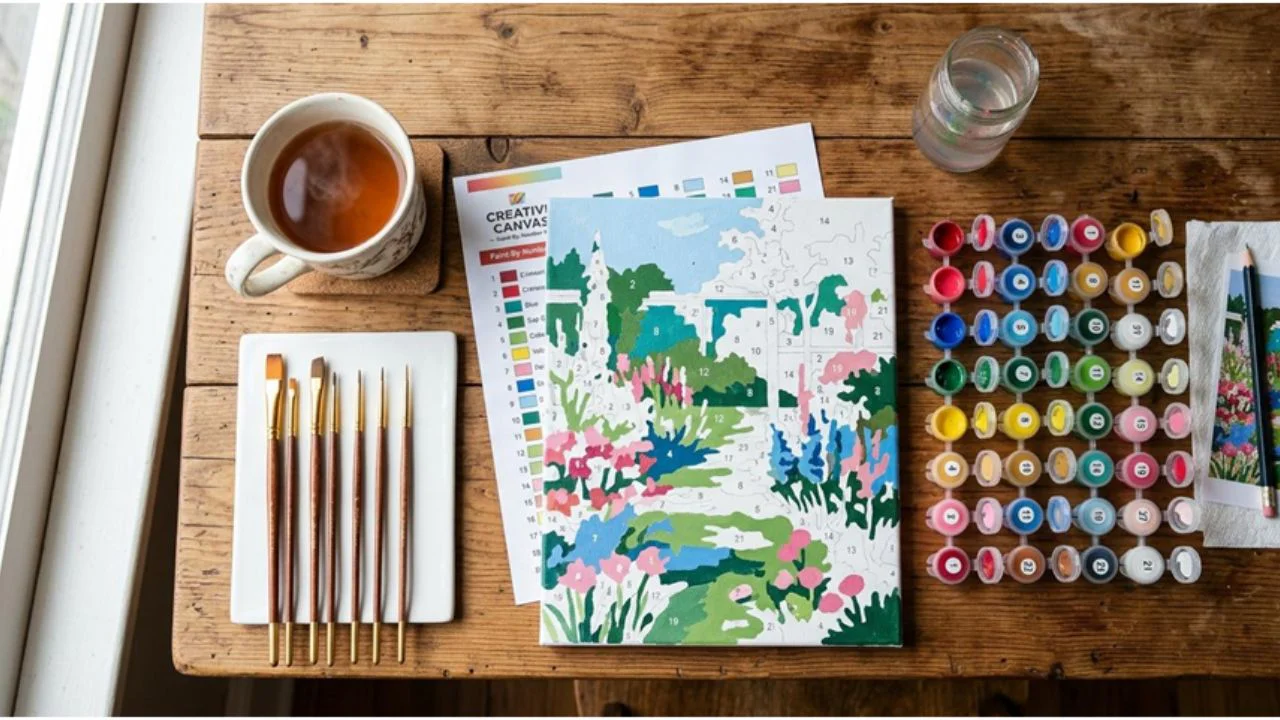
A simple paint-by-numbers kit laid out on a home work table – everything you need to get started with a creative hobby
More adults in the UK and beyond are picking up creative hobbies than at any point in the past decade, and the reasons run deeper than pandemic-era boredom. Something changed. The idea that art is only for formally trained people has quietly collapsed, and in its place is a much more interesting question: which creative hobbies are actually worth your limited time?
This article ranks seven of the most rewarding art hobbies right now – weighing accessibility, mental health benefits, and genuine creative satisfaction. The list runs from the most structured option to the most freeform. Neither end is better. They suit different people, different moods, and different spaces.
Why Adults Are Picking Up Art Hobbies Again

A well-lit home studio space – the kind of setup that makes it easier to build a regular creative habit
The mental health case for creative hobbies is now backed by proper evidence. A 2025 poll from the American Psychiatric Association found that 71% of adults who rated their mental health as “excellent” engage in creative activities more frequently than those who don’t. The same poll found 46% of US adults use creative activities specifically to relieve stress and anxiety.
UK data tells a similar story. A March 2025 survey by Jackson’s Art found that 21% of UK artists say art helps them feel relaxed, 20% say it boosts confidence and self-esteem, and 9% report it reduces anxiety and depression symptoms.
Another major reason adults are returning to creative hobbies is accessibility. Many modern art hobbies no longer require formal training, expensive supplies, or years of practice before you can make something you genuinely enjoy looking at. That change has made creative work feel approachable again for people who once believed they “weren’t artistic.”
1. Custom Paint by Numbers – Structured Calm That Actually Works

Filling in a numbered section on a custom canvas – the repetitive process is where the stress relief actually happens
Paint by numbers ranks first for one reason: it removes the biggest barrier adults face with art, which is the blank canvas. You don’t need to know how to draw. You don’t need to have an eye for composition. You follow the numbers, and something that looks genuinely good emerges at the end.
Custom paint-by-numbers kits have become one of the fastest-growing entry points for adults coming to art for the first time. Personalised options, where beginners can upload a photo and receive a numbered canvas based on it, can be found at https://numberartist.com/products/custom-paint-by-numbers-kit, making it easier for first-time painters to start with something meaningful to them. Starting with a familiar image rather than a generic landscape makes the process feel more personal and emotionally rewarding from the beginning.
The global paint-by-numbers market is projected to grow at 7.1% annually between 2025 and 2033, reaching USD 2.87 billion by 2033, according to a 2025 Accio market analysis. Custom kit formats, where you upload a personal photo and receive a numbered canvas based on it, are projected to make up 40% of the adult market by 2027.
The psychology behind why it works is straightforward. Repetitive, focused tasks, filling in colour section by section, produce something close to a flow state, where attention narrows and background mental noise fades. It’s not a cure for anything. But 45 minutes with a numbered canvas is noticeably quieter than 45 minutes scrolling.
A 2025 scoping review published in the Journal of Psychosocial Nursing confirmed that hobbies are consistently associated with fewer depressive symptoms, higher quality of life, and greater social connection across multiple peer-reviewed studies.
2. Watercolour Painting – Low Commitment, High Reward
Watercolour punches above its weight for adults with limited time. The kit is small: a basic pan set, three or four brushes, and a pad of watercolour paper. That fits in a bag. You can set it up in ten minutes and put it away in five.
The medium is also genuinely forgiving in a way oils and acrylics aren’t. Watercolour blooms and bleeds in ways that often look better than what you planned. Many adult beginners find that the “mistakes” in watercolour produce more interesting results than their carefully controlled marks. That’s a useful lesson to internalise.
Online tutorials have brought the barrier down further. There’s a real community of watercolour artists on YouTube who teach for adults with zero background – not children’s craft videos, but actual painting techniques explained clearly.
3. Pottery and Hand-Building With Clay – The Most Tactile Option
Pottery is the hobby that gets the strongest “I’ve been meaning to try that” response from people who haven’t tried it. The reason is that it’s fully physical in a way most creative activities aren’t. Your hands are in the material, and your attention has to be there too. You can’t think about your inbox while centering clay.
Studio pottery classes are available in most UK towns, and home clay kits have improved significantly. Air-dry clay won’t give you the same results as kiln-fired work, but it’s a real starting point for hand-building – pinch pots, coil-built bowls, small sculptural forms.
Clay work also connects naturally to wabi-sabi philosophy. Every piece you make by hand is slightly uneven, slightly asymmetrical, slightly its own thing. That’s not a flaw. That’s the point.
4. Art Journaling – Where Writing Meets Visual Expression
Art journaling has almost no barrier to entry. You don’t need to be able to draw. A sketchbook, a few pens, some paint or collage materials, and you’re there. The format is private by default, which removes the self-consciousness that stops a lot of adults from making art at all.
The hybrid nature of art journaling – part writing, part visual making, part scrapbook – means it covers more ground than a single medium. People use it to process things, plan things, or just fill pages without a goal. That lack of a goal is underrated. Not every creative session needs to produce a finished object.
It’s also genuinely cheap. A basic art journal setup costs under £20. For people who want to test whether a creative habit is something they’ll actually maintain, that’s a sensible starting point.
5. Wabi-Sabi Painting – Finding Beauty in Imperfection

A wabi-sabi painting with intentional imperfection – earthy tones and raw texture rather than polished symmetry
Wabi-sabi is a Japanese philosophy built around the beauty of imperfection, impermanence, and simplicity. In painting terms, it means organic brushstrokes, earthy muted tones, visible texture, and compositions that don’t try to be symmetrical. It’s the deliberate opposite of the hyper-polished aesthetic that dominated Instagram for most of the last decade.
The trend numbers are striking. Searches for “wabi-sabi wall decor” surged 90% in 2025, and Michaels’ 2026 Creativity Trend Report named wabi-sabi one of the dominant DIY aesthetics of the year, with the observation that “after years of hyper-polished feeds and showroom-perfect homes, people are embracing the beauty of imperfection.”
What makes wabi-sabi painting particularly well-suited for adult beginners is that it actively rewards the things beginners do anyway – uneven lines, brushmarks that show, layers that don’t blend smoothly. Unlike styles where you’re fighting your inexperience, here your inexperience often produces more interesting results. Original wabi-sabi painting from independent artists captures that philosophy directly – these aren’t prints optimised for mass production, they’re pieces where the artist’s hand is still visible.
6. Linocut Printing – Satisfying, Repeatable, and Very British
Linocut has a strong UK craft community, and for good reason. You carve a design into a linoleum block, ink it, and press it onto paper or fabric. The result is a clean, graphic print with a hand-made quality that’s very hard to replicate digitally.
The satisfaction of linocut comes from the irreversibility of carving. Once you’ve cut a line, it’s there. That constraint forces a kind of decisiveness that other media don’t require, and many people find it clarifying. You have to commit.
It also produces multiples, which means you can gift prints or make small editions. That aspect – making something others can actually use – appeals to a different motivation than personal creative expression. For people who feel self-indulgent about “making art,” linocut feels more like a craft, which is a psychologically useful reframe.
For more on how creative choices connect to everyday self-expression, there’s a broader discussion of how aesthetic habits shape personal identity.
7. Collage and Mixed Media – The Most Accessible Entry Point
Collage needs no skill at all. You cut things from magazines, printed images, or found paper, and you arrange them. That’s it. If you want to add paint, paint. If you want to add text, add text.
The medium suits people who describe themselves as “not creative” more than almost any other. Because you’re working with existing images rather than making marks from scratch, the self-judgment that blocks people from painting doesn’t apply in the same way. You’re curating rather than creating, which feels less exposed.
Mixed media – combining collage with paint, ink, pen, or fabric – scales in complexity from completely beginner to genuinely sophisticated. You can spend 20 minutes on a collage or 20 hours. The medium doesn’t care, and neither should you.
The collage approach also connects to a broader idea: that purpose-driven creativity doesn’t have to involve grand artistic ambition. Sometimes it just means making something that feels good to make.
How to Choose the Right Art Hobby for You
The honest framework is simpler than most guides suggest. Two questions: how much structure do you want, and how much time do you realistically have?
If you want structure, paint by numbers and linocut give you a clear process to follow. If you want freedom, wabi-sabi painting and collage actively reward improvisation. If you want tactile, physical engagement, pottery and watercolour both deliver that differently – pottery through full physical involvement, watercolour through a lighter touch and unpredictable results.
A 2023 Nature Medicine study covering 93,000 people aged 65 and older across 16 countries found that hobby engagement was associated with fewer depressive symptoms, higher happiness, and greater life satisfaction. The specific hobby mattered less than simply having one.
Thirty minutes a week is enough to build a habit. One session a week with any of these hobbies will produce noticeable changes in six weeks.
A Final Thought
The best creative hobby is the one you’ll actually do. That sounds obvious, but most hobby guides ignore it completely in favour of telling you what’s objectively best.
What the evidence supports clearly, from the APA poll, the Taylor & Francis scoping review, and the Nature Medicine data, is that creative activity is consistently linked to better mental health outcomes. The mechanism isn’t complicated. Making something with your hands takes your attention off things you can’t control and puts it onto something you can.
Start small. Expect nothing polished. Adjust from there.
Also Read: Lady Tatiana Mountbatten Birth Announcement: Welcoming Baby Auberon “Albie”