
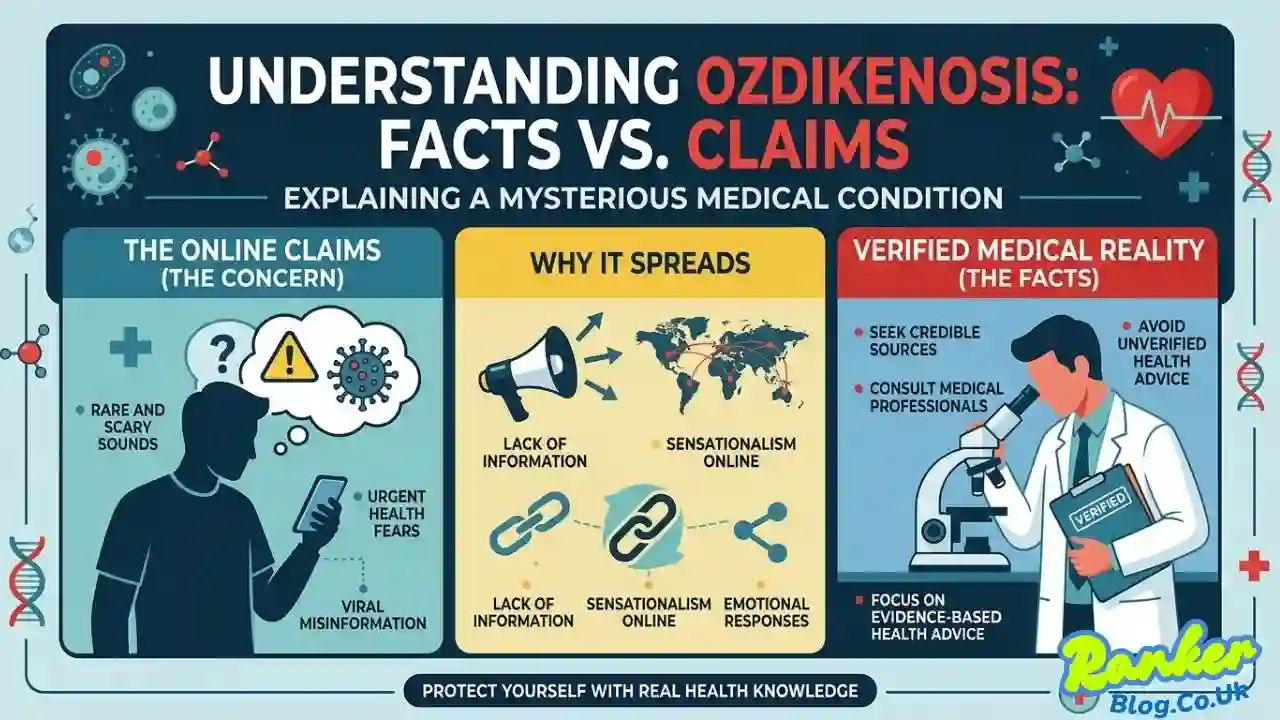
Ozdikenosis is a term that has quietly found its way into online health discussions, sparking real concern among everyday readers. While many people have never encountered this rare condition before, the questions surrounding it feel urgent and personal. Understanding what it actually means is the first step toward clarity.
The truth is, when something sounds medical and frightening, people naturally want answers fast. This article breaks down everything around Ozdikenosis — what is claimed online, why it spreads, and what verified medicine actually says. Getting the real facts protects you and helps you make smarter health decisions.
What Is Ozdikenosis?
Before diving into the deeper questions, it helps to start at the beginning. Ozdikenosis is a term circulating across health blogs and search results, often described as a rare and fatal genetic disorder. Many articles frame it with clinical-sounding language — metabolic dysfunction, organ failure, mitochondrial damage — giving it an air of medical legitimacy.
However, a thorough search across established medical databases, including PubMed, the National Institutes of Health, and the World Health Organization’s disease registry, returns no verified record of this condition. No peer-reviewed study, no named researcher, no ICD diagnostic code, and no clinical trial is associated with it anywhere in legitimate scientific literature.
That doesn’t mean the people asking questions about it are wrong to be curious. It means the information they’re finding may be doing them more harm than good.
How the Internet Creates Medical Myths
The rise of AI-generated content and low-quality health blogs has made it surprisingly easy for fictional medical terms to gain traction online. A single article written with confident language can be republished dozens of times across different websites, and before long, a made-up condition starts appearing in autocomplete suggestions and sparks thousands of worried searches.
This is exactly the kind of digital environment in which a term like Ozdikenosis thrives. The more alarming the framing — especially when paired with phrases like “why does ozdikenosis kill you” — the more clicks it earns. And more clicks means more republishing, more spreading, more fear.
It is a cycle that feeds itself, and ordinary readers end up caught in the middle.
Why Does Ozdikenosis Kill You — And Why That Question Is So Powerful
The phrase “why does ozdikenosis kill you” is not just a search query. It reflects a deeply human fear — the fear of a diagnosis no one has heard of, of something lurking quietly in the body before it strikes. That emotional weight is exactly why this kind of content spreads.
When someone reads that a rare genetic disorder “doesn’t hit one organ and stop” or that it “spreads slowly until the systems you depend on can’t keep up,” it activates real anxiety. Even if the condition itself is unverified, the emotional experience of reading about it is entirely real.
This is something worth taking seriously. Health misinformation doesn’t just confuse people — it can delay them from seeking help for conditions that actually do exist, or cause unnecessary panic that affects daily life and mental wellbeing.
The Psychology Behind Scary Health Searches
Research in health communication consistently shows that people are more likely to share and remember frightening health content than neutral content. This is known as the negativity bias — the brain is wired to pay more attention to threats.
Content built around terms like Ozdikenosis exploits this bias cleverly. By packaging an invented condition with the emotional vocabulary of real suffering — words like “cruel,” “deadly,” and “relentless” — writers create content that feels authentic and authoritative, even when it has no medical foundation whatsoever.
Readers deserve better than that.
The Stages of Ozdikenosis — What Circulates Online vs. What Medicine Knows
Searching for the “stages of ozdikenosis” online brings up content that describes a detailed progression of symptoms: metabolic acidosis, tissue breakdown, cardiovascular damage, neurological deterioration. It reads convincingly. But once again, none of this staging information appears in any verified clinical framework.
Real genetic and metabolic disorders — conditions that do have established stages — go through rigorous scientific processes before that staging information becomes public. Doctors and researchers conduct years of clinical observation, peer review, and patient studies before any disease progression is formally classified.
The so-called “stages of ozdikenosis” found online skip all of that. They are written to sound medical without any of the science behind them.
What Real Rare Genetic Disorders Look Like
For context, here is how actual rare progressive disorders are characterized in medicine:
Real rare diseases have names tied to discoverers or biological mechanisms — think Gaucher disease, Tay-Sachs, or Wilson’s disease. They appear in the OMIM (Online Mendelian Inheritance in Man) database. They have patient advocacy groups, clinical registries, and documented case studies.
They also have something fictional conditions never will: a community of real patients and families navigating genuine, difficult journeys.
If someone is experiencing symptoms they are worried about — fatigue, unexplained pain, metabolic irregularities, neurological changes — those symptoms deserve to be taken to a real doctor, not a content farm.
Why Medical Misinformation Spreads So Fast
Understanding how misinformation travels helps explain why so many people end up reading about conditions that do not exist in verified medicine.
Search engines are designed to surface content that answers the specific words a user types. When enough websites publish similar content around a phrase, that phrase earns authority in algorithmic terms — not scientific ones. A term like Ozdikenosis can rise to the top of search results entirely because of content volume, not because any medical institution endorses it.
Social media amplifies this further. When someone shares a frightening health article — even out of genuine concern for others — they add another link in the chain. Within days, a fabricated condition can look like an established medical fact simply due to the number of times it has been referenced.
The Role of AI-Generated Content
Artificial intelligence tools have made it faster and cheaper than ever to produce large volumes of health content. Unfortunately, speed and volume do not equal accuracy. AI systems can generate medically formatted text — complete with symptoms, stages, and treatment suggestions — for conditions that have never been documented in real clinical practice.
This is not speculative. Multiple fact-checking organizations have identified clusters of AI-generated health articles containing invented diseases, fabricated statistics, and nonexistent studies. Ozdikenosis fits this pattern closely.
How to Protect Yourself From Fake Medical Content
The good news is that protecting oneself from medical misinformation is a skill anyone can develop. A few practical habits make a significant difference.
Check the source. Any serious health claim should be traceable to a government health body, an academic institution, or a peer-reviewed journal. If the only sources are other blogs, that is a red flag.
Look for named experts. Real medical articles cite real doctors, researchers, and institutions by name. Vague references to “studies show” or “experts agree” without specifics are warning signs.
Search verified databases. Websites like PubMed, MedlinePlus, and the NIH’s Genetic and Rare Diseases Information Center are free to use and contain only verified medical information. If a condition does not appear there, it warrants serious skepticism.
Notice emotional language. Phrases designed to generate fear — especially around death or fatal progression — are often deliberate engagement tactics rather than medical communication.
When Symptoms Are Real, Even If the Diagnosis Isn’t
Here is something important: the fact that Ozdikenosis is not a verified condition does not mean the people searching for it are imagining their symptoms. Many people who find themselves deep in rabbit holes of rare disease content are doing so because something feels wrong in their bodies, and they are trying to find an explanation.
Those experiences are valid. What those individuals deserve is not a convincing-sounding fake diagnosis, but access to real healthcare professionals who can run actual tests, review actual history, and provide actual answers.
If someone is genuinely concerned about unexplained symptoms — particularly those involving fatigue, organ function, or neurological changes — reaching out to a primary care physician or a specialist in rare diseases is the right move. Organizations like the National Organization for Rare Disorders (NORD) provide legitimate support and direction.
What Responsible Health Content Actually Looks Like
At its best, health writing informs without alarming. It acknowledges uncertainty without exploiting it. And it always points readers toward verified sources rather than keeping them inside a loop of recycled misinformation.
The question “why does ozdikenosis kill you” deserves a straight answer: there is no verified record that Ozdikenosis is a real condition, and therefore its supposed mechanisms of death cannot be validated. What can be validated is the very real harm that health misinformation causes — anxiety, delayed care, erosion of trust in legitimate medicine.
That harm is worth talking about, and it is worth protecting against.
Final Thoughts
Ozdikenosis may have found a life online, but it has not found a place in verified medical science. The people searching for answers about it are not foolish — they are human. They are doing what anyone does when something frightens them: they look it up.
The responsibility lies with the content that meets them in those searches. Content that chooses accuracy over alarm, clarity over clicks, and truth over traffic does something genuinely valuable. It gives readers a reason to trust what they read — and that trust, in health especially, genuinely matters.
If this topic has brought up real health concerns, speaking with a licensed medical professional is always the best next step. Real answers come from real medicine, not from search results alone.