

The most significant bottleneck in creative production has never been the act of creation itself; it is the latency between thought and visualization. In a traditional agency or in-house studio environment, a creative brief typically undergoes a series of serial transformations. A director provides a verbal or written prompt, a designer spends several hours or days interpreting that prompt into a low-fidelity draft, and only then does the review cycle begin. This “latency tax” is the primary reason why creative projects often bloat in both timeline and budget.
When a creator is forced to wait forty-eight hours for a revision, the momentum of the original vision dissipates. Designers find themselves constantly context-switching, moving from one client’s feedback to another’s production while waiting for approval emails to land. This friction doesn’t just slow down the output; it actively degrades the quality of the conceptual work because the feedback loop is too wide to allow for genuine exploration. Generative media tools are beginning to collapse this loop entirely, moving production from a linear, high-latency model to a parallelized, real-time environment.
The Invisible Tax of Creative Latency
In standard creative operations, the feedback loop is essentially a game of “telephone” played across different time zones and software suites. A performance marketing team might need a set of social media assets for a new campaign. The request goes to the art director, who then assigns it to a motion designer. The motion designer creates a storyboard, waits for feedback, then moves to animation. If the aesthetic isn’t right on the first pass, the entire engine grinds to a halt.
This serial process creates a significant economic cost. High-velocity campaigns—the kind that need to respond to a cultural trend or a sudden shift in market data—cannot survive a two-week production cycle. Furthermore, relying on stock assets or mid-tier outsourcing often results in a “generic” feel that fails to differentiate a brand. The challenge has always been achieving bespoke quality at the speed of an automated system.
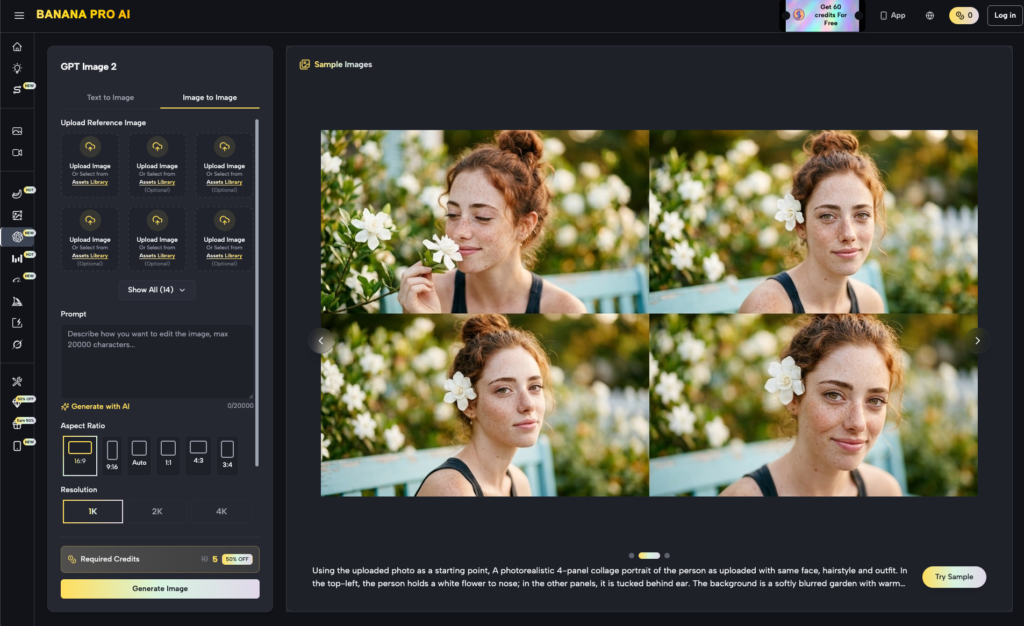
Short-Circuiting the Review Loop with Banana Pro AI
The integration of generative tools into the creative stack changes the fundamental nature of the review meeting. Instead of a “present and feedback” session, it becomes a “collaborative exploration” session. When using a tool like Nano Banana AI, the director and the designer can sit in a virtual room (or a physical one) and iterate on visual concepts in real-time.
If the lighting in a product shot is too harsh, or if the background composition feels too cluttered, the correction isn’t a task to be completed by Tuesday; it is a prompt or a slider adjustment that happens in seconds. The ability to use text-to-image or image-to-image workflows to translate verbal feedback into immediate visual prototypes allows teams to exhaust dozens of “bad ideas” in ten minutes rather than ten days. This is not about the AI producing the final, polished product—though it often gets close—but about drastically narrowing the gap between a concept and its first visual confirmation.
By the time the formal production phase begins, the “vision” is already 90% solidified because it was vetted through twenty iterations in the first hour. This reduces the risk of major pivot points late in the production cycle, which are historically the most expensive moments in any creative project.
From Linear Stages to Canvas-Based Concurrency
The shift in production velocity is further amplified when creators move away from siloed prompting tools and into integrated canvas environments. Systems like Banana Pro AI provide a workflow studio where image and video generation coexist. In a traditional pipeline, you would finish your key art, export it, and then import it into a video editor to begin the motion phase.
Using the Banana AI framework within a unified canvas allows for a concurrent workflow. A creator can refine a high-resolution hero image while simultaneously generating video overlays or motion backgrounds derived from the same seeds and prompt logic. This level of concurrency means that the “video” portion of a campaign can be prototyped while the “static” portion is still being debated.
This model relies on the ability to maintain aesthetic consistency across different mediums. For instance, using the Banana AI or Banana Pro models allows a team to lock in a specific color palette and character consistency, ensuring that the visual identity remains stable even as assets are churned out at a massive scale. The Workflow Studio becomes the central nervous system of the campaign, where the transition from a static image to a 4-second motion clip is a click rather than a reconfiguration of the entire project.

Redefining the Final Deliverable in an AI-First World
As production velocity increases, the definition of a “final deliverable” is shifting. In the pre-AI era, a designer might deliver a “hero” asset and perhaps two or three variations for different social platforms. Today, performance marketing demands hyper-segmentation. To be effective, a brand needs dozens of variations tailored to specific audience segments, testing different hooks, visual styles, and color schemes.
Generative workflows allow content teams to move from delivering a single asset to delivering an entire asset library. This has a direct impact on how review cycles are managed. The creative lead is no longer just looking at the “technical perfection” of one image; they are reviewing the “strategic alignment” of a hundred images. The focus of human labor shifts from the manual execution of pixels to the high-level curation of outputs.
However, this increased velocity forces a difficult conversation about quality control. There is a trade-off between the hyper-speed of AI-generated content and the traditional standard of “pixel-perfect” manual design. Creative teams are finding that for certain high-volume channels, a “90% perfect” asset that is culturally relevant today is more valuable than a “100% perfect” asset that is delivered three weeks late.
The Edge Cases: Where Speed Becomes a Liability
Despite the efficiency gains, the transition to generative workflows is not without significant friction. The first major hurdle is what many creators call “iteration fatigue.” When you can generate twenty versions of a scene in a minute, the psychological burden of decision-making increases. Creative leads often find themselves paralyzed by the sheer volume of choices, leading to a new kind of bottleneck where the human capacity to choose cannot keep up with the machine’s capacity to produce.
There are also hard technical limitations that persist in the current generation of tools. For example, while Banana Pro tools are exceptionally good at textures and lighting, they still struggle with complex spatial reasoning and specific, brand-mandated typography. If a project requires a very specific architectural layout where every window must be in a precise coordinate, the AI will often hallucinate details that require extensive manual overpainting. You cannot yet “prompt” your way out of a requirement for architectural accuracy or exact logo placement without significant human intervention.
Furthermore, the legal landscape surrounding these assets remains a point of significant uncertainty. While many teams use these tools for internal prototyping and mood boarding without hesitation, the long-term status of copyright and asset rights for AI-generated media is still being litigated globally. Content teams must maintain a level of caution, often layering manual design work over generative foundations to ensure a “human-in-the-loop” threshold that satisfies legal departments.
The move toward generative review cycles is less about the “AI” and more about the “cycles.” By collapsing the distance between a creative director’s thought and a visual reality, tools like Nano Banana AI are fundamentally changing the rhythm of professional creativity. The future of creative operations is not just faster designers, but a shorter, more intense, and more collaborative feedback loop that prioritizes rapid experimentation over safe, slow delivery.