
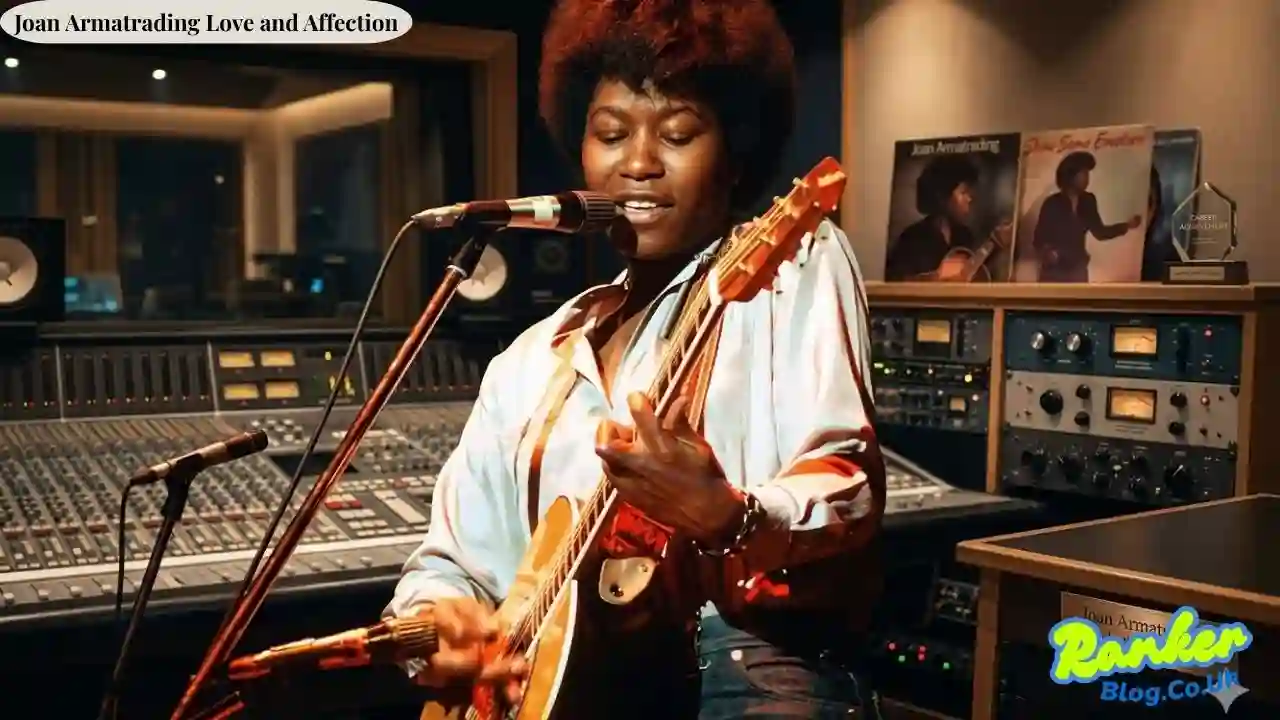
There are songs that find you at the right moment, and then there are songs that seem to have been written for every moment. Joan Armatrading Love and Affection is firmly in the latter camp. Released in 1976, this quietly devastating ballad became the track that introduced the world to one of Britain’s most distinctive voices — and it has never really left the cultural conversation since. Whether you first heard it on the radio decades ago or stumbled across it on a reissued Joan Armatrading vinyl record recently, the song holds its grip in the same way it always has.
Who Is Joan Armatrading?
Joan Armatrading is a Kittitian-English singer-songwriter and guitarist whose talent, authenticity, and sheer musical range set her apart from virtually every other artist of her generation. Born on 9 December 1950 in Basseterre, Saint Kitts, she moved to Birmingham, England as a child and grew up to become a true trailblazer in British music. For anyone wondering how old is Joan Armatrading — she turned 74 in December 2024.
She is widely recognised as the first Black British female singer-songwriter to achieve major international success, a milestone that speaks to both her artistry and the cultural barriers she quietly dismantled throughout her career. Joan Armatrading songs span folk, jazz, rock, soul, and blues — a breadth that reflects a musician who has always refused to be boxed in.
A self-taught guitarist, Armatrading developed an acoustic style that became instantly recognisable, warm and complex in equal measure. Her voice — capable of the softest intimacy one moment and a commanding full-throated power the next — has earned her three Grammy Award nominations and two BRIT Award nominations in the Best Female Artist category. In 1996, she received the Ivor Novello Award for Outstanding Contemporary Song Collection, a recognition of the full body of her work rather than any single hit.
The Making of “Love and Affection”
The story behind joan armatrading love and affection is as personal as the song itself. Armatrading wrote it in 1975, though it was released the following year. The inspiration arrived while she was driving along King’s Road in London — she has said she could point to the exact spot where the lyrics came to her. True to form, she has kept the specific subject matter close to her chest, saying only that it was about someone trying to persuade her to be with them.
What she has shared is that the song is, at its heart, about love, friendship, and the value of not being fickle. The opening line — “I’m not in love, but I’m open to persuasion” — became one of the most quoted in British music for good reason. It manages to be vulnerable and self-possessed at the same time, which is about as good a summary of Joan Armatrading herself as anyone could write.
The recording was produced by Glyn Johns, whose CV reads like a who’s who of rock history — The Beatles, The Rolling Stones, The Who, Led Zeppelin, and The Eagles. Johns later said the Joan Armatrading album was the finest he had ever been associated with. That kind of endorsement from someone who had sat at the console for some of the most celebrated recordings in history says everything.
The session musicians assembled for the track were equally impressive. The distinctive deep baritone backing vocal was performed by Clarke Peters — later known to millions as Lester Freamon in HBO’s The Wire, but then still going by Pete Clarke. He and Armatrading had met during the London run of the rock musical Hair, and she specifically sought him out when she needed a voice that could reach those low registers. The alto saxophone was handled by Jimmy Jewell, a session player known for his work with Gallagher and Lyle, while former Fairport Convention members Jerry Donahue on guitar and Dave Mattacks on drums completed the lineup.
It was also the first of Joan Armatrading’s albums to be recorded entirely in London, giving it a cohesion and intimacy that the earlier records, partly made in France and Wales, hadn’t quite captured in the same way.
Chart Performance and Commercial Success
“Love and Affection” was Joan Armatrading’s fourth single overall and her third for A&M Records. It reached number 10 on the UK Singles Chart in November 1976 — her first chart success after years of releasing music that was critically admired but had failed to break through commercially. The parent album, Joan Armatrading, peaked at number 12 on the UK Albums Chart and was later certified Gold by the British Phonographic Industry. Across the Atlantic, the album also made the Billboard Top 20 in the US.
The numbers alone don’t capture what this moment meant. After nearly a decade of paying her dues — playing small venues, recording sessions, making eight appearances on the John Peel show between 1972 and 1976 — the success of this single was long overdue. It was also the first single by a Black British female singer-songwriter to achieve major chart success in the UK, a landmark that still resonates today.
What Makes the Song a Classic?
“Love and Affection” has been described as a “deceptively feisty ballad” and “an instant classic” — phrases that get at something true about the song’s curious power. On the surface it is gentle, acoustic, unhurried. But there is an emotional tension running through it that catches you off guard.
The 12-string guitar arrangement is central to that effect, providing a shimmering texture underneath Armatrading’s vocal. Her voice builds through the song from something almost conversational to a delivery of genuine force, a dynamic that feels completely natural rather than performed. It was unlike anything else in British pop at the time — and, honestly, it remains unlike most things since.
The song’s breakthrough into wider public consciousness came through a performance on the BBC’s Old Grey Whistle Test, where host Bob Harris introduced her to a television audience that had, largely, never heard of her before. By most accounts, a significant number of people who watched that broadcast went out and bought the album the very next day. Joan Armatrading later recalled introducing the song with characteristic directness: “Track four, album three, side one.” On 14 May 1977, she performed both “Love and Affection” and “Down to Zero” on NBC’s Saturday Night Live, bringing the song to an American audience in equally memorable fashion.
Legacy and Enduring Impact
Decades on, joan armatrading love and affection has lost none of its resonance. The song has served as the title track for two separate compilation albums: Love and Affection: The Best of Joan Armatrading (1999) and Love and Affection: Classics 1975–1983 (2003), which speaks to how naturally it functions as an introduction to her work for new listeners.
The list of artists who have covered the track reflects its reach across genre and generation. Sheena Easton, Courtney Pine, Sly Stone and Martha Davis, Kele le Roc, and Sinitta — who released a version as a non-album single in 1990 — have all taken it on. Armatrading’s personal favourite cover comes from Two Nice Girls, who wove it together with Velvet Underground’s “Sweet Jane” in a mash-up she has cited with genuine warmth.
The song continues to be played on adult contemporary, soft rock, and oldies radio formats worldwide. It found devoted audiences in Japan and Australia as well as across Europe, proof that its themes transcend geography as readily as they transcend time. In concert, “Love and Affection” has remained a centrepiece of Joan Armatrading’s live set across all her tours, consistently drawing some of the most emotional responses of the night. Fans who collect joan armatrading vinyl in particular prize the original 1976 pressing of the self-titled album for the warmth and presence it captures in the recording.
Joan Armatrading’s Career Before and After “Love and Affection”
The hit didn’t come from nowhere. Before “Love and Affection” changed everything, Joan Armatrading had already released two albums: Whatever’s for Us (1972), which showcased her blend of folk, jazz, and pop, and Back to the Night (1975), produced by Pete Gage. Those years of relative obscurity were far from wasted — they produced a writer and performer of exceptional depth.
After the breakthrough, the quality of Joan Armatrading albums remained consistently high. Show Some Emotion (1977) and To the Limit (1978) cemented her reputation, followed by Me Myself I (1980), which became her highest-charting album in both the UK and the US, and Walk Under Ladders (1981). Other celebrated joan armatrading songs from this era include “joan armatrading the weakness in me,” a track from the 1981 album Walk Under Ladders that became another of her defining recordings — and for many listeners, its emotional honesty ranks alongside “Love and Affection” as her finest work. Those seeking out joan armatrading the weakness in me lyrics will find a song about romantic vulnerability that is, if anything, even more nakedly confessional than its famous predecessor. Similarly, joan armatrading drop the pilot lyrics — from her 1983 album The Key — demonstrate a lighter, more playful pop touch that showed her range extended well beyond the introspective ballad.
In 2007, her album Into the Blues debuted at number 1 on the US Billboard Blues Chart, making her the first UK female artist to achieve that distinction, and earned her a Grammy nomination in the Blues category — another first for a British woman. A live concert at the Royal Albert Hall in 2010 was released as a CD/DVD album, capturing the enduring power of her live performances for posterity.
She has also brought her passion for the instrument to broadcasting, hosting Joan Armatrading’s Favourite Guitarists on BBC Radio 4 in 2009 and a follow-up series in 2011. In 2019, BBC Four aired a documentary about her life and songwriting, also titled Me Myself I. A joan armatrading tour continues to attract devoted audiences wherever she plays, a testament to a career maintained entirely on her own terms.
Joan ArmatradingPersonal Life: Partner, Marriage, and Home
Fans curious about joan armatrading partner will find that she has always kept her private life carefully guarded — a stance she has maintained throughout her career with quiet consistency. That said, certain details have become publicly known. For those asking who is joan armatrading wife or who is joan armatrading partner: she is married to artist Maggie Butler. The joan armatrading maggie butler wedding took place in the Scottish Shetland Islands, and Armatrading made no effort to conceal the engagement when asked about it publicly. As for maggie butler wife joan armatrading — Butler is a visual artist, and the two have maintained a low-profile life together. For those wondering where does joan armatrading live now, she has kept that information out of the public domain entirely, which is very much in keeping with her character. On the question of is joan armatrading married — yes, she is.
Questions about joan armatrading net worth circulate online, though Armatrading herself has never addressed the subject. Estimates vary widely, and none should be taken as authoritative given the lack of official confirmation.
Frequently Asked Questions About Joan Armatrading and “Love and Affection”
What is “Love and Affection” about?
Armatrading has described it as a personal song about love, friendship, and the idea of not being fickle — of valuing genuine closeness over casual acquaintance. She has never publicly identified the specific person who inspired it.
Did Joan Armatrading write “Love and Affection”?
Yes. Every track on the 1976 Joan Armatrading album was written solely by her, which was true of virtually all her recordings.
What album is “Love and Affection” on?
It appears on her self-titled third studio album, Joan Armatrading, released in 1976 on A&M Records. Those looking for joan armatrading love and affection lyrics will find the song on streaming platforms and lyric sites, though the words carry considerably more weight heard alongside Armatrading’s vocal performance.
Who sang the bass vocal on “Love and Affection”?
Clarke Peters, then known as Pete Clarke, performed the distinctive deep baritone vocal. He went on to become a celebrated actor, perhaps best known as Lester Freamon in The Wire.
Has “Love and Affection” been covered by other artists?
Many times. Notable versions have come from Sheena Easton, Courtney Pine, Sly Stone and Martha Davis, Kele le Roc, and Sinitta, among others.
Also Read: Trino Marin Wife Maria: What the Records Actually Show