
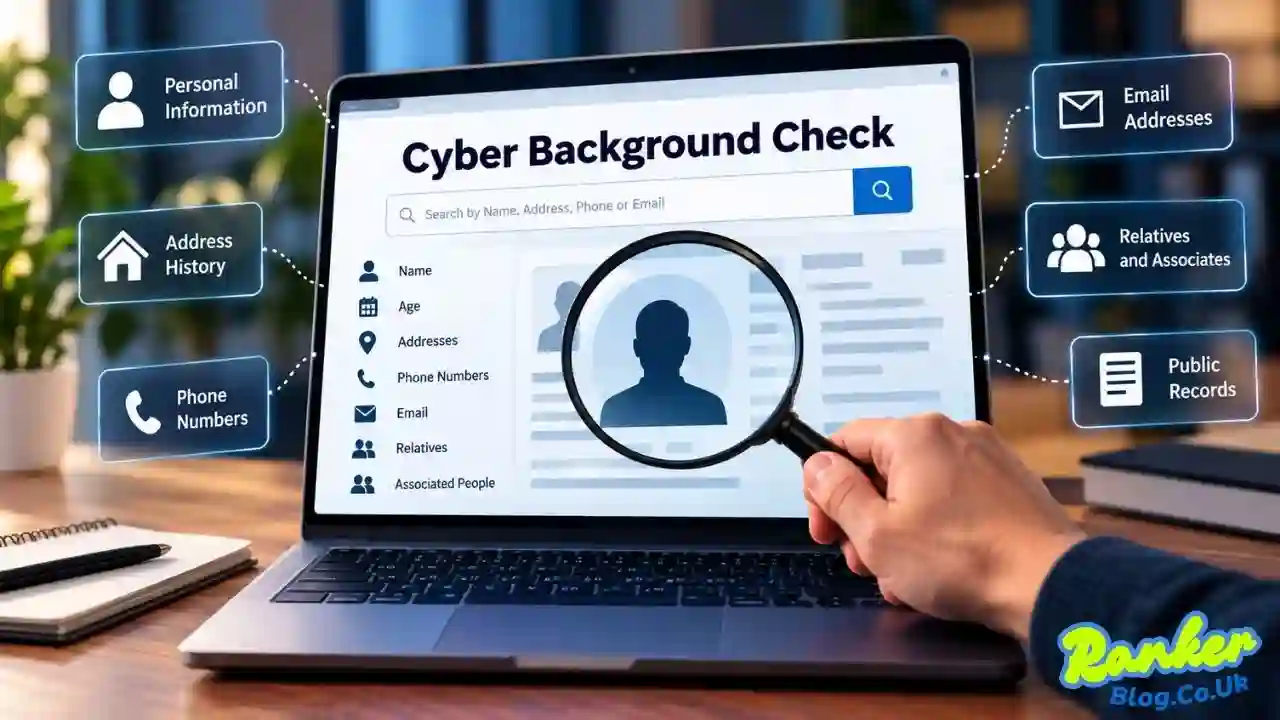
A cyber background check is an online search that can help people find publicly available information about an individual. When people use the phrase, they may mean a general online background search or the specific Cyber Background Checks people-search website, which compiles public and directory-style information into searchable profiles. Current listings describe the service as allowing searches by name, address, phone number, or email, with free access to basic people-search information.
That distinction matters. Cyber Background Checks is not the same thing as a professional employment-screening provider. Its site states that it is not a consumer reporting agency under the Fair Credit Reporting Act and cannot be used for employment, credit, tenant screening, or related purposes.
What Is a Cyber Background Check?
The phrase cyber background check can sound like a cybersecurity assessment, but in the context of online searches it usually refers to researching a person’s public information through the internet.
Cyber Background Checks is a people-search service that organizes information associated with individuals in the United States. Publicly indexed examples of its profiles show information such as a person’s age, current or previous addresses, other observed names, phone numbers, related people, and associated individuals.
This type of search can be useful for everyday identity research. Someone might want to reconnect with an old acquaintance, investigate an unfamiliar phone number, check whether a name matches an address, or locate publicly available contact information.
However, a search result should be treated as information to investigate, not automatic proof that every detail belongs to the person you searched for.
Names can be shared by multiple people. Addresses can be outdated. Phone numbers can change owners. Aggregated databases may also combine records from different sources, which means users should verify important information independently.
How Does Cyber Background Checks Work?
A typical search begins with an identifier such as a person’s name. Depending on the search interface and available data, users may also be able to search using an address, telephone number, or email address. Current third-party listings describe these as supported lookup methods.
The service then presents information associated with the search criteria. Publicly indexed pages show categories such as current location, previous addresses, alternate names, phone numbers, relatives, and associated people.
The important point is that this is an aggregation process rather than a direct connection to one authoritative database.
A profile may pull together records from multiple public or commercially available sources and organize them into one page. That makes the information easier to review, but it does not automatically make every data point current or accurate.
Why Search Results Can Look Different
A person may appear in several locations because of previous residences, family connections, business records, or outdated data.
For example, a profile could list an old address that the individual left years ago. It might also show several people as relatives or associates based on historical or public-record connections.
That is why the strongest way to use a cyber background check is to cross-check important information against a reliable primary source.
What Information Can a Cyber Background Check Show?
The exact information varies from person to person, but publicly indexed Cyber Background Checks pages demonstrate several common categories.
| Information type | What it may include | Important limitation |
|---|---|---|
| Name | Current name and observed name variations | Similar names can produce mixed results |
| Age | An estimated or listed age | Data can become outdated |
| Address history | Current and previous addresses | An old address does not necessarily indicate current residence |
| Phone numbers | Numbers associated with a person | Numbers may have changed owners |
| Related people | Relatives or other linked individuals | Association does not establish a precise relationship |
| Other names | Alternate or observed names | Variations may come from different records |
| Business associations | Possible links to organizations or businesses | Must be independently verified |
These categories are visible in indexed examples of Cyber Background Checks profiles, although the amount of information available can differ between searches.
The service should therefore be viewed as a starting point for public-information research, rather than a complete biography or official identity file.
Is a Cyber Background Check Free?
One of the most common searches is “cyber background check free.” Current third-party sources commonly describe Cyber Background Checks as offering free people-search access, allowing users to view basic information without purchasing a traditional background-report subscription.
There is an important catch to the word “free.”
Free access does not mean that every related service, report, or third-party offer is free. Some people-search pages can contain sponsored links or advertisements for paid background-check providers.
The practical lesson is simple: check exactly what information is being offered before assuming you are receiving a complete background report.
A free people-search profile may be useful for finding leads, but it should not be confused with a professionally verified investigation.
What Is Cyber Background Checks Used For?
People use online people-search services for a range of ordinary research tasks.
Finding an Old Contact
Someone trying to reconnect with a former classmate, neighbor, colleague, or acquaintance may use a name or previous location to find publicly available information.
Checking an Unknown Number
A reverse phone search can sometimes help users identify the person or organization associated with a number.
This can be particularly useful when a person receives repeated calls from an unfamiliar number and wants additional context before responding.
Researching a Name
A common search is simply checking what public information is associated with a person’s name.
This can help distinguish between people with similar names by comparing locations, age ranges, addresses, or other identifiers.
Checking Your Own Information
People can also search for themselves.
This is one of the more useful privacy applications because it can show what information may already be available through public people-search databases.
Finding an unexpected phone number, old address, or family association can encourage someone to review their online privacy settings and investigate removal options.
What a Cyber Background Check Does Not Prove
A common mistake is treating an aggregated profile as a definitive record.
For example, finding someone’s name associated with an address does not necessarily prove that the person currently lives there. Likewise, seeing two names connected to the same household does not by itself establish a particular relationship.
The FTC has also noted that background reports can contain inaccurate information, which is one reason consumer-reporting rules provide protections when those reports are used for employment decisions.
For important decisions, verify information through an authoritative source.
| Situation | Use a people-search result as | Do not treat it as |
|---|---|---|
| Finding an old acquaintance | A research lead | Definitive proof of identity |
| Checking an unfamiliar phone number | Additional context | Guaranteed ownership evidence |
| Reviewing your online footprint | A privacy discovery tool | A complete list of all public data |
| Researching a public address connection | A starting point | Proof of current residence |
| Investigating information for legal or employment purposes | Background information that may require separate verification | A compliant employment screening report |
Can You Use Cyber Background Checks for Employment Screening?
This is one of the most important limitations to understand.
Cyber Background Checks has been publicly identified as not being a consumer reporting agency under the FCRA, and indexed site pages state that its information cannot be used for employment, credit, tenant screening, or similar purposes.
That distinction is important because employment background reports are governed by specific legal requirements in the United States.
The Federal Trade Commission explains that employment background checks obtained from companies that compile consumer reports are covered by the Fair Credit Reporting Act, including requirements related to notice, authorization, and adverse-action procedures.
The Equal Employment Opportunity Commission also explains that employers must make sure background information is not used in a discriminatory manner.
So if an employer needs a formal pre-employment background screening process, a general free people-search website is not a substitute for a properly compliant screening provider.
Can It Be Used for Tenant or Credit Screening?
The same caution applies to housing and financial decisions.
The site has stated that it cannot be used for tenant screening or credit-related purposes.
This makes sense from a compliance perspective. Decisions involving employment, housing, or credit can trigger legal obligations that are different from casual online research.
A person looking for basic public information is in a very different situation from a business making a regulated decision about another person’s eligibility.
How Accurate Is a Cyber Background Check?
Accuracy is one of the biggest questions people have about any people-search service.
A better way to think about the information is in terms of confidence levels.
Information that appears in multiple independent sources is generally easier to verify than information appearing in only one aggregated profile.
For example, if a person’s name and business association appear on an official corporate registry, that registry is a stronger source for the business relationship than a general people-search profile.
Similarly, if a phone number is important, confirmation through an official business website or another trusted source can add confidence.
Cyber Background Checks can therefore be useful for discovery, while primary sources are better for verification.
Is Cyber Background Checks Legit?
Cyber Background Checks is an identifiable online people-search service with publicly indexed profile pages and a stated privacy and opt-out process. Current BBB material also references its opt-out, “Do Not Sell,” and privacy-rights processes.
That answers the question of whether the website exists as a real service, but it does not mean every record it provides is automatically correct.
Legitimacy and accuracy are different questions.
A real database can still contain outdated, incomplete, or incorrectly matched information. Users should avoid making serious accusations or decisions about a person based on one profile alone.
Privacy Concerns With People-Search Websites
The same information that makes a people-search service useful can create privacy concerns.
A person may discover that their name is connected to old addresses, telephone numbers, relatives, or associates in a public-facing profile. Current privacy-related sources describe Cyber Background Checks as a data-broker or people-search service and provide removal guidance.
That means users should consider both sides of the service:
Searchers may find useful public information.
Subjects of searches may discover that personal information about them is publicly exposed.
For privacy-conscious users, searching your own name can be a practical first step toward understanding your public digital footprint.
How to Remove Your Information From Cyber Background Checks
Removal procedures can change, so users should follow the current instructions published by the service rather than relying on an old screenshot or third-party guide.
Current sources describe an opt-out process through the site’s privacy or removal pages, while BBB material also references the service’s opt-out and privacy-rights mechanisms.
A sensible approach is to:
- Search for your name and identify the matching profile.
- Confirm that the profile actually refers to you.
- Use the site’s current opt-out or privacy-rights procedure.
- Complete any identity or verification steps requested.
- Save confirmation of your request.
- Search again later to see whether the information has reappeared.
The last step matters because data can be republished or reintroduced after removal from one service.
Cyber Background Check vs. a Professional Background Screening
These terms can sound similar even though they serve different purposes.
A people-search site is generally designed for public-information discovery.
A professional screening service may be used by organizations that need a structured background-check process subject to applicable laws and procedures.
| Feature | People-search service | Professional screening provider |
|---|---|---|
| Main purpose | Find public or aggregated information | Conduct formal background screening |
| Typical users | Individuals and researchers | Employers and organizations |
| Cost | May offer free basic access | Often paid |
| Information | Public-record and directory-style data | Formal screening reports from relevant databases |
| Employment compliance | Not necessarily suitable | Designed for applicable screening requirements |
| Best use | Research and discovery | Regulated screening workflows |
The FTC specifically treats employment reports obtained from consumer-reporting companies as subject to FCRA requirements.
How to Get Better Results From a Cyber Background Check
The quality of your search depends heavily on the information you start with.
A common name may return many possible matches, while a less common name can narrow the results quickly.
Adding context such as a state, city, phone number, or known previous location can help distinguish between people with similar names.
It is also worth checking more than one identifier.
For example, if you find a profile with a name and city, compare that information with another public source before deciding that you have found the correct person.
Verify Before You Act
The best rule is simple: use the result to ask better questions, not to skip verification.
A people-search profile can point you toward a possible address, associated name, or phone number. It should not automatically become the final answer.
This is especially important when the information could affect someone’s employment, housing, reputation, financial standing, or personal safety.
Common Mistakes People Make
One mistake is searching only by name and assuming the first result is the right person.
Another is treating an old address as proof of someone’s current location.
People can also overestimate what “free” means and assume a basic lookup is the same as a comprehensive background investigation.
Finally, some users may copy information from a people-search profile and share it publicly without checking whether it is accurate. That can create unnecessary privacy problems and, in some cases, serious personal consequences.
Frequently Asked Questions
Is Cyber Background Checks free?
Basic people-search access is commonly described as free by current third-party sources, although some pages may contain sponsored links or promotions for paid services.
What can a cyber background check find?
Depending on the person and available data, a search may show names, age information, current or previous addresses, phone numbers, observed name variations, relatives, and associated people. Publicly indexed Cyber Background Checks pages show these types of information.
Can I use Cyber Background Checks to check a job applicant?
You should not use it as a substitute for a compliant employment background screening report. Cyber Background Checks has stated that it is not an FCRA consumer reporting agency and that its site cannot be used for employment screening.
Is information on Cyber Background Checks always accurate?
No online people-search database should be assumed to be perfectly accurate. Records can be outdated, incomplete, or incorrectly associated with a person, so important information should be verified with reliable sources. The FTC has specifically warned that background reports can contain inaccurate information.
Can I search for myself on Cyber Background Checks?
Yes. Searching your own name can help you understand what information may be publicly associated with you and can help you identify profiles you may want to review for privacy or removal.
How do I remove my information?
Use the current opt-out, removal, or privacy-rights process provided by the service. Current BBB material confirms that the company directs users to its opt-out and privacy-rights processes.
Is a cyber background check the same as a cybersecurity background check?
Not necessarily. The phrase can be used broadly, but Cyber Background Checks is a people-search service focused on public information about individuals. A cybersecurity personnel screening process is a different concept and may involve assessing a person’s qualifications, access, risks, or suitability for security-sensitive work.
Final Thoughts
A cyber background check can be useful when the goal is to discover publicly available information about a person. Cyber Background Checks, in particular, functions more like a people-search and public-information aggregation service than a formal employment background-check provider.
The biggest benefit is convenience: users can search information associated with a name, address, phone number, or other identifier without starting from dozens of separate public sources.
The biggest limitation is that convenience does not guarantee accuracy, completeness, or legal suitability for regulated decisions. Treat search results as leads, verify important details independently, and avoid using an ordinary people-search profile as a replacement for a compliant employment, tenant, or credit screening process.
For privacy-conscious readers, the same service can also be useful in another way: search for your own information, see what is exposed, and take appropriate steps to remove or limit information you do not want publicly available.
Also Read: DolphinRadar: What It Is and How Its Instagram Tracking Tools Actually Work