
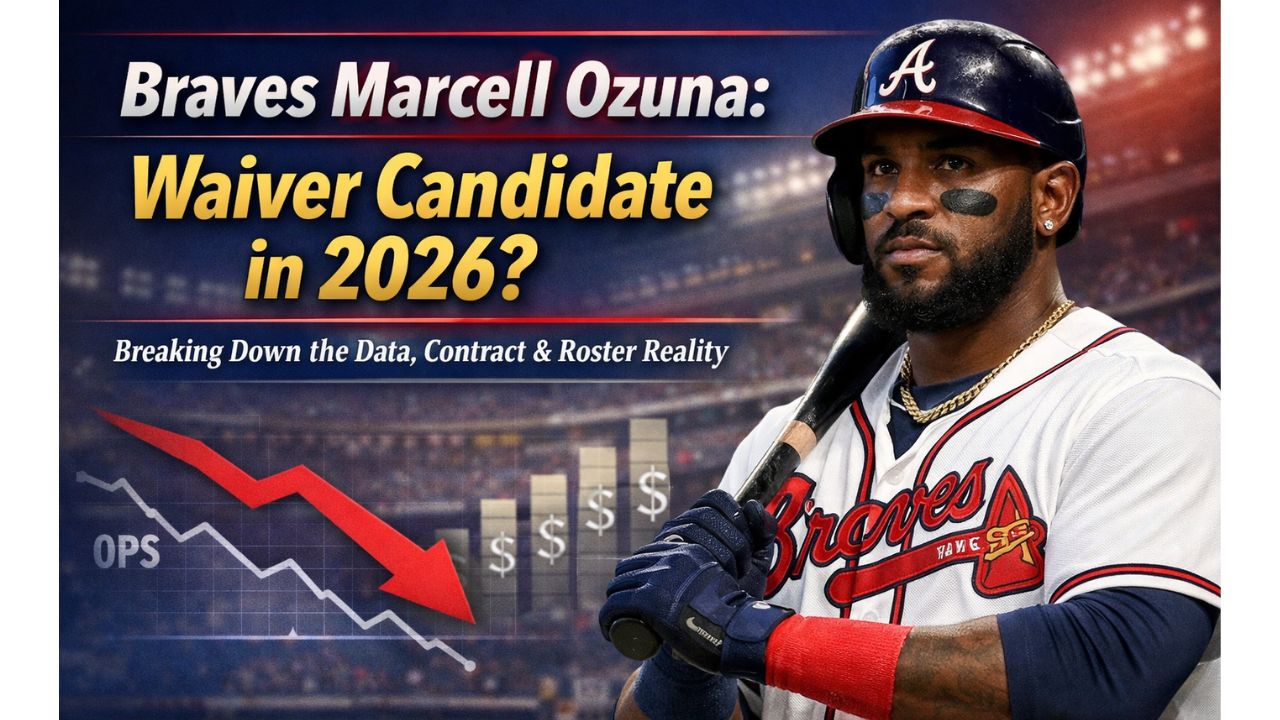
Speculation surrounding Marcell Ozuna’s roster status has intensified as the Atlanta Braves evaluate their 2026 designated hitter situation. The Braves Marcell Ozuna waiver candidate discussion stems from performance decline and payroll considerations rather than confirmed front office intentions. At The London Magazine, we examine the statistical reality, contractual obligations, and MLB waiver mechanics to determine whether such speculation represents credible roster strategy or premature narrative construction.
Marcell Ozuna’s 2025 Performance Overview
A Season Derailed by Injury
Marcell Ozuna entered the 2025 season carrying enormous expectations. Fresh off a fourth-place NL MVP finish in 2024, where he slashed .302/.378/.546 with 39 home runs and posted a remarkable 4.7 fWAR, Atlanta’s long-time designated hitter was widely considered one of the most dangerous bats in the National League. What followed, however, was a frustrating tale of a season undone by injury and inconsistency.
Things started promisingly enough. Through April, Ozuna was batting a healthy .283 with a .915 OPS, looking every inch the elite run producer Braves fans had come to rely on. May held firm at .277 with an .851 OPS, and Atlanta had every reason to feel confident in their veteran slugger. Then June arrived — and so did the news that Ozuna had been playing through a torn hip labrum.
The effect on his numbers was stark and immediate. His batting average crashed to .188 in June, his OPS plummeted to .550, and the power that had defined his best seasons simply evaporated. From June 1 through the remainder of the regular season, Ozuna managed just a .189/.301/.362 slash line with 11 home runs — a far cry from the player who had cracked 79 homers over the previous two seasons combined.
The Statistical Reality of His Decline
By season’s end, Ozuna had finished with a .232 batting average, 21 home runs, and a .755 OPS across 145 games — his worst production by batting average since 2022 and a significant step backward from his career-high output in 2024. His home run total dropped from 39 to 21, while his OPS fell nearly 170 points from the previous year.
There were some silver linings buried in the numbers. His walk percentage climbed to a career-best 15.9%, placing him in the 98th percentile league-wide. His chase rate improved from the 62nd to the 85th percentile. But these gains were overshadowed by declines in the core power metrics that define his value as a DH. Exit velocity softened, average exit velocity dropped, and hard-hit percentage struggled through the summer months. FanGraphs analysts noted that launch angle consistency fluctuated throughout the year, consistent with a player compensating for lower body discomfort.
Ozuna endured two particularly brutal power droughts — a 21-game homerless stretch before the All-Star break and a 32-game drought in the second half. He shared DH reps with catchers Sean Murphy and Drake Baldwin down the stretch, a visible sign that Atlanta’s confidence in him had wavered.
Breaking Down Ozuna’s Contract and Payroll Impact
The Structure of His Deal
Ozuna’s financial relationship with the Atlanta Braves stretches back to January 2020, when the team signed him to a one-year, $18 million deal that turned out to be one of the best short-term investments in franchise history. He led the NL in home runs and RBIs during the COVID-shortened season and finished sixth in MVP voting. Atlanta rewarded him with a four-year, $65 million extension in 2021, which included a club option for 2025 that the Braves ultimately exercised.
That 2025 club option carried a $16 million salary — a figure that began to look increasingly difficult to justify as the season wore on. For context, $16 million for a designated hitter who finishes the year with 21 home runs and a .232 average represents a meaningful overpay by modern MLB valuation standards, even accounting for his injury-impacted campaign.
Free Agency and the Pittsburgh Move
Crucially for understanding the Braves Marcell Ozuna waiver candidate narrative, Ozuna did not hit waivers at the end of 2025. He completed his contract, reached free agency naturally, and ultimately signed a new deal with the Pittsburgh Pirates in February 2026. This distinction is important and often lost in the swirl of roster speculation — waivers apply to players still under contract and on a team’s 40-man roster, not to free agents negotiating new terms in the open market.
Kiley McDaniel of ESPN had predicted Ozuna would command a two-year deal worth around $30 million in free agency, while the FanGraphs crowdsource projected a more conservative one-year, $12 million arrangement. The Pirates ultimately landed him, with Ozuna sliding into their designated hitter role and pushing Ryan O’Hearn to left field. Pittsburgh got a high-risk, high-reward bat who is just one season removed from one of the best offensive campaigns of his career.
Understanding MLB Waivers in 2026
What Waivers Actually Mean
The casual use of “waiver candidate” in baseball media often creates confusion among fans, so it is worth clarifying exactly what the term means in the modern MLB landscape. Waivers are a procedural tool used for players already under contract who are being designated for assignment — essentially removed from a team’s 40-man roster. When a player clears waivers, no other team has claimed him, and the original organization can release or reassign him. When a player is claimed, the claiming team assumes his contract.
This process applies specifically to active roster players under binding agreements. It does not apply to players whose contracts have expired and who are freely negotiating with any team they choose. By the time the Braves Marcell Ozuna waiver candidate conversation reached peak volume in the media, Ozuna had already completed his contractual obligations to Atlanta and was a free agent — meaning the waiver mechanism was never actually in play.
The Trade Route That Did Not Happen
What was genuinely in play during the 2025 season was the possibility of a trade. Atlanta explored moving Ozuna at the July 31 deadline, and there were early signs of interest from multiple clubs. However, Ozuna held 10-and-5 rights — 10 years of MLB service time combined with 5 consecutive years on the same team — which gave him the legal authority to veto any trade he chose not to accept. Reports surfaced that he had blocked at least three deals during the deadline period, preferring to remain in Atlanta and finish the season rather than join a contender under uncertain circumstances.
His $16 million salary and the medical uncertainty surrounding his hip further cooled the market. Teams willing to take a chance on his upside were not willing to absorb the full financial risk of a declining, injured 34-year-old DH with veto power. Atlanta ultimately held on to him, watched him share DH duties with their catchers in September, and let him walk to free agency when the season concluded.
Performance vs Financial Strategy — A Data Comparison
What the Numbers Say About Ozuna’s Value
To understand why the Braves let Ozuna walk and why the waiver conversation gained traction, it helps to place his 2025 performance in financial context. The table below provides a simplified comparison of his output relative to contract cost across his most recent Atlanta seasons.
| Season | BA | HR | OPS | fWAR | Salary |
|---|---|---|---|---|---|
| 2023 | .274 | 40 | .853 | 3.2 | $14M |
| 2024 | .302 | 39 | .925 | 4.7 | $16M (option) |
| 2025 | .232 | 21 | .755 | ~1.5 | $16M (option) |
The contrast between 2024 and 2025 is the central story. A 4.7 fWAR season at $16 million is genuinely excellent value for a DH. A 1.5 fWAR season at the same price sits at roughly break-even for a corner bat, particularly one who no longer plays the field. When ZiPS and Steamer projections pointed toward a similar output in 2026, Atlanta’s decision to move on became fairly straightforward from a front-office perspective.
Why Atlanta Chose Flexibility Over Loyalty
President of Baseball Operations Alex Anthopoulos has spoken publicly about the importance of anticipating player decline curves rather than reacting to them after the fact. With Ozuna turning 35 in the offseason and carrying a hip injury that required management for most of the second half, the Braves made a calculated decision to embrace roster flexibility over continuity at the DH position.
Rather than committing another multiyear guarantee to an aging slugger with declining peripheral metrics, Atlanta opted to distribute DH at-bats among Sean Murphy, Drake Baldwin, and potentially incoming additions. Murphy had already been logging DH appearances to manage his catching workload, and Baldwin represented a younger developmental option capable of growing into a larger offensive role. The move was less a rejection of Ozuna the person and more a recalibration of organizational priorities — exactly the kind of proactive decision-making that has defined Atlanta’s front office under Anthopoulos.
Is the Braves Marcell Ozuna Waiver Candidate Narrative Realistic?
Separating Fact from Speculation
Here is the honest answer: the Braves Marcell Ozuna waiver candidate framing was never technically accurate, but it captured something real about the underlying situation. The spirit of the conversation — whether Atlanta would part ways with Ozuna due to declining production and financial considerations — was entirely legitimate. The specific mechanism being described was not.
Ozuna was never placed on waivers by the Braves. He completed a contract year, became a free agent as expected, and signed with Pittsburgh. The waiver narrative emerged from a genuine analysis of his production versus his salary and the Braves’ evolving roster construction philosophy, but it incorrectly applied a specific procedural mechanism to what was simply a natural contract conclusion.
What Would Have Needed to Happen for Real Waivers
For Ozuna to have been a genuine waiver candidate during the 2025 season, the Braves would have needed to designate him for assignment — a move that would have required releasing or outright trading him without compensation if another team claimed him. Given his $16 million salary and his veto rights on trade destinations, DFA would have been a highly unusual and financially messy option. It was never seriously pursued.
The more realistic version of the conversation — and the one worth having — was always about whether Atlanta would exercise another contract option, pursue a new free agent deal, or let Ozuna move on entirely. They chose the third option, and Ozuna found a new home with Pittsburgh. The story resolved itself through the normal machinery of the offseason, not through waivers.
What This Means for Atlanta’s 2026 Championship Window
The DH Situation Going Forward
Ozuna’s departure leaves Atlanta with a more flexible designated hitter arrangement heading into 2026. Murphy, one of the best defensive catchers in the sport, figures to see regular DH appearances to manage the physical demands of his primary position. Baldwin brings upside as a younger bat with developing plate discipline. The Braves may also explore additional free agent or trade options if they determine the internal alternatives are insufficient for a serious NL East title run.
It is worth noting that Atlanta’s offensive ceiling was never entirely dependent on Ozuna. Ronald Acuña Jr.’s return to health, Austin Riley’s continued development as an elite third baseman, and the depth of the lineup around them give the Braves a formidable offensive core with or without their longtime DH. The bigger challenge for Atlanta’s 2026 championship window may be pitching health and outfield depth rather than the designated hitter question.
The Broader Organizational Message
The decision not to re-sign Ozuna sends a broader message about how the Braves intend to operate going forward. Atlanta has consistently prioritized positional versatility and roster elasticity over permanent role assignment. The era of carrying a dedicated, everyday DH who plays no defense appears to be over in Atlanta, at least for now. That approach opens payroll flexibility for moves elsewhere, whether that means extending current players, acquiring rental pieces at the deadline, or signing a positional upgrade if one becomes available at the right price.
Anthopoulos has built one of the most consistently competitive franchises in baseball by making these kinds of unsentimental, data-informed decisions. Moving on from Ozuna fits that pattern neatly, even if it carries emotional weight for fans who watched him contribute to some of the best Atlanta baseball in a generation.
Conclusion
The Braves Marcell Ozuna waiver candidate conversation was rooted in genuine questions about production, salary value, and organizational direction — but it misidentified the mechanism by which their relationship would end. Ozuna was never placed on waivers; he simply played out his contract, hit free agency, and signed with Pittsburgh. His 2025 season — limited to 21 home runs and a .232 average by a persistent hip injury — made it easy for Atlanta to look elsewhere rather than commit new money to a 35-year-old designated hitter with uncertain health.
What the narrative captured correctly was the underlying reality: the Braves had evolved beyond the point where Ozuna fit their 2026 plans. His departure represents a clean break rather than a messy roster move, and Atlanta appears better positioned for the flexibility it creates than it would have been locking up another year of declining production at a premium price. As for Ozuna, Pittsburgh gets a veteran slugger with genuine upside if his hip recovers — and one of the best power seasons in recent Braves history will remain on his resume regardless of how the final chapter reads.
Frequently Asked Questions
Was Marcell Ozuna actually placed on waivers by the Braves?
No. Ozuna completed his 2025 contract with the Atlanta Braves and entered free agency naturally at the end of the season. He was never designated for assignment or placed on waivers. He subsequently signed with the Pittsburgh Pirates in February 2026.
Why did the Braves not re-sign Ozuna for 2026?
Atlanta chose not to pursue a new deal primarily due to Ozuna’s declining production in 2025 — which included a .232 batting average and 21 home runs, significantly down from his 39-homer 2024 season — combined with a hip injury that raised durability concerns. The organization also shifted toward a more flexible DH rotation using internal options like Sean Murphy and Drake Baldwin.
What does “waiver candidate” actually mean in MLB?
A waiver candidate refers to a player who is still under contract but being considered for placement on waivers — a procedural step used when teams designate players for assignment or remove them from the 40-man roster. Other teams can claim such players and assume their contract. It does not apply to free agents, which is why the term was technically inaccurate when applied to Ozuna.
Did Ozuna veto any trade deals in 2025?
Yes. Ozuna held 10-and-5 rights, giving him the power to veto trades without his consent. Reports indicated he blocked at least three potential deals at the 2025 trade deadline, choosing to remain with Atlanta rather than move to another club.
What are Ozuna’s chances of bouncing back with Pittsburgh?
Ozuna’s 2024 campaign — 39 home runs, an .925 OPS, fourth in NL MVP voting — shows he is capable of elite production when healthy. If his hip heals properly, a significant bounce-back season is realistic. Most projection systems see him as a league-average to slightly above-average DH, which makes him a reasonable low-to-mid-cost signing for a team willing to absorb the risk.
How does Ozuna’s departure affect Atlanta’s 2026 championship window?
The short-term impact is manageable. Atlanta retains Ronald Acuña Jr., Austin Riley, and a strong pitching core. The DH role will be distributed among Murphy, Baldwin, and potentially new additions. The payroll flexibility created by not re-signing Ozuna may prove more valuable than the production he would have provided, depending on how Atlanta chooses to allocate those resources.
Also Read: Golden State Warriors vs Lakers Match Player Stats Complete Analysis