
There was a time when a trip to Claire’s felt like a rite of passage. Whether it was getting ears pierced for the first time, picking out a glittery hair clip, or loading up a basket with friendship bracelets and novelty lip gloss, Claire’s was the destination for tweens across the world. For decades, it thrived in shopping malls, high streets, and retail parks, quietly becoming one of the most recognisable accessories brands on the planet.
But that era is now officially over.
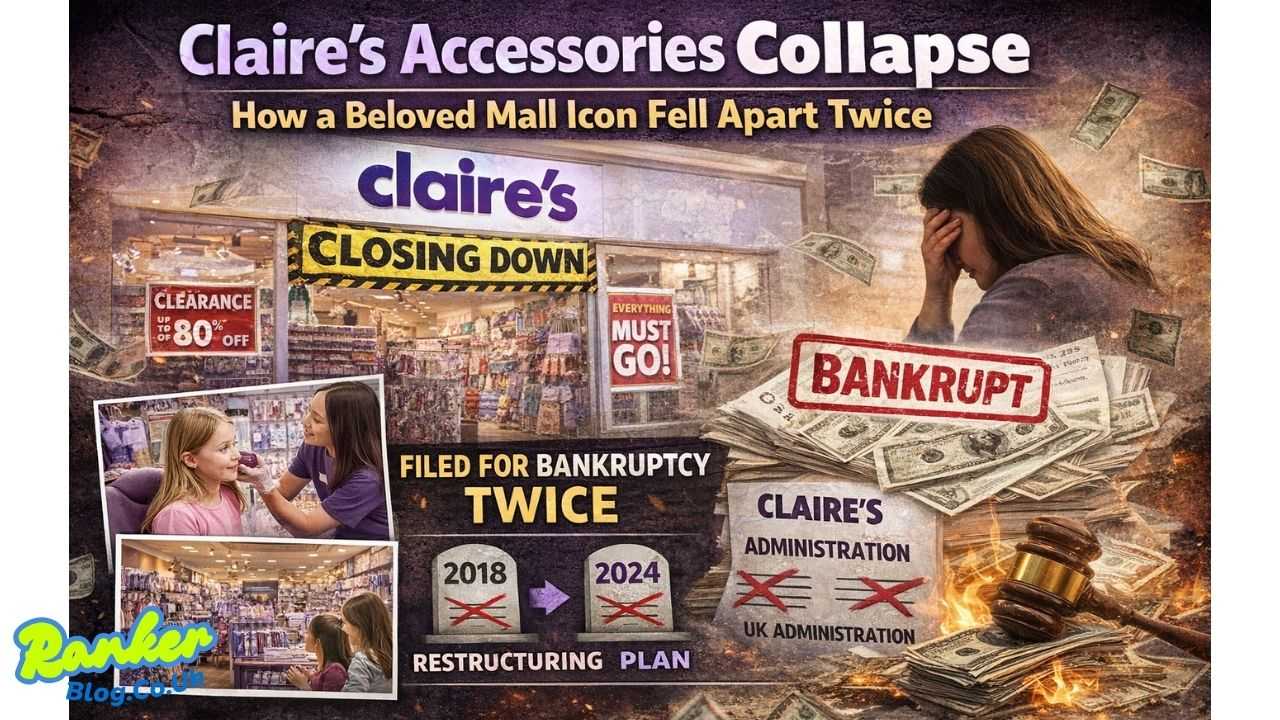
The Claire’s accessories collapse is not just a retail story — it is a slow-motion cautionary tale about what happens when a brand loses its identity, drowns in debt, and refuses to evolve fast enough in a world that has already moved on. This is the full story of how a brand that survived for over five decades ended up filing for bankruptcy not once, but twice — and how even a last-ditch rescue effort in the UK could not save it from administration.
A Brand Built on Glitter and Ear Piercings
Claire’s was not always a struggling retailer. In fact, for a long stretch of its life, it was genuinely thriving.
Founded in the 1970s, the chain built its entire identity around something simple but powerful: affordable, fun accessories aimed at girls and young women. Chunky jewellery, colourful hair accessories, novelty bags, and — perhaps most iconically — in-store ear piercing. It was the kind of shop that felt exciting and accessible at the same time, and that combination worked beautifully for years.
By the early 2000s, the numbers told a compelling story. Annual sales grew from around $846 million in fiscal 2000 to $1.48 billion by fiscal 2007, and the store count expanded globally to over 2,750 locations across 17 countries in North America and Europe, alongside 190 ICING stores in North America. At its peak, Claire’s was not just a retailer — it was a cultural institution for an entire generation of young shoppers.
Then came the moment that, in hindsight, changed everything.
In 2007, Apollo Global Management took the company private in a leveraged buyout worth $3.1 billion. Leveraged buyouts (LBOs) are a well-known private equity strategy, but they come with serious risk: they load enormous amounts of debt onto the acquired company, which must then generate enough cash flow to service that debt while also running its day-to-day operations. For Claire’s, that debt burden would eventually prove fatal.
The First Bankruptcy: 2018
By 2018, the weight of that debt had become unbearable. Claire’s filed for Chapter 11 bankruptcy protection for the first time, and the company was taken over by creditors Elliott Management Corporation and Monarch Alternative Capital. The restructuring wiped out $1.9 billion in debt, and the chain exited bankruptcy within seven months with a leaner balance sheet and a new ownership structure.
On paper, it looked like a second chance. And for a while, there were genuine signs of life. In 2021, Claire’s began talking about a potential initial public offering (IPO) — a move that would have signalled confidence in the brand’s future. But by 2023, that plan had been quietly abandoned, a signal that the underlying problems had not gone away.
In the years that followed, the company did try to modernise. It expanded its retail footprint through partnerships with major players like Walmart and Walgreens, launched a loyalty programme, and invested in influencer-led social media content to reconnect with younger audiences. These were sensible moves, but they were too incremental to overcome the structural challenges that were piling up.
The Road to a Second Collapse
Several forces converged to push Claire’s toward a second collapse, and understanding them separately is important — because together, they formed a near-impossible situation.
A Debt Crisis With No Easy Exit
Even after the 2018 restructuring, Claire’s was not operating on solid financial ground. A nearly $500 million loan was due in December 2026, and by mid-2025 the company had already begun deferring interest payments — planning to cover them with even more debt. That kind of financial manoeuvring is rarely sustainable, and it signalled that Claire’s was in serious trouble long before the second bankruptcy filing became official.
Changing Consumer Habits
The company’s own leadership acknowledged that consumer behaviour had fundamentally shifted. Shoppers — particularly the younger demographic Claire’s had always relied on — were growing more reluctant to spend on impulse purchases like novelty jewellery, faux-gold bangles, or character-branded accessories. Rising inflation made discretionary spending feel riskier, and Claire’s core product range was about as discretionary as it gets.
The Rise of Digital-Native Competitors
Perhaps the most damaging long-term force was the rise of fast-fashion e-commerce platforms. Retailers like Shein and Temu had swooped in and captured Claire’s audience with staggering efficiency. They offered a far wider range of merchandise — at the same low price points Claire’s was built on — while benefiting from the kind of algorithm-driven trend responsiveness that a traditional brick-and-mortar retailer simply cannot match. For a brand that made its name selling affordable accessories, being undercut on both price and variety by online giants was a serious problem.
Tariff Pressure From US Trade Policy
As if the competitive landscape were not challenging enough, Claire’s also found itself caught in the crossfire of US trade policy. The vast majority of its products were sourced from China, which faced the steepest tariffs under President Trump’s renegotiation of global trade agreements. Those tariffs added significant new import costs to a business that was already struggling to maintain its margins — and there was no easy way to absorb them without either raising prices (and risking further customer loss) or accepting even slimmer profits.
A Generation That Had Moved On
Analysts were blunt about the brand’s fundamental challenge. Claire’s target demographic — tweens and young teens — is notoriously fickle and heavily driven by what they see on social media. By the time Shein hauls were racking up millions of views on TikTok and Instagram, the idea of browsing a mall Claire’s for accessories felt, to many of those same customers, like a relic of another era. The brand had simply not evolved fast enough to stay relevant.
The Second Bankruptcy: August 2025
On August 6, 2025, Claire’s Holdings LLC and a number of its US and Gibraltar-based subsidiaries formally commenced Chapter 11 bankruptcy proceedings in the United States Bankruptcy Court for the District of Delaware. A parallel process was also launched in Canada under the Companies’ Creditors Arrangement Act.
CEO Chris Cramer was direct about the reasons. He pointed to increased competition, shifting consumer spending patterns, the continued migration away from physical retail, mounting debt, and broader macroeconomic pressures as the forces that had made this step unavoidable. Retail analysts were largely unsurprised. One described the situation as a cocktail of problems — both internal and external — that had made it impossible for Claire’s to stay afloat, noting that the retailer had become out of step with modern consumer demand.
The bankruptcy filing reported estimated assets and liabilities of between $1 billion and $10 billion. North American stores were kept open throughout the proceedings while the company explored strategic alternatives, including a potential sale.
The Attempted Rescue: Late 2025
Claire’s spent months searching for a buyer, and a deal eventually emerged. In September 2025, the company was acquired by Ames Watson — a private equity firm — in a transaction valued at approximately $140 million, covering up to 950 stores. The structure included $104 million in cash and a $36 million seller note, with Ames Watson also assuming certain liabilities including cure costs and employee wages.
The bankruptcy court confirmed Claire’s First Amended Joint Chapter 11 Plan on October 29, 2025, and the Plan took effect on November 10, 2025. It was presented as a genuine turning point — a moment at which the brand could finally stabilise and rebuild.
But while the US deal was being structured, a very different story was unfolding across the Atlantic.
The Claire’s Accessories Collapse in Administration: UK & Ireland (2025–2026)
When the American parent company filed for bankruptcy in August 2025, the UK and Ireland arm of the business was pulled directly into the chaos. The UK operation entered administration shortly afterwards, and Modella Capital — a private equity firm with a track record of acquiring struggling high-street brands — stepped in to take over a significant portion of the UK estate.
The initial intervention cost around 145 store closures and the loss of approximately 1,000 jobs. At the time, Modella positioned the deal as a rescue mission: the remaining 134 stores would be protected, and more than 1,350 jobs would be preserved. There was cautious optimism that the brand might yet find a path forward in the UK market.
That optimism did not last long.
Why the UK Recovery Failed
The Claire’s accessories collapse into administration for a second time — in January 2026, less than 12 months after the first — exposed just how fragile that recovery had always been. Modella itself stated that there was no realistic possibility of the business trading profitably. The reasons were multiple and mutually reinforcing.
Christmas trading — the most critical retail period of the year for any accessories brand — had significantly underperformed expectations. At the same time, inflationary pressures continued to squeeze operating costs across wages, energy, and logistics. Competition from Shein, Temu, and TikTok Shop was intensifying, pulling Claire’s core audience toward faster, cheaper, and more trend-responsive alternatives. Consumer confidence in the UK remained subdued amid a prolonged cost-of-living squeeze.
One retail analyst put it plainly: the margins in mid-market accessories had been squeezed from every direction.
Administration Formalised in January 2026
In late January 2026, Claire’s Accessories UK & Ireland formally entered administration. Insolvency specialists from Kroll were appointed to manage the process. All remaining UK and Irish stores continued to trade while administrators explored options — whether that meant finding a buyer for the whole business, parts of it, or managing an orderly wind-down.
The Claire’s accessories collapse into administration had put over 1,350 jobs and more than 130 stores at risk. For staff and communities that had depended on those stores for years, the news was deeply unsettling. For anyone watching the retail sector closely, it was sadly not surprising.
What the Collapse Reveals About Modern Retail
The story of Claire’s is not just about one company. It reflects some uncomfortable truths about the state of retail more broadly.
The “Zombie Retailer” Problem
There is a well-recognised pattern in the retail industry: a struggling chain emerges from Chapter 11 bankruptcy, sheds some debt, closes some stores, and promises a fresh start. But if the underlying structural problems — changing consumer habits, outdated business models, excessive debt from leveraged buyouts — have not been fixed, the brand simply delays the inevitable. Retailers that file for bankruptcy and then file again typically find themselves liquidating everything and closing down entirely, perhaps with a token online presence left behind.
Claire’s fits that pattern almost exactly.
The Mall Is Dying — And Taking Brands With It
Claire’s is far from the only brand to have reached this point. In 2025 alone, Forever 21, At Home, and Quicksilver-owner Liberated Brands all filed for bankruptcy. The common thread across many of these collapses is dependence on physical mall and high-street retail at a time when footfall has been declining for years.
The LBO Legacy
The private equity leveraged buyout model has a genuinely troubling track record in retail. Loading a consumer brand with billions in debt and then expecting it to service that debt while also adapting to a rapidly changing market is a high-risk formula. For Claire’s, the 2007 Apollo buyout planted a debt seed that grew until it became unmanageable — regardless of how the brand might otherwise have performed.
Gen Z and Gen Alpha Are Different Consumers
Young shoppers today discover trends on TikTok, buy directly from Shein or Temu, and have little reason to walk into a mall specifically to browse accessories. They are digitally native in a way that fundamentally changes how retail must operate. Brands that fail to meet them where they are — online, on social platforms, with trend-responsive products — risk being left behind entirely.
What Comes Next for Claire’s?
The US chapter of the Claire’s story continues, at least for now. Under Ames Watson’s ownership, the restructured North American business is attempting to find its footing in 2026. The Bankruptcy Court entered the Final Decree closing a number of the Chapter 11 cases on March 17, 2026, though Claire’s Holdings LLC Case No. 25-11454 remains open.
Whether the remaining stores can build a sustainable business model — perhaps through in-store concessions, digital expansion, or a pivot to experiences like ear piercing rather than product sales — remains genuinely uncertain.
In the UK and Ireland, the fate of the brand rests in the hands of administrators. A buyer may yet emerge for some or all of the remaining stores. But given how many attempts have already been made to rescue this particular brand, the bar for optimism is understandably low.
For private equity firms, investors, and retail operators watching this story unfold, the lessons are stark: debt-heavy acquisitions in a sector undergoing structural disruption are extraordinarily risky, and nostalgia alone cannot sustain a brand.
Conclusion: The End of an Era
The Claire’s accessories collapse is, at its heart, a deeply human story. It is about a brand that meant something real to millions of people — a first ear piercing, a birthday treat, a Saturday afternoon with friends in a shopping centre. That emotional connection was genuine, and it sustained the business for far longer than the financials probably warranted.
But emotional resonance is not enough to service a $500 million debt load, compete with Shein’s algorithm, or survive a global shift away from physical retail.
What Claire’s accessories collapse into administration in the UK, and the back-to-back US bankruptcies, ultimately demonstrate is this: even beloved brands can fail when they are buried under debt, slow to adapt, and outpaced by a retail world that simply does not wait for anyone.
The ear-piercing queen of the mall has had her time. Whether any version of Claire’s survives into the future — online, in concessions, or in some reimagined form — only time will tell. But the era of Claire’s as the world knew it is, for all intents and purposes, over.
Also Read: Universal Credit Loophole £1500 Is It Real or Just Another Internet Myth in 2026?