
Introduction
In the competitive world of Precision Manufacturing, companies relentlessly seek efficiency and reliability. A common yet critical pain point is the production of CNC turning parts. Many manufacturers face budget overruns, delayed deliveries, and inconsistent quality, especially when dealing with complex geometries and tight tolerances.
The root cause often lies in insufficient consideration of manufacturability during the design phase, inappropriate material selection, and a mismatch with supplier capabilities. Traditional approaches frequently lack a systematic Design for Manufacturability (DFM) analysis, leading to preventable errors and added costs.
This article adopts a ranked analysis format, detailing the five most critical mistake areas in CNC turning. It provides optimization strategies based on international standards, offering a roadmap to build a scientific system for cost control and quality assurance. The following sections will dissect the cause, impact, and solution for each critical error.
How Does Inadequate Tolerance Control Cause Costs to Skyrocket for CNC Turned Parts?
Improper tolerance specification is a primary driver of unnecessary expense in producing CNC turning parts. Overly tight or incorrectly applied tolerances directly increase machining time, necessitate specialized equipment, and elevate scrap rates.
The High Cost of “Tighter is Better”
A pervasive myth is that the tightest tolerance yields the best part. In Precision Manufacturing, each precision increment demands exponentially more resources. Achieving ±0.005mm versus ±0.01mm for CNC turning parts may double costs via extra steps, slower speeds, and climate control. ASME Y14.5 stresses tolerances must serve function, not arbitrary benchmarks.
Strategy and Collaboration for Optimal Tolerances
Effective tolerance control requires a disciplined, collaborative approach.
l Employ Functional Stack-Up Analysis
This technique assesses how dimensional variations accumulate in an assembly. Research, like that in the ASME Digital Collection, shows a statistical (RSS) method can ensure fit with looser part tolerances. Critical dimensions are tightly controlled; non-critical features use standard ranges. Mastering this is key for CNC machine turning parts.
l Engage in Collaborative Specification Review
Clear communication with your manufacturer is vital. Discussing “fit” versus “form” features allows experts to suggest adjustments that relax tolerances without compromising function, enabling significant savings and smoother production.
How Does Incorrect Material Selection Impact the Final Performance of Turned Parts?
Choosing the wrong material for a CNC turning machine project is a costly error that affects everything from machinability to the component’s lifecycle performance. The ideal material balances functional requirements with manufacturability and cost.
The Direct Cost of Material Machinability
Materials have inherent machinability ratings directly impacting cost. Free-machining aluminum allows high-speed, low-cost production, while tougher titanium accelerates tool wear, lowers cutting speeds, and raises time and tooling costs. Unnecessarily hard materials inflate expense for Custom Parts.
Strategic Selection for Performance and Cost
Optimal material selection requires balancing application needs with total cost.
l Match Material to Operating Environment
Data, like from Materials Today, stresses application-specific choice. Marine parts need 316 stainless for corrosion; aerospace brackets demand high-strength aluminum or titanium. Using a standard or overly-specialized alloy risks failure or waste.
l Consider the Total Cost of Ownership
Choice affects more than billet cost. Poor selection can cause finishing issues, tolerance difficulties, and secondary process challenges. A holistic view of the full manufacturing chain and operational life is essential.
Why Can Neglecting DFM Extend Turning Production Cycles by 65%?
Overlooking Design for Manufacturability (DFM) is perhaps the most significant avoidable mistake in CNC machining turning. DFM is the practice of designing parts to optimize them for the chosen manufacturing process, and its absence can lead to drastic inefficiencies.
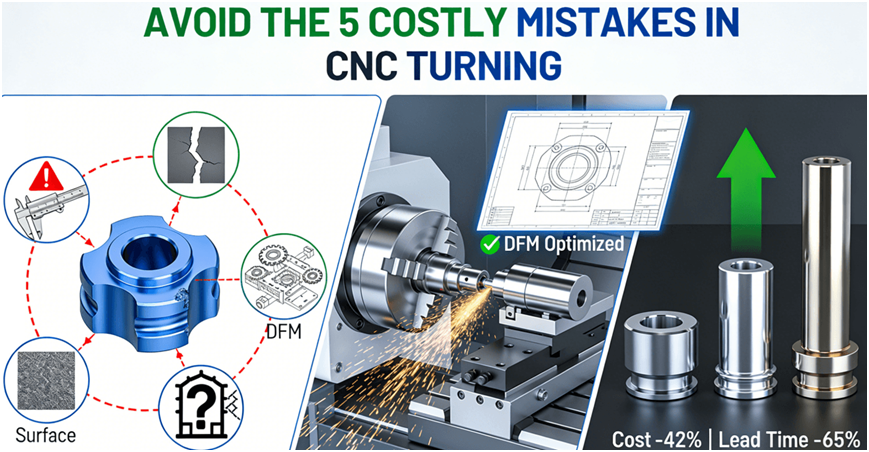
DFM optimization for CNC machining turning simplifies geometry for symmetry, minimizes setups, and ensures tool accessibility. Standards like ISO 9013:2017 advocate reducing complexity. A case shows its power: a multi-operation milled part was redesigned for turning, slashing cost by 42% and lead time by 65%, boosting production efficiency. This highlights that effective DFM isn’t solitary; it requires early designer-manufacturer collaboration to preemptively solve issues, ensuring a smooth, cost-effective journey.
How Does the Choice of Surface Finishing Process Determine the Market Competitiveness of Turned Parts?
Surface finishing is the final, defining step for custom turned parts, impacting aesthetics, corrosion resistance, wear properties, and dimensional stability. Selecting the wrong finish can undermine an otherwise perfectly machined component.
Choosing a surface finishing process is a critical cost-performance decision for custom turned parts. Each technique, from anodizing to plating, offers distinct properties. Industry needs vary: medical requires biocompatible finishes like electropolishing, while automotive prioritizes durable coatings. Crucially, the finish must be integrated during design. Processes like plating add thickness affecting tolerances, while powder coating needs geometry for uniform coverage. Early specification ensures proper stock allowance and feature design, guaranteeing a flawless final product and true quality enhancement..
How to Evaluate the True Technical Capability of a CNC Turning Service Provider?
Selecting the right partner for CNC turning services is the ultimate safeguard. A rigorous supplier evaluation must assess both technical infrastructure and collaborative capability. Technically, a competent provider should possess advanced multi-axis machine tools, comprehensive quality certification (like ISO 9001, IATF 16949, or AS9100D for aerospace), and precise metrology equipment like CMMs. Beyond hardware, their engineering support is critical; a valuable partner provides rapid, actionable DFM optimization feedback.
Furthermore, evaluating their supply chain stability for materials and secondary processes ensures reliability. A partner excelling in these areas becomes a true extension of your engineering team, mitigating risk and ensuring project success.
Conclusion
Optimizing the cost and quality of CNC turned parts is a systemic endeavor. It requires meticulous control from tolerance design and material selection through DFM application and final supplier evaluation. By consciously avoiding the five common mistakes detailed herein—poor tolerance control, incorrect material choice, neglected DFM, inappropriate surface finishing, and an inadequate vendor selection process—manufacturing enterprises can realistically achieve the cited average savings of 42% in cost and a 65% acceleration in delivery timelines.
Take the first step towards optimized production. Our expert team will provide a customized manufacturability and cost-optimization analysis based on your part drawings, helping you achieve precise cost control without compromising on quality.
Author Biography
A senior expert in the field of precision manufacturing with over 15 years of experience inCNC machining technology. Specializing in turning process optimization and cost control research, he has provided technical consulting services for numerous global manufacturing enterprises, accumulating over 300 optimization projects with an average production cost reduction of more than 35% for clients.
FAQs
Q1: What is the typical tolerance range achievable in CNC turning?
A: Standard CNC turning can hold tolerances of ±0.127mm, with high-precision equipment capable of ±0.005mm. The achievable tolerance depends on material properties, part geometry complexity, and machine tool performance, requiring process optimization based on specific needs.
Q2: What is the main difference between CNC turning and CNC milling?
A: Turning involves a rotating workpiece and a moving cutting tool, making it ideal for axi-symmetric parts. Milling involves a rotating tool and a stationary workpiece, suitable for complex contours and profiles. The choice depends on part geometry, batch size, and precision requirements.
Q3: Which materials are most suitable for high-precision CNC turned parts?
A: Aluminum 6061, Stainless Steel 304, and Brass C36000 are common choices, offering a good balance of machinability, strength, and cost. For medical and aerospace applications, Titanium Ti-6Al-4V is frequently used but presents higher machining difficulty.
Q4: How can DFM help reduce CNC turning costs?
A: DFM reduces costs by optimizing part design to decrease machining difficulty. This includes simplifying geometric features, unifying tolerance bands, and minimizing the number of required set-ups. This can reduce material waste by 20-40% and shorten machining time by 30-50%.
Q5: What certifications should a reliable CNC turning supplier possess?
A: Beyond the foundational ISO 9001 quality system certification, the automotive industry requires IATF 16949, aerospace requires AS9100D, and medical devices require ISO 13485. An ISO 14001 environmental management system certification indicates a commitment to sustainable development.