
Introduction
Some rivalries are born out of decades of divisional battles. Others sneak up on you — quietly building through scattered interleague series, star-studded rosters, and one unforgettable October. The Dodgers vs Toronto Blue Jays timeline is exactly that kind of story.
On the surface, these two franchises couldn’t be more different. One calls the sun-soaked streets of Los Angeles home; the other represents Canada’s largest city with a blue-collar pride that runs deep through Rogers Centre. They play in different leagues, in different time zones, and under different skies. Yet, over the decades, their paths have crossed in ways that have consistently captured the attention of baseball fans across North America.
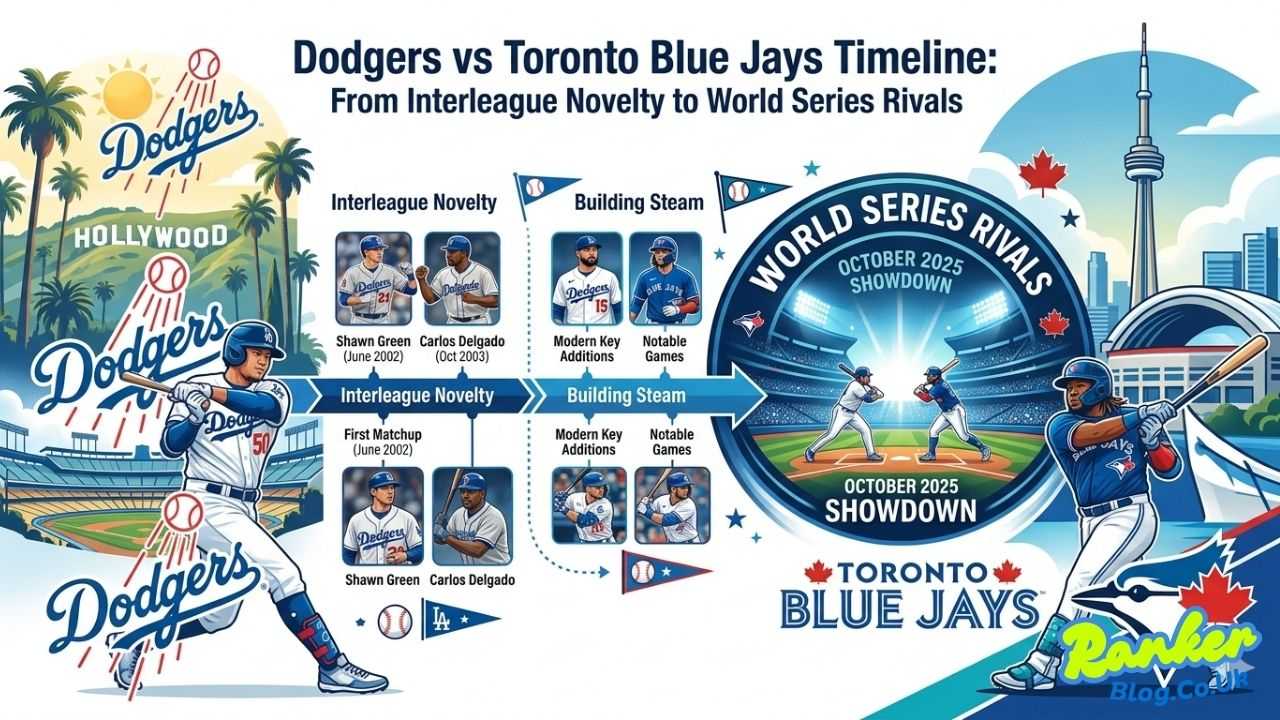
From the early days of interleague play to a full-blown World Series showdown in 2025, the Toronto Blue Jays vs Dodgers timeline is a fascinating study in contrast, competition, and the beauty of baseball when its two best teams finally share a stage. This article traces every meaningful chapter of that journey — the numbers, the names, the moments, and what comes next.
Early History & Franchise Origins (Pre-1997)
The Dodgers’ Legacy and NL West Dominance
Long before interleague play was even a concept, the Los Angeles Dodgers had already built one of the most storied franchises in professional baseball. Since relocating from Brooklyn in 1958, the Dodgers established themselves as a perennial powerhouse in the National League West. With World Series titles in 1959, 1963, 1965, 1981, and 1988, they carried a winning tradition that most franchises could only dream of.
Their pitching-first identity — shaped by legends like Sandy Koufax, Don Drysdale, and later Fernando Valenzuela — made them one of the most respected organizations in the game. By the time the 1990s arrived, the Dodgers were still a competitive force, even if a championship had become elusive in that decade.
The Blue Jays Enter the Picture
Meanwhile, north of the border, a new franchise was finding its footing. The Toronto Blue Jays were born in 1977 as an American League expansion team, joining a loaded AL East division that included the New York Yankees and Boston Red Sox. Their early years were predictably rough, but the organization built steadily and intelligently.
By the late 1980s and early 1990s, Toronto had transformed into a genuine powerhouse. Back-to-back World Series championships in 1992 and 1993 — the first titles ever won by a Canadian franchise — announced the Blue Jays as legitimate baseball royalty. The Blue Jays entered the American League in 1977, establishing the baseline for what would become an occasional yet noteworthy series with the Dodgers.
Pre-Interleague Encounters
Before 1997, the two clubs had no reason to meet in the regular season. AL and NL teams simply didn’t play each other outside of the All-Star Game, Spring Training, or the World Series. The Dodgers and Blue Jays never met in the Fall Classic during this era, though both teams were among the most celebrated names in baseball through the 1980s and into the ’90s. Their stories ran parallel — not intersecting — until a rule change would finally force them to share a field.
The Interleague Era Begins (1997–2006)
Regular Season Meetings Finally Arrive
Major League Baseball changed the landscape of the sport when it introduced interleague play in 1997. For the first time, National League teams would face American League opponents during the regular season, creating matchups that fans had only previously imagined. The official history of regular-season competition between the two clubs began in earnest with the advent of interleague play in 1997.
The early interleague series between the Dodgers and Blue Jays were relatively modest affairs — low-profile three-game sets tucked into busy summer schedules. But for fans in both cities, they carried a certain novelty that made them feel like events.
The Geographic Challenge
One thing that consistently shaped these early matchups was pure geography. Flying cross-country from Los Angeles to Toronto — or vice versa — is no small task, and scheduling these series in concentrated bursts created a unique dynamic. The geographic challenge meant these series were often scheduled in concentrated bursts, making the results feel more impactful than a typical series against a division rival.
A sweep in one of these series could send a team into a road stretch with momentum or leave them scrambling. The limited nature of the matchup gave each game extra weight.
DH Rules and Roster Management
Another subtle but significant factor in this era was the designated hitter rule. The Blue Jays, as an AL team, relied on the DH position as a regular offensive weapon. When games were played in Los Angeles, the NL rules applied — no DH — which forced Toronto managers to make strategic decisions about lineup construction. This back-and-forth created a chess-match dimension to every LAD vs TOR series that added a layer of intrigue for baseball purists.
Mid-2000s: Both Teams in Transition
By the mid-2000s, neither team was at its competitive peak. The Dodgers were under new ownership and beginning to lay the groundwork for a future dynasty, while the Blue Jays were hovering around the .500 mark, searching for the pieces that could make them contenders in the brutal AL East. Individual performances often defined these interleague series more than team excellence — a dominant pitching outing here, a surprise offensive explosion there.
The Competitive Windows Era (2007–2019)
Blue Jays Flash Dominance
One of the most lopsided results in the Blue Jays vs Dodgers history came in June 2007. The Blue Jays posted their biggest win over Los Angeles in franchise history with a 12-1 victory at home on June 20, 2007 — a statement game that reminded the baseball world that Toronto could still hang with the best.
But over the years, the Dodgers answered in kind. The Dodgers’ record victory in this matchup came with a dominant 16-3 blowout at home on August 20, 2019 — a performance that underscored just how deep and powerful the Los Angeles roster had become under the stewardship of president of baseball operations Andrew Friedman.
The Blue Jays’ “All-In” Window
Perhaps the most exciting period in recent Blue Jays history was the 2015–2016 run, when Toronto went all-in on contention. The roster featured sluggers like José Bautista, Josh Donaldson — who won the AL MVP in 2015 — and Edwin Encarnación, one of the most feared power hitters in baseball. That Blue Jays team captured the imagination of Canadian baseball fans in a way that hadn’t been seen since the early 1990s championships.
When this Toronto squad faced the Dodgers in interleague play, it was appointment television. Both rosters were stacked with star power, and series often drew significant national attention, especially when broadcast in both the U.S. and Canada, as marquee pitchers faced elite sluggers across both lineups.
Dodgers Build a Dynasty
While Toronto’s window eventually closed, the Dodgers kept building. Beginning with back-to-back NL pennants in 2017 and 2018 — both ending in heartbreak — Los Angeles was becoming the gold standard of the National League. Their combination of homegrown talent, smart free agency, and analytics-driven decision-making made them nearly impossible to match over a full season. This Dodgers dynasty would soon collide with a resurgent Blue Jays organization in ways that neither fan base could have anticipated.
The Modern Rivalry Takes Shape (2020–2024)
Dodgers Claim the 2020 Title
In the pandemic-shortened 2020 season, the Los Angeles Dodgers finally broke through and won the World Series, defeating the Tampa Bay Rays in six games. It was the franchise’s first championship since 1988 and validated years of near-misses. The Dodgers were officially a dynasty, and the baseball world was watching.
Toronto’s Next Generation Rises
On the other side of the rivalry, the Blue Jays were rebuilding around an exciting young core. Vladmir Guerrero Jr., son of Hall of Famer Vladimir Guerrero, established himself as one of the most dangerous hitters in baseball. Shortstop Bo Bichette, son of former big-leaguer Dante Bichette, gave Toronto a dynamic offensive presence at the top of the lineup. The new-look Blue Jays were fast becoming one of the most compelling stories in the AL East.
Scheduling Changes Bring More Meetings
As MLB began shifting toward more balanced interleague scheduling, the two clubs started crossing paths more frequently. The universal DH standardization — adopted permanently in 2022 — provided a cleaner, more consistent comparison between the two rosters, reshaping the modern dynamic of the Dodgers vs Blue Jays matchup. No longer would roster construction be distorted by diverging league rules.
Head-to-Head Numbers Tell the Story
The numbers through the regular season reflected a clear Dodgers edge. The Dodgers hold a 19-11 record against Toronto in regular season play alone — a winning percentage that speaks to the sustained excellence of the Los Angeles franchise across multiple eras of this matchup.
The 2025 World Series — The Rivalry’s Biggest Stage
The Road to the Fall Classic
The 2025 MLB season set the stage for something nobody in the Dodgers vs Toronto Blue Jays timeline had ever seen before. Both franchises navigated deep playoff runs to finally meet in the Fall Classic — the most significant chapter yet in their shared history. For Blue Jays fans, it was a long-awaited return to October glory. For Dodgers fans, it was another chance to extend a dynasty.
A Seven-Game Classic
The series went the full distance. The two teams met in the 2025 World Series, which the Los Angeles Dodgers won in seven games — a hard-fought battle that kept fans in both countries glued to their screens. Toronto came up just short, falling 5–4 in Game 7 on November 1 in a devastating walk-off loss on home soil.
It was the kind of series that defines franchises and galvanizes fan bases. Every game was competitive, and the margin between champion and runner-up was razor-thin throughout.
Key Performers and Defining Moments
The 2025 World Series produced standout performances on both sides. Los Angeles showcased why they had become back-to-back champions — their depth, their pitching, and their ability to manufacture runs in pressure moments was evident throughout. Toronto, despite the loss, proved they belonged on baseball’s biggest stage and gave their fans reason for genuine optimism heading into 2026.
The Dodgers’ championship cemented this rivalry’s status. This was no longer just an interleague curiosity — this was a genuine World Series matchup between two of baseball’s most formidable organizations.
2026 Season — The Rivalry Continues
A World Series Rematch Right Out of the Gate
The 2026 MLB season barely had time to warm up before these two teams reminded everyone what the Dodgers vs Blue Jays history is capable of producing. The Dodgers routed the Blue Jays 14-2 in April 2026, a World Series rematch that featured five home runs — including contributions from Dalton Rushing, Teoscar Hernández, Freddie Freeman, and Shohei Ohtani. It was a statement game by a defending champion that clearly hadn’t lost its competitive edge.
Rushing was particularly impressive, going 4-for-4 with two solo home runs for his first career multi-homer game. Hernández, who spent several productive seasons in Toronto before joining Los Angeles, drove in four runs in what amounted to a very personal victory against his former club.
Blue Jays Strike Back
To Toronto’s credit, they didn’t take the lopsided loss lying down. Just days later, the Blue Jays snapped a six-game losing streak with a 4-3 win on April 8, 2026, on a walk-off throwing error in the eighth inning — scrappy, unscripted baseball at its finest. It was the kind of victory that reminded everyone why the Blue Jays are dangerous even when they’re not at their best.
Current Storylines Worth Watching
The 2026 season has already introduced compelling subplots. Shohei Ohtani’s on-base streak has been one of the most-watched storylines across the entire league, while Max Scherzer — the three-time Cy Young Award winner now pitching for Toronto at age 41 — is making a remarkable case that elite competitors don’t simply fade away. These individual narratives add texture to every Dodgers-Blue Jays meeting in 2026.
All-Time Head-to-Head Statistical Breakdown
The Overall Record
The numbers tell a clear story of Dodgers dominance across the Dodgers vs Toronto Blue Jays timeline. The Dodgers and Blue Jays have played a total of 37 games against each other across the regular season and postseason, with Los Angeles holding a 23-14 overall advantage — a 62.2% winning percentage.
The Dodgers average significantly more runs per game in this matchup, reflecting their offensive depth and consistency across multiple roster generations.
Home and Away Splits
Home-field advantage has played a meaningful role throughout this series. The Blue Jays have historically been more competitive at Rogers Centre, where crowd support and familiarity with the turf give them a slight edge. The Dodgers, meanwhile, have been particularly dominant at Dodger Stadium, where their lineups and pitching rotations tend to perform at their highest levels.
Pitching Dominance Trends
Across different eras of the Toronto Blue Jays vs Dodgers timeline, pitching has often been the deciding factor. When Los Angeles has run out elite starters against Toronto’s power-heavy lineups, the results have typically favored the Dodgers. Conversely, when Toronto has matched up quality arms against the Dodgers’ deep lineup, the games have been far more competitive — and often decided by single runs.
Notable Individual Performances
From Clayton Kershaw dominance to José Bautista home run celebrations, individual moments have punctuated this series throughout its history. The 2026 series has already added Dalton Rushing’s multi-homer game to the list of memorable individual highlights in this matchup.
Key Player Connections & Storylines
Players Who Wore Both Uniforms
One of the most compelling threads running through the Dodgers vs Blue Jays history is the number of players who have suited up for both franchises. These cross-pollination stories give the rivalry a personal dimension that pure statistics can’t capture.
Teoscar Hernández: From Toronto to Los Angeles
Perhaps no player better embodies the current chapter of this rivalry than Teoscar Hernández. The outfielder was a fan favorite in Toronto, where he earned multiple All-Star appearances and established himself as one of the most feared power hitters in the AL East. His move to Los Angeles transformed him into a key piece of a championship roster — and his performances against his former team in 2026 have added a deeply personal storyline to every matchup.
Front Office and Managerial Connections
Beyond players, the front offices of both teams have occasionally shared talent evaluators, scouts, and coaching staff over the years. The Dodgers’ analytical approach to roster construction — widely respected across the industry — has influenced how other organizations, including Toronto, think about building a winning team.
Free Agency as the Great Connector
In the modern era, free agency serves as the most consistent bridge between these two franchises. As both the Dodgers and Blue Jays compete for marquee talent each offseason, their paths inevitably cross — sometimes resulting in a player switching coasts, changing leagues, and eventually facing their former team in a setting that carries real emotional weight.
Looking Ahead — The Future of This Matchup
More Meetings on the Horizon
The future of the Dodgers vs Toronto Blue Jays timeline is brighter — and busier — than ever before. As MLB moves toward more balanced interleague scheduling, the frequency of Dodgers-Blue Jays meetings is set to increase, rapidly evolving the historical narrative and giving fans more opportunities to see these two clubs compete.
Can Toronto Break Through?
The question every Blue Jays fan is asking: will Toronto finally get that elusive World Series rematch victory? The 2025 Fall Classic proved they can compete with the best. With Vladmir Guerrero Jr., Bo Bichette, and a roster that continues to add quality pieces, the Blue Jays are not a one-time contender. They are building toward something sustained — and the Dodgers know it.
Roster Trajectories
Los Angeles shows no signs of slowing down. With Shohei Ohtani locked in for the foreseeable future, Freddie Freeman providing veteran leadership, and a farm system that continues to produce contributors like Dalton Rushing, the Dodgers are positioned for continued excellence. Toronto, meanwhile, is deepening its rotation and adding pieces that could make them legitimate World Series contenders again as soon as 2026.
A Must-Watch Series for Years to Come
What started as an infrequent interleague curiosity has grown into one of baseball’s most compelling cross-league matchups. With a World Series already on the books and a 2026 rematch already delivering memorable moments, this rivalry is no longer a footnote — it’s a headline.
Conclusion
The Dodgers vs Toronto Blue Jays timeline is a story still being written. From the early days of interleague play in 1997, through the star-powered series of the 2010s, and into the historic drama of the 2025 World Series, this matchup has grown from an occasional curiosity into a genuine rivalry that commands national — and international — attention.
The Blue Jays vs Dodgers history teaches a simple lesson: great baseball finds a way to matter, regardless of league affiliation or geographic distance. Two cities, two leagues, one increasingly compelling rivalry.
As the 2026 season unfolds, both teams are proving there is plenty left to be decided between them. The next chapter of the Dodgers vs Toronto Blue Jays timeline is being written right now — and if the early returns are any indication, baseball fans on both sides of the border should be paying very close attention.