
When you pick up an Olight, you’re holding more than a flashlight. You’re holding a carefully engineered system where optics, electronics, materials science, and thermal management converge. Behind every switch and beam is a set of technologies designed to push the boundaries of what a portable light can do.
Let’s look at the technology that makes Olight a leader in the field.
1. Magnetic Charging: Redefining Convenience
One of Olight’s signature innovations is its magnetic charging system (MCC). Instead of fumbling with rubber covers and micro‑USB ports, an Olight connects effortlessly with a magnetic USB cable.
From an engineering standpoint, this solves several problems:
- Durability: Fewer open ports mean better dust and water resistance (IPX8 ratings are common across the lineup).
- Ease of use: One‑handed, blind‑connection charging is intuitive, even in low‑light conditions.
- Reliability: The magnetic contacts are recessed and robust, reducing wear over thousands of charge cycles.
What appears as a simple “click” is actually a carefully designed interface that prioritizes long‑term reliability and user experience.
2. LED and Optical Design: Maximizing Every Lumen
Olight doesn’t just select off‑the‑shelf LEDs; it works closely with LED manufacturers to tune color temperature, beam profile, and efficiency.
Key technologies include:
- TIR (Total Internal Reflection) lenses: Unlike traditional reflectors, TIR lenses create a smooth, concentrated beam with minimal artifacts. This gives Olight’s flashlights their signature balanced spill and defined hotspot.
- Color temperature tuning: Many Olight models offer neutral white or cool white options, with high‑color‑rendering (CRI) variants for users who need accurate color perception—essential for medical, inspection, or photography applications.
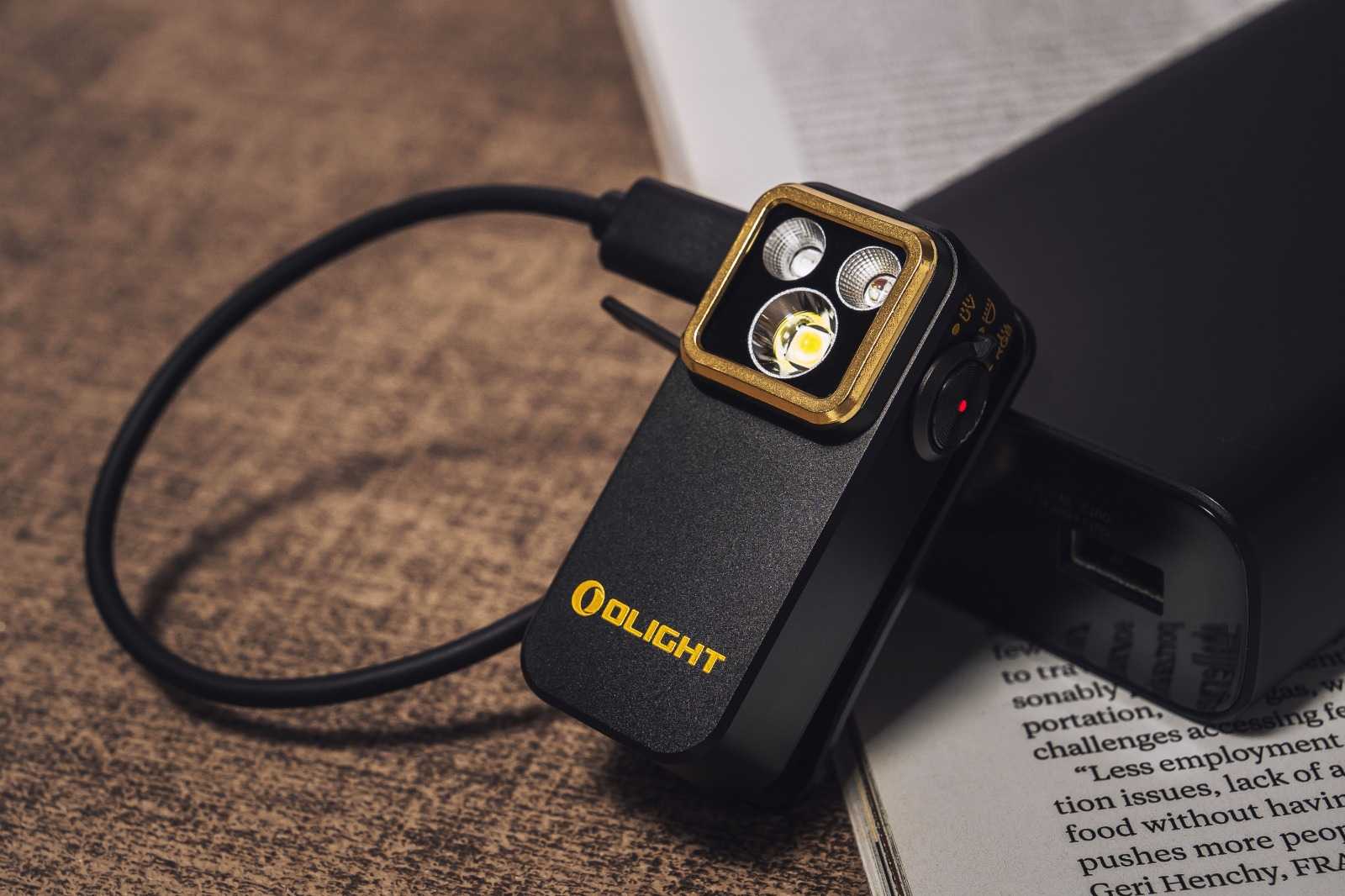
- Multi‑light systems: Models like the Oclip Pro S incorporate white, UV, and RGB LEDs in a compact form factor, requiring sophisticated optical isolation and thermal management to keep each emitter performing optimally.
3. Materials and Thermal Management
High‑output LEDs generate heat. How a flashlight manages that heat directly affects performance, safety, and longevity. Olight achieves this through:
- 6061 aluminum alloy bodies: This material is chosen for its excellent thermal conductivity, lightweight strength, and corrosion resistance.
- Precision machining: The fins, contours, and internal structures are CNC‑machined to maximize surface area for passive cooling.
- Intelligent thermal regulation: Built‑in sensors monitor temperature and gradually step down output when necessary, preventing overheating without abruptly cutting power.
This thermal engineering allows Olight to achieve high lumen outputs—sometimes over 4,000 lumens in models like the Marauder Mini—in packages small enough for pocket carry.
4. User Interface and Control Systems
Modern flashlights are essentially embedded systems. Olight’s UI reflects a deep understanding of how users interact with light in real‑world scenarios.
- Programmable switches: Many models use electronic side switches with tactile feedback, enabling instant access to Turbo, Moonlight, or strobe without cycling through all modes.
- Sensors and feedback: Proximity sensors in some models automatically lower brightness when the lens is near an object, preventing accidental burns or damage.
- Battery intelligence: Olight’s proprietary batteries integrate protection circuits and communicate with the flashlight to provide real‑time battery level indicators via LEDs or digital displays.
5. Battery Technology and Safety
The battery is the heart of any portable light. Olight’s approach includes:
- Custom‑formulated lithium‑ion cells: Designed specifically for high‑discharge applications, they balance capacity, current delivery, and safety.
- Multi‑layer protection: Over‑charge, over‑discharge, short‑circuit, and reverse‑polarity protection are built into both the battery and the flashlight circuitry.
- USB‑C integration: While Olight pioneered magnetic charging, newer models also embrace USB‑C, reflecting the brand’s responsiveness to evolving user habits.
6. Environmental Durability
From freezing mountain trails to humid jungle environments, Olight engineers for extremes.
- IPX8 waterproofing: Many models are rated for submersion beyond 1 meter, achieved through precision‑molded seals and o‑rings.
- Impact resistance: Aluminum construction, reinforced lens retainers, and internal potting of electronics allow Olight products to survive drops that would destroy lesser lights.
A Culture of Iteration
What distinguishes Olight’s technology is not any single feature, but the culture of continuous iteration. Each new model often incorporates lessons from user feedback, field testing, and component advancements. The result is a product lineup that evolves rapidly—improving runtime, reducing size, increasing output, and refining interfaces.
From the magnetic charging that makes daily use effortless, to the optical systems that turn raw LED output into useful beams, Olight’s technology serves a simple mission: deliver the right light, exactly when and how it’s needed.