
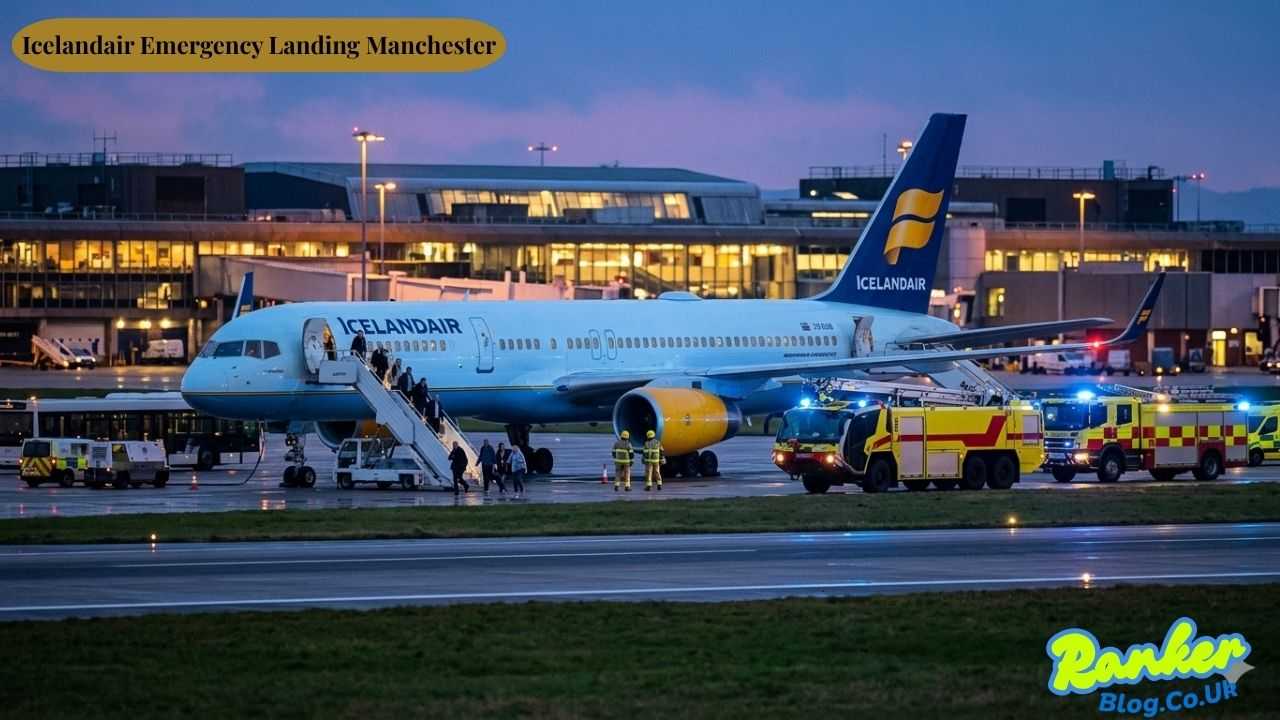
When emergency vehicles line the tarmac at Manchester Airport and fire trucks position themselves on either side of a runway, it’s the kind of scene that grabs attention fast — both for those on the ground and for anyone scanning aviation news. Over the past several years, Icelandair has been involved in more than one unscheduled incident at Manchester, and each time, the story has ended the same way: safely.
For travelers who fly with Icelandair, follow Icelandair flight status updates, or are simply curious about how one of Europe’s most reliable transatlantic carriers handles pressure situations, this article breaks it all down — from timelines to procedures to what it all means for the average passenger.
A Quick Look at Icelandair: Iceland’s Flag Carrier
Before diving into the incidents, it’s worth understanding who Icelandair is. Founded in 1937, Icelandair is Iceland’s national airline and a major player in transatlantic aviation. Operating from its hub at Keflavík International Airport near Reykjavík, the airline connects more than 31 European cities with 12 US cities and two Canadian hubs. The Icelandair fleet has evolved considerably over the decades and now includes Boeing 737 MAX 8 and MAX 9 aircraft, plus newer Airbus A321LR jets, with the aging Boeing 757 being gradually phased out.
Those traveling on Icelandair UK routes — particularly from London Heathrow and Manchester — will be familiar with the airline’s well-regarded stopover program, which allows passengers to spend up to seven days in Iceland at no extra airfare cost. It’s one of the many reasons Icelandair reviews from UK-based travelers tend to be quite positive.
But even the best airlines face emergencies. Here’s what happened — and how everyone handled it.
The Incidents: A Timeline of Icelandair Emergency Landings at Manchester
Flight FI5443 — June 20, 2025
The most recent and widely reported Icelandair emergency landing Manchester involved Flight FI5443, a Boeing 767-300ER (registration TF-ISW), a 27-year-old aircraft conducting a repositioning or ferry flight from Paris Charles de Gaulle to Keflavík. Notably, the flight was carrying no passengers at the time — it was an empty repositioning operation.
The flight departed Paris over five hours behind schedule. Roughly one hour after takeoff, the pilots declared a general emergency by squawking 7700 — the universal emergency transponder code used in aviation — and began descending near Liverpool due to a reported technical issue. The crew made the professional call to divert to Manchester Airport, landing on runway 23R, where fire trucks were waiting on the ground as a precaution.
After a thorough post-landing inspection, engineers confirmed that no serious fault had actually occurred. The precautionary measures had done exactly what they’re designed to do: ensure the aircraft landed safely, no matter what.
Flight FI424 — June 5, 2024
A year earlier, a more passenger-facing incident unfolded on Icelandair Flight FI424, operating from Reykjavík Keflavík to Manchester. With 178 passengers and 6 crew members on board, the pilot declared a “pan-pan” — aviation’s second-highest level of urgency, indicating a serious but not immediately life-threatening situation.
The suspected fault was linked to the aircraft’s landing gear deployment system, detected approximately 20 minutes before landing. Manchester Airport activated its emergency response plan (Code Yellow), deploying both fire and medical teams to the runway.
The landing was smooth. All 178 passengers and 6 crew disembarked without a single injury. It was a textbook example of well-trained pilots and ground crews working in sync.
Flight FI440 — February 2017
Going back further, Icelandair Flight FI440 from Keflavík, carrying 160 passengers, declared an emergency on approach to Manchester Airport — not because of a mechanical fault, but because the aircraft’s fuel levels had dropped low following two unsuccessful landing attempts. The emergency declaration was made to ensure the flight received priority landing clearance, which it did. Once again, all passengers were safe.
How the Emergencies Were Handled
The Cockpit Crew’s Response
In each of these incidents, the flight crews demonstrated exactly the kind of decision-making and adherence to procedure that makes aviation one of the safest forms of travel in the world. Whether it was squawking 7700 for a full general emergency or issuing a pan-pan call for an urgent but non-critical situation, pilots followed standard protocol using certified checklists for technical faults.
The choice to divert to Manchester rather than pressing on to the intended destination is never taken lightly — it reflects training, situational awareness, and an unwavering commitment to passenger safety.
Manchester Airport’s Emergency Response
Manchester Airport’s ground teams didn’t miss a beat. Upon receiving the emergency alert, fire crews were deployed, the runway was cleared, and emergency units were positioned on both sides of the landing zone as a precautionary measure. In the 2024 incident involving passengers, the airport activated its Code Yellow emergency response plan, bringing fire and medical teams to the field in real time.
It’s worth noting why Manchester is a go-to diversion airport in northern England. The airport operates 24-hour emergency response teams, has extensive runway capacity, and is strategically positioned to handle diversions from across the region. Carriers including easyJet, Air France, and British Airways have all diverted there at various points for similar reasons. The swift handling of each Icelandair diversion reflects a level of operational readiness that doesn’t happen by accident — it’s the result of consistent preparation during Europe’s increasingly busy travel seasons.
Post-Landing Procedures
After each landing, the process moved quickly. Aircraft were inspected by engineers on site. In passenger-carrying incidents, travelers were accommodated, rebooking options were arranged, and meal vouchers were provided where applicable. In the June 2025 repositioning flight case, engineers confirmed after a full check that there had not been a serious underlying fault.
Why Manchester Airport?
People sometimes wonder why aircraft divert to Manchester rather than other northern English airports. The answer comes down to infrastructure and capability.
Manchester is the UK’s third-busiest airport and one of the most equipped for handling emergency landings outside of London. Its 24/7 emergency response teams, long runways, and proximity to major transport links make it the natural choice for diversions in the north. The airport also has a strong track record of handling irregular operations calmly and professionally, which is exactly what pilots need when they’re making a split-second decision about where to land.
For Icelandair specifically, Manchester has long been a key destination on its Icelandair flights network, particularly for Icelandair UK passengers traveling between Iceland and northern England.
Is Icelandair a Good Airline? What Its Safety Record Shows
This is probably the question most travelers are asking after reading the headlines. So — is Icelandair a good airline?
When it comes to safety, the answer is yes. Icelandair has been operating since 1937 and is fully certified under European Union Aviation Safety Agency (EASA) regulations. The incidents at Manchester are not indicative of a dangerous airline — quite the opposite. Pilots declaring emergencies, following protocol, and landing safely is precisely what good safety culture looks like. Previous incidents in other locations — including a 2016 diversion in Seattle and a 2019 medical emergency near Winnipeg — all ended without serious harm.
These events show the opposite of danger. They demonstrate pilots making the right calls, following their training, and protecting everyone on board. The fact that no injuries have been recorded across any of these Manchester incidents is proof that aviation safety systems, when properly implemented, work.
Icelandair reviews from passengers and aviation observers consistently highlight the professionalism of its crew. The airline’s Saga Premium cabin — its business class offering — earns particularly strong marks for comfort and service on transatlantic routes.
What Passengers Should Know
How Common Are Emergency Landings?
Emergency landings are uncommon, but they are not as rare as many people assume. Airlines are required by regulation to declare emergencies even for precautionary reasons, which is why squawk 7700 is used far more often than it might sound from news coverage. The declaration itself does not mean a crash was imminent — it means the crew wanted priority access to runway and ground support, just in case.
What to Expect If It Happens on Your Flight
If passengers find themselves on a flight that declares an emergency, the crew will communicate clearly. Passengers should remain calm, listen to instructions, and trust the process — which, as these Icelandair incidents show, is designed to prioritize safety above all else.
Passenger Rights and Compensation
Under EU Regulation 261/2004, passengers are entitled to compensation for delays over three hours caused by circumstances within the airline’s control. Technical faults typically fall under the airline’s responsibility, though airlines may argue cases of extraordinary circumstances. Travelers are encouraged to check with Icelandair customer service directly if they experienced delays related to emergency diversions.
Icelandair check in processes and rebooking support are handled through the airline’s official website and app. Affected passengers can also reach the Icelandair customer service team to explore their options.
Carry-On and Baggage: What to Know Before You Fly
For those planning Icelandair flights, especially on Icelandair UK routes, it’s good to be prepared on the practicalities. The Icelandair carry on size limit for international flights is 55 x 40 x 20 cm (21.6 x 15.7 x 7.8 inches), with a maximum weight of 10 kg. All passengers — regardless of fare class — are permitted one carry-on bag plus one personal item.
Icelandair baggage allowance varies by fare type. Economy Light includes no checked bags, while Economy Standard includes one checked bag of up to 23 kg. Saga Premium passengers receive two checked bags, each up to 32 kg. For those flying Icelandair baggage-heavy with sports equipment or oversized items, booking online in advance can save roughly 20% compared to airport rates.
What Terminal Does Icelandair Use at Heathrow?
For UK passengers flying from London, Icelandair operates from Terminal 2 at London Heathrow Airport. Icelandair check in at Heathrow Terminal 2 is available both online (from 24 hours before departure) and at the airport desk. Saga Premium passengers can access Fast Track security as part of their fare.
Saga Premium: Flying Icelandair in Style
It would be incomplete to discuss Icelandair without mentioning what many consider the highlight of the travel experience — Saga Premium, the airline’s business class cabin, often referred to simply as Icelandair Saga Premium or Saga business class.
Rather than offering lie-flat beds like many full-service carriers, Icelandair business class features spacious recliner-style seats in a 2-2 configuration. The seats are more comparable to domestic first class in the US, with generous legroom, premium meals featuring Icelandic specialties, complimentary Wi-Fi, access to the Saga Lounge at Keflavík, and priority Icelandair check in across participating airports. On the newer Airbus A321LR aircraft, passengers also benefit from 16-inch 4K OLED screens and USB-C charging outlets.
Saga Premium is often priced closer to premium economy than traditional business class, making it an appealing option for transatlantic travelers who want a step up without paying full business class fares.
The Broader Aviation Context
The Icelandair incidents at Manchester don’t exist in isolation. They reflect a broader reality across European aviation: record passenger numbers, aging aircraft fleets, and an increasingly complex airspace are all putting pressure on the system. The 27-year-old Boeing 757 that forms part of the Icelandair fleet is one example of aging aircraft still in active service — though the airline is actively modernizing with A321LR deliveries and Boeing 737 MAX variants.
EASA continues to push for greater transparency and incident reporting across the industry, and airlines like Icelandair that follow proper emergency procedures — declaring emergencies early, diverting proactively, and cooperating fully with ground teams — are exactly the kind of carriers that reinforce public trust in air travel.
Conclusion
Multiple Icelandair emergency landings at Manchester Airport have made headlines, but the real story is one of aviation safety working as it should. Skilled crews, prepared ground teams, and a well-equipped airport came together each time to ensure passengers and crew returned home safely.
For anyone wondering whether Icelandair is a good airline — these incidents, handled professionally and without injury in every case, speak for themselves. The airline’s long history, EASA certification, expanding modern Icelandair fleet, and consistently capable crew make it a solid choice for transatlantic travel, whether passengers are flying Icelandair business class in Saga Premium or hopping across on a standard economy fare.
For the most up-to-date Icelandair flight status information, baggage guidance, and check-in support, travelers can visit the official Icelandair website or contact Icelandair customer service directly.
Frequently Asked Questions
What happened during the Icelandair emergency landing at Manchester?
There have been multiple incidents. In June 2025, an empty repositioning Boeing 767 declared a general emergency and diverted to Manchester after a technical issue; engineers later confirmed no serious fault. In June 2024, a passenger flight carrying 178 people declared a pan-pan due to a suspected landing gear issue and landed safely at Manchester.
Was anyone injured in the Icelandair Manchester incident?
No. In every recorded incident involving Icelandair at Manchester Airport, all passengers and crew disembarked safely with no injuries reported.
Why did Icelandair divert to Manchester Airport?
Manchester is a major, well-equipped airport in northern England with 24-hour emergency response teams, long runways, and strong operational infrastructure — making it an ideal diversion airport for flights in the region.
How does Manchester Airport handle emergency landings?
Manchester deploys fire and medical teams on alert, clears runways for priority landing, and activates its emergency response plan as needed. The airport’s Code Yellow protocol was activated during the June 2024 Icelandair passenger incident.
Is Icelandair a safe airline to fly with?
Yes. Icelandair has operated since 1937 and is certified under EASA regulations. Its emergency response in each Manchester incident demonstrates strong safety culture and well-trained crews.
Can passengers get compensation after an emergency landing?
Depending on the cause and delay duration, passengers may be entitled to compensation under EU Regulation 261/2004. Travelers should contact Icelandair customer service directly to discuss their specific situation.
Also Read: TUI Flight BY6754 Emergency Landing: What Really Happened After Takeoff from Cardiff