
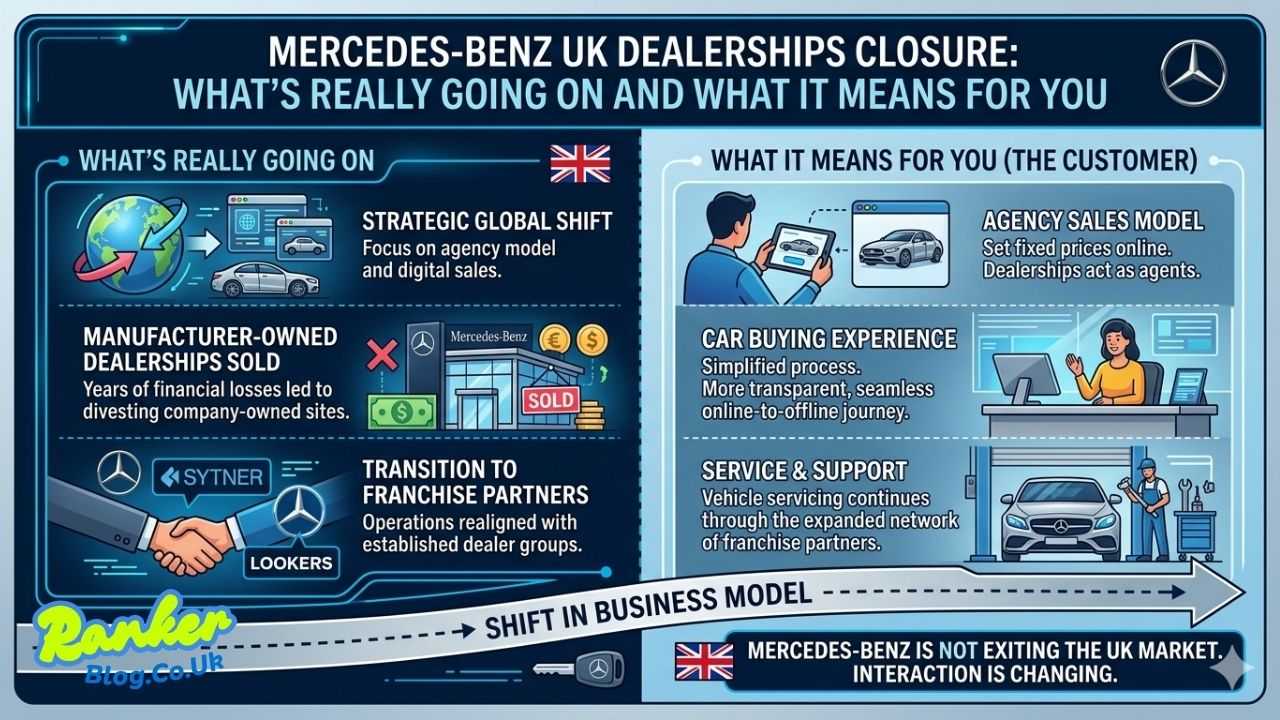
Mercedes-Benz has officially closed and sold off all its manufacturer-owned UK dealerships as part of a strategic global shift, impacting how cars are bought and serviced across the country. This move is linked to years of financial losses, a switch to the agency sales model, and a realignment of operations with franchise partners like Sytner and Lookers. While Mercedes-Benz is not exiting the UK market, the way you interact with the brand is changing significantly.
Why Did Mercedes-Benz Close Its UK Dealerships?
If you’ve recently gone looking for your local Mercedes showroom and found it no longer there, you’re not alone — and there are some very real, layered reasons behind what happened.
The short answer is this: Mercedes-Benz Retail Group ceases trading after years of mounting financial strain that made running a large, company-owned network of showrooms across Britain simply unsustainable. The pre-tax losses were significant — £35 million in 2019 and £20.9 million in 2020 — and while the losses narrowed to £3.66 million by 2023, the damage had been done. The group’s own director, Wolfgang Pipperger, confirmed publicly that the company had finalised the sale of its remaining dealerships, bringing an end to all trading activity.
But this wasn’t just about money. Broader forces were at play. Changing consumer habits played a major role — more and more UK car buyers were researching vehicles online, comparing prices digitally, and even completing purchases without ever walking through a showroom door. Traditional physical dealerships, with their high fixed overheads, heavy staffing costs, and large leased premises, were increasingly out of step with that behaviour.
On top of that, Mercedes-Benz Group AG had been steering toward a fundamental rethink of how it sells cars globally. The rise of electric vehicles (EVs) added another dimension — EVs require different servicing expertise and infrastructure than combustion engines, which made concentrated, better-equipped centres more practical than a sprawling network of mid-sized locations.
Put it all together, and the Mercedes-Benz retail group ceases trading story becomes one of the clearest examples of a luxury car brand adapting to the 21st century — whether customers are ready for it or not.
Which Mercedes-Benz Dealerships in the UK Have Closed So Far?
The closures didn’t happen overnight. They’ve unfolded over the past five or six years, starting with some of the brand’s most recognisable locations and gradually spreading to regional towns across England.
The process began as early as 2020, when sites in Bromley, Caterham, and Chelsea were shut. London might seem like one of the last places you’d expect a luxury car brand to give up retail space — and as one long-time dealer famously put it, “If you can’t make money selling Mercs in Chelsea, where can you make money?” But those closures turned out to be the beginning of a wave rather than a blip.
In 2022, five North London dealerships — including the Mercedes Temple Fortune location, Colindale, Loughton, Stratford, and Watford — were transferred to Sytner Group, marking a shift from closure to consolidation.
Car dealership closures continued regionally. Among the most symbolic losses was the mercedes cleveland area’s regional footprint shifting, while sites in mercedes benz ulverston (South Lakes, Cumbria) and Weston-super-Mare also shut their doors in early 2025. The wakefield mercedes presence in Yorkshire also felt the effects of the wider network squeeze.
The closure that carried the most emotional weight, however, was the Bradford dealership — a site operational since 1953 and one of the very first Mercedes-Benz distributors in the UK. Operated by Stratstone, it ceased trading on 31 October 2024 after 70 years of service. Regional media covered it widely, and former customers and staff alike mourned what felt like the end of a local institution.
Other notable car dealers closed during this period include Walsall (with operations redirected to an expanded Wolverhampton site under Lookers) and Loughborough, which closed on 30 April 2025.
Car dealerships closing across the network has been far from uniform — some locations were permanently shut, others were sold to new operators and continued serving customers under different management. But the net effect is the same: far fewer Mercedes-Benz Retail Group-owned outlets exist in the UK today. None, in fact.
What Is the Mercedes-Benz Agency Model and How Does It Work?
If you haven’t encountered the term “agency model” before, it can sound a little corporate and abstract. But the idea is actually quite simple — and once you understand it, the dealership changes make a lot more sense.
Under the traditional mercedes dealer locator uk franchise system, dealerships would buy cars from Mercedes-Benz at a wholesale price and then sell them to customers, setting their own retail prices and offering whatever discounts they saw fit. This meant prices could vary quite a bit depending on where you bought your car and how good a negotiator you were.
The agency model flips that arrangement entirely. Under the new framework — launched in the UK in January 2023 — Mercedes-Benz retains ownership of the vehicles. It sets a fixed, nationally consistent price for every car. Franchise partner retailers (now called “agents”) facilitate the actual transaction and handover, earning a set commission from Mercedes-Benz rather than profiting from a markup.
What this means for you as a buyer is simpler, more transparent pricing. Whether you walk into a showroom in Guildford or buy online from your sofa, you’ll pay the same price for the same car. No more haggling, no more price shopping between dealers.
The agency model had already been trialled in Sweden, Austria, South Africa, and India before arriving in the UK, and by 2025, Mercedes-Benz UK had delivered its 100,000th private retail sale under the model — with the milestone car being a Mercedes-AMG E 53 Hybrid collected from a Sandown Motors site in Guildford.
The results under the model have been notable. New car registrations have grown 20% year-on-year, with private retail sales up 29%. Customer satisfaction sits at an average of 4.85 out of 5 stars — a figure Sally Dennis, Mercedes-Benz UK’s Sales and Marketing Director, has cited as evidence that buyers have embraced the new approach. From a dealer perspective, franchise director Keith Caddick at Lookers noted that “gross profit has increased and our costs have decreased” under the model.
Who Now Operates Mercedes-Benz Sales in the UK?
With the manufacturer-owned retail group gone, the brand’s UK presence is now entirely in the hands of authorised franchise partners. Several major groups have stepped in — and in some cases, actively expanded — to fill that gap.
Role of Sytner Group, Sandown Motors, Lookers, and Marshall
Sytner Group has become the largest Mercedes-Benz retail partner in the UK, operating 14 franchised locations after taking on five key North London sites from the Retail Group back in 2022. In addition to full sales operations, Sytner also runs aftersales centres at Heathrow, Wandsworth, and Stratford.
Sandown Motors picked up the Epsom dealership in 2021, extending its South East England footprint. Gavin McAllister, Sandown’s Group Managing Director and head of the Mercedes-Benz Retailer Board, was notably upbeat about the agency model, calling it “a game-changer for the Mercedes-Benz network.”
Lookers continues to operate a number of Mercedes-Benz dealerships across the UK, though it has also made some rationalisations — including the Walsall site, whose operations were consolidated into Wolverhampton. Neil Williamson of Lithia UK (Lookers’ parent company) has spoken positively about Mercedes-Benz’s collaborative approach during the transition.
Marshall Motor Group previously ran multiple Mercedes-Benz outlets, including in Cumbria (South Lakes), though that site closed in early 2025 with customers redirected to nearby branches.
Other partners involved in the network include LSH Auto UK, L&L Automotive, Hedin, and Eastern Western Motor Group.
Which Dealerships Were Sold or Transferred?
The sell-off was systematic. L&L Automotive acquired the peterborough mercedes benz dealer area site at Hemel Hempstead as early as July 2021. Sandown Motors followed with Epsom later that year. The five North London dealerships — including Temple Fortune and Stratford — went to Sytner in 2022. Later, sites in mercedes aylesbury and surrounding areas were realigned under partner management, while Stratstone (before its own restructuring post-Lithia acquisition) closed the historic drayton mercedes benz stoke area and Bradford locations.
The inchcape mercedes benz derby connection is also worth noting for Midlands customers: Inchcape operated Mercedes-Benz retail in the Derby area and, while the wider group underwent its own ownership changes, the local dealership structure for that region evolved accordingly.
Mercedes-Benz World and Remaining Sites
Not everything has shut down. Mercedes-Benz World in Weybridge, Surrey — the brand’s iconic experiential centre — remains open. Sites at Croydon and Dartford are also still operational. For aftersales and servicing, many former Mercedes-Benz Retail Group sites continue to offer support under new ownership.
How Does This Closure Impact You as a Car Buyer?
Whether you’re an existing Mercedes-Benz owner or someone who was planning to buy one, these changes are worth understanding practically — not just conceptually.
If you’re an existing owner, the most important thing to know is that servicing, warranty work, and genuine parts remain available through authorised service centres operated by the franchise partners. The brand hasn’t abandoned its customer base — it’s redirected it. That said, some regions have seen their nearest authorised centre move further away, which can mean longer journeys for routine work.
For buyers, the shift to the agency model means no negotiating on price — but also no surprises or inconsistencies depending on where you shop. Pricing is set nationally by Mercedes-Benz, and it applies equally whether you buy online or in a showroom.
The reading mercedes dealer situation reflects what many buyers across England’s market towns have experienced: the nearest authorised point may have changed, and it pays to double-check using the updated mercedes dealer locator uk tool on the official Mercedes-Benz UK website.
If you’re looking at a used vehicle, it’s worth noting that the used car market still operates through franchised partner sites and independent traders. Used pricing is not governed by the agency model in the same way, so there’s still some room for variation there.
Will Car Prices and Offers Be Affected by the Agency Model?
One of the most common questions buyers have is whether cars will end up costing more or less under the new system.
The honest answer is: it depends on how you used to buy.
If you were the type of buyer who walked into a dealership, spent an afternoon negotiating, and drove away with a 15% discount, the agency model may feel less financially favourable. Those days of retail-level discounting are largely gone under the new framework.
However, for buyers who found the old negotiation process stressful or intimidating — or who weren’t confident they were getting a fair deal — the transparent, fixed-price model may actually feel like a relief. Everyone pays the same. There’s no advantage to being a shrewd haggler, and no disadvantage to being a first-time buyer.
Mercedes-Benz also frequently updates the offers available through agents, so promotional deals and finance packages do still exist — they’re just presented the same way to every customer, across every channel.
There are also signs the market has responded reasonably well. With new car registrations growing 20% year-on-year and private retail sales up 29%, the numbers suggest buyers have adapted to the new model more smoothly than some predicted when it launched in 2023.
What’s Next for the UK Luxury Car Market After These Closures?
The Mercedes-Benz story isn’t happening in a vacuum. It’s a signal of where the broader UK automotive retail industry is heading — and other brands are watching closely.
BMW and Audi are both exploring agency-style approaches of their own. Volkswagen Group has already begun transitioning EV model sales to an agency framework, and Mini was expected to follow. Even brands that initially rejected the agency model have revisited their position as digital buying habits have accelerated.
The shift also mirrors what’s happened in other retail sectors. The economics of running a large physical estate — high rents, large staff costs, fluctuating footfall — have become harder to justify when so much of the purchase decision-making happens online anyway.
For the mercedes benz ulverston community and others in smaller towns who lost nearby access to a Mercedes dealership, the practical impact is real and not trivial. Travelling further for servicing is an inconvenience at minimum. But hub-style dealerships with better EV infrastructure, broader technician training, and more consistent stock are arguably a better fit for where the market is going.
The EV dimension is particularly important. Electric vehicles require fundamentally different servicing knowledge and charging infrastructure. Concentrating those capabilities in fewer, better-equipped centres makes more logistical and financial sense than trying to replicate them across dozens of mid-sized sites.
Looking ahead, the UK luxury car market is likely to be shaped by three things: digital-first buying journeys, electrification of the fleet, and consolidated, premium physical experiences at flagship sites rather than broad regional coverage. Mercedes-Benz’s restructuring has, in many ways, just moved faster down that road than its competitor
Where Can You Find a Mercedes-Benz Dealership in 2026?
With so many car dealerships closing over the past few years, it’s understandable if you’re not sure where to turn. Here’s a practical guide to finding Mercedes-Benz sales and service support in 2026.
The best starting point is always the official Mercedes-Benz UK website. The dealer locator tool is updated in real time as the network changes, and it will show you authorised sales agents and service centres by postcode. Whether you’re in reading looking for your reading mercedes dealer, searching for a mercedes benz derby centre through the Inchcape network, or hoping to find the nearest alternative to the now-closed mercedes aylesbury site, the official locator is the most reliable place to start.
Here are some key franchise partners with broad UK coverage:
- Sytner Group — 14 Mercedes-Benz locations, concentrated in London and the South East
- Sandown Motors — Strong presence in Surrey and surrounding areas
- Lookers (Lithia UK) — Regional coverage including the North and Midlands
- LSH Auto UK — Significant presence in the Midlands and North West
- Eastern Western Motor Group — Coverage in Scotland and Northern England
- L&L Automotive — South East locations including former MBRG sites
If you’re buying new, you can also configure and reserve a vehicle entirely online via Mercedes-Benz’s digital platform, with the local agent handling delivery and handover. For aftersales, always call ahead to confirm service availability, particularly if your nearest location has changed hands recently.
Mercedes-Benz World in Weybridge remains one of the brand’s most distinctive experiences in the UK — part showroom, part driving experience centre. If you’ve never visited, it’s well worth a trip, particularly if you’re exploring the electric model range.
Conclusion
The Mercedes-Benz UK dealerships closure story is a big one — but it’s also a nuanced one. This isn’t a brand retreating from Britain. It’s a brand fundamentally reorganising how it engages with British car buyers.
The Mercedes-Benz Retail Group’s exit from direct retail is the result of sustained financial losses, a strategic pivot toward digital and agency-based selling, and the broader global push to make the business more efficient and EV-ready. For the communities and employees who lost local dealerships — from drayton mercedes benz stoke to Bradford to Walsall — the impact has been real and, in some cases, difficult.
But for buyers who engage with the brand going forward, the agency model promises something the old system never could: true price consistency, a seamless digital-to-physical buying journey, and a network of well-capitalised partners focused on quality over quantity.
The UK luxury car market will continue to evolve, and Mercedes-Benz has placed its bets clearly. The question now is how long it takes the rest of the market to catch up
Frequently Asked Questions
Has Mercedes-Benz left the UK market?
No. Mercedes-Benz remains fully active in the UK through a network of authorised franchise partners including Sytner, Sandown Motors, Lookers, and others. Only the manufacturer-owned Mercedes-Benz Retail Group has ceased trading.
Can I still get my Mercedes serviced in the UK?
Yes. Authorised service centres continue to operate across the country through franchise partners. Use the official Mercedes-Benz UK dealer locator to find your nearest centre.
Why did so many Mercedes dealerships close?
A combination of sustained financial losses within the Retail Group, changing buyer habits, rising operational costs, and a global strategic shift toward the agency model all contributed to the closures.
What is the agency model and how does it affect me as a buyer?
Under the agency model, Mercedes-Benz sets nationally consistent, fixed prices for new vehicles. You can buy online or through a showroom and pay the same price either way. Partner dealers facilitate the sale and handover, earning a commission from Mercedes-Benz.
Are used Mercedes-Benz cars still available through dealers?
Yes. Used vehicles continue to be sold through franchised partner sites and independent authorised dealers. The fixed-price agency model applies to new cars only.
Which areas have been most affected by the closures?
Regionally, areas including Bradford, Cumbria (South Lakes/Ulverston), Weston-super-Mare, Walsall, and Loughborough have seen permanent closures. London and the South East saw more consolidation under groups like Sytner rather than outright closures.
Is the Mercedes-Benz agency model working?
According to official figures, yes — new car registrations grew 20% year-on-year after the model’s launch, private retail sales rose 29%, and customer satisfaction averaged 4.85 out of 5 stars. Over 100,000 private retail sales had been completed under the model by early 2025.
Also Read: Tevva Motors: Rise and Fall of a British Electric Truck Pioneer