
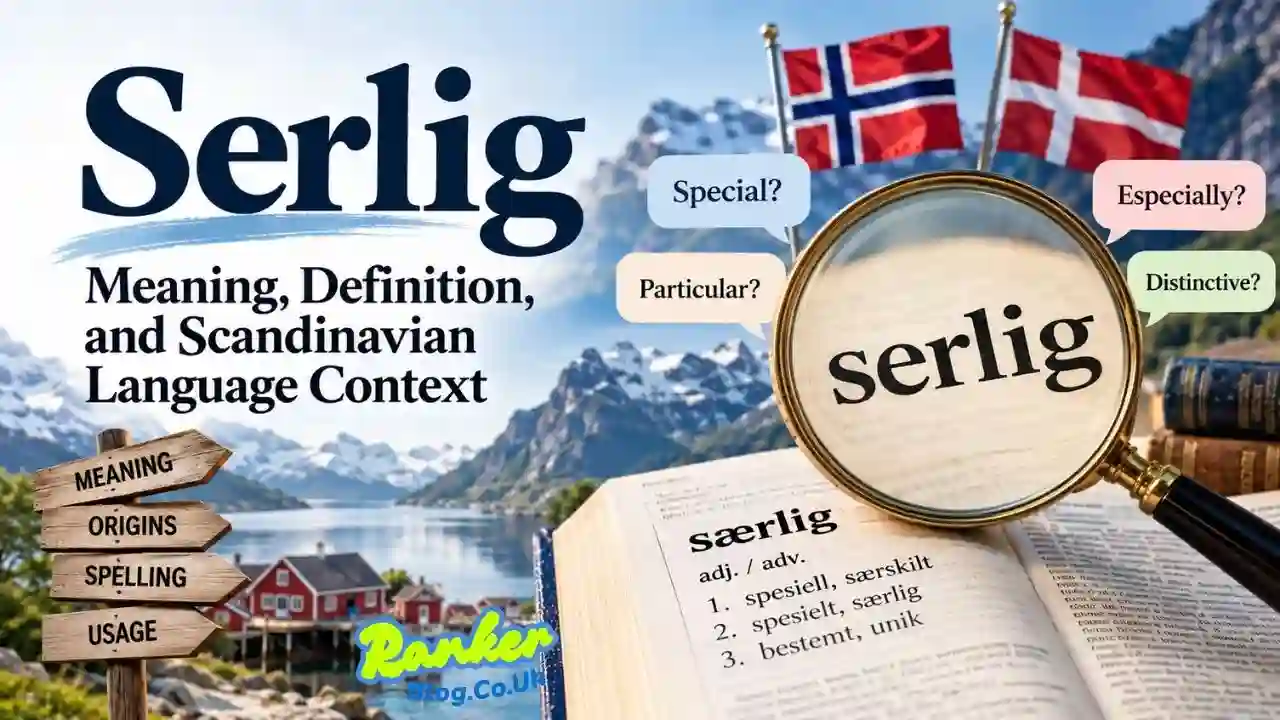
When people search for serlig, they may be expecting a simple definition, but the term is more complicated than it first appears. The strongest documented linguistic connection is to the Scandinavian word særlig, used in Norwegian and Danish to mean something special, distinctive, particular, or especially relevant. At the same time, “serlig” has appeared online in different contexts, including as a name or label, so the exact meaning can depend on where you encountered it.
That distinction matters because not every page that uses the word gives it the same definition. Some online articles treat Serlig as a modern concept or digital platform, while linguistic sources provide a much clearer and established explanation for særlig.
What Is Serlig?
Serlig is best understood as a term whose meaning depends on context, with its strongest documented linguistic connection being the Scandinavian word “særlig.”
The official Norwegian Bokmålsordboka lists særlig as a word meaning something that is outside the ordinary, special, or particular. It can also work as an adverb to emphasize something, similar to “especially” or “particularly” in English.
The Danish dictionary Den Danske Ordbog gives closely related meanings. It defines særlig in contexts involving something that differs from the usual, has distinctive characteristics, or is especially relevant in a particular situation. It also records the word’s Old Norse origin as sérligr.
This makes the relationship between serlig and særlig important when trying to understand what someone means by the shorter spelling.
What Does Serlig Mean?
There is no single English definition that can be safely assigned to every occurrence of serlig.
In a language-related context, the closest established reference is særlig. Depending on the sentence, that word can communicate ideas such as:
- Special
- Particular
- Especially
- Particularly
- Distinctive
- Outside the ordinary
- Specifically relevant
The Norwegian dictionary gives examples where særlig describes something unusual or special, and also examples where it is used to emphasize one thing over others.
For example, the Norwegian phrase “i særlige tilfeller” refers to special or particular cases. In another grammatical use, særlig can emphasize something, much like the English word “especially.”
So when you see the spelling serlig, the surrounding sentence is essential. Without context, translating it into one fixed English word can be misleading.
Is Serlig a Correct Scandinavian Spelling?
This is where the distinction becomes especially important.
The standard Norwegian spelling documented by Bokmålsordboka is særlig, not “serlig.” The dictionary records the word with the letter æ and traces its origin to the Old Norse sérligr.
The same general spelling appears in the Danish dictionary, which also records særlig and gives its historical origin as Old Norse sérligr.
That means serlig should not automatically be treated as the standard Norwegian or Danish spelling of the word.
It may appear online because of simplified typing, missing special characters, transliteration, branding, usernames, domain names, or people searching for the term without knowing the original spelling.
This is one reason search results for “serlig” can look inconsistent.
Serlig vs. Særlig: What Is the Difference?
The simplest way to understand the distinction is to separate the spelling from the documented word.
| Term | What it represents | Typical meaning |
|---|---|---|
| særlig | Established Scandinavian word | Special, particular, especially |
| serlig | Simplified or alternative online spelling in some contexts | Meaning depends on context; often associated with særlig |
| Serlig | Capitalized form that may be used as a name or label | Could refer to a specific website, project, or brand |
The official dictionaries clearly document særlig. They do not establish “serlig” as an alternative standard spelling in the same way.
Therefore, someone researching the meaning of serlig should check whether the intended word is actually særlig before assuming that every search result refers to the same thing.
Where Does the Word Særlig Come From?
The historical background gives another useful clue.
Bokmålsordboka identifies the origin of særlig as the Old Norse word sérligr. The Danish dictionary gives the same Old Norse origin and connects the word to sær.
That history helps explain why the modern Scandinavian meaning centers around ideas such as being distinct, separate, unusual, or worthy of particular attention.
Language naturally changes over time. Words can preserve older roots while developing several related uses in modern speech and writing. Særlig is a good example because it can describe something as special while also functioning as an adverb meaning especially or particularly.
How Is Særlig Used in Norwegian?
Norwegian provides some of the clearest examples of the word’s practical meaning.
According to Bokmålsordboka, særlig can be used as an adjective for something outside the ordinary or specifically special. It can also be used as an adverb.
Consider these general patterns:
Special or particular meaning:
A person may refer to “special cases,” where særlig describes circumstances that are different from ordinary situations.
Emphasis:
A sentence may use særlig to draw extra attention to one location, group, situation, or characteristic.
Degree or emphasis:
It can also help convey the idea of “especially” or “particularly,” depending on the sentence.
This makes the word more flexible than a single English translation suggests.
How Is Særlig Used in Danish?
Danish usage follows a similar pattern.
Den Danske Ordbog explains that særlig can describe something that differs from what is usual or expected. It can also describe something with distinctive characteristics or something that is particularly relevant within a specific context.
The dictionary also records adverbial use, where særlig helps emphasize the part of a statement that deserves particular attention.
This is useful for English-speaking readers because it shows why “special” is not always the only appropriate translation. In some sentences, especially, particularly, or specifically may communicate the intended meaning more naturally.
Why Are People Searching for Serlig?
Search intent around an unusual term can come from several directions.
Someone may have encountered serlig in a sentence and want a translation. Another person may have seen the word on a website, social media post, username, product page, or branding project.
There is also evidence that recent websites are using “Serlig” as a standalone label for concepts or digital platforms. For example, one website presents Serlig as a digital environment for bloggers, creators, and communities, while other sites describe the term as a broader modern concept. These uses should be treated as site-specific interpretations, rather than as established dictionary definitions.
This explains why a search for the same keyword can return apparently conflicting answers.
Is Serlig a Brand, Website, or Platform?
It can be used that way online, but context is essential.
There are current websites using Serlig as a name or identity. One example presents “Serlig” as a digital platform combining publishing, community features, and creator-focused interaction.
However, the existence of a website using the name does not establish that the word itself universally means “digital platform.”
This is an important distinction for readers researching unfamiliar keywords. A brand name can have a meaning created by its owner, while a dictionary word has an established linguistic meaning supported by language references.
For that reason, “Serlig” as a website or brand should be researched separately from “særlig” as a Scandinavian word.
Why Search Results About Serlig Can Be Confusing
The confusion largely comes from the fact that the same spelling can be interpreted in different ways.
| Search context | What the user may actually want |
|---|---|
| “serlig meaning” | Definition or translation |
| “serlig pronunciation” | How the word is pronounced |
| “serlig Norwegian” | Information about særlig |
| “serlig Danish” | Danish-language meaning |
| “Serlig website” | A specific website or brand |
| “Serlig platform” | A particular online service |
| “Serlig origin” | Linguistic or historical background |
A useful article therefore needs to distinguish linguistic meaning from online branding rather than presenting all uses as one established definition.
How Do You Pronounce Særlig?
Pronunciation is another reason someone might search for the simplified spelling “serlig.”
The Danish dictionary provides a pronunciation for særlig, while the Norwegian dictionary identifies it as the standard written form used in Norwegian.
English speakers may find the sound unfamiliar because the Scandinavian æ does not correspond neatly to a single English vowel.
Rather than relying on an English approximation, it is better to use a native-language pronunciation reference when learning the word.
Can Serlig Be Used in English?
Yes, someone can use “Serlig” in English as a name, username, website name, project title, or other coined expression.
That is different from saying that “serlig” is a standard English vocabulary word.
When a foreign-language word enters an English-language environment, its use can expand beyond its original meaning. Brand names, usernames, domain names, and creative projects frequently do this.
Therefore, an English-language search result containing “Serlig” does not automatically establish a new dictionary definition for the term.
Is Serlig the Same as “Special”?
Not always, although special is one of the useful English translations of the related word særlig.
The official Norwegian dictionary explains særlig as something outside the ordinary and gives “særskilt” and “spesiell” as related descriptions.
The Danish dictionary similarly associates særlig with something that differs from the usual and lists speciel as a synonym.
The better approach is to translate the word according to the sentence.
In one context, “special” may work perfectly. In another, “especially,” “particularly,” “specific,” or “distinctive” may be more accurate.
Common Misunderstandings About Serlig
Assuming Serlig Has Only One Meaning
This is probably the biggest mistake.
Because the term appears in different online contexts, assuming one universal definition can lead to an inaccurate explanation.
Treating Serlig and Særlig as Identical Spellings
They should not be treated as identical simply because they look and sound related.
Særlig is the documented Norwegian and Danish form.
Assuming Every Serlig Website Uses the Same Concept
Online uses are not automatically connected.
A website, brand, or project can independently choose the name “Serlig,” so its definition may have little to do with the Scandinavian word.
Ignoring the Context
The sentence, website, language, and surrounding words can change what the user actually means by “serlig.”
What Should You Check When You Encounter Serlig Online?
A few simple checks can make the term much easier to understand.
First, look at the language of the surrounding text. If the content is Norwegian or Danish, the intended word may be særlig.
Next, check whether Serlig is capitalized. Capitalization can be a useful clue that the term is being used as a proper name, company name, website name, or product name.
Then examine the source itself. A dictionary entry, a brand website, and a blog article do not carry the same type of authority.
Finally, look at the complete sentence instead of translating the keyword by itself.
Why Context Matters More Than Ever
Modern search engines bring together information from dictionaries, businesses, blogs, social media, websites, and user-generated content.
That can be helpful, but it can also make an unfamiliar term appear more established than it really is.
With serlig, the distinction is especially useful. Official language sources provide evidence for særlig, while recent online pages demonstrate that “Serlig” is also being used as a standalone name or concept. Those are two different kinds of evidence and should not be treated as interchangeable.
For readers, the safest method is simple: identify the language, identify the source, and then interpret the term in its immediate context.
Frequently Asked Questions About Serlig
What does serlig mean?
Serlig does not have one universally established English meaning. Its strongest documented linguistic connection is to the Scandinavian word særlig, which can mean special, particular, especially, or something outside the ordinary.
Is serlig a Norwegian word?
The standard Norwegian form documented by Bokmålsordboka is særlig, not “serlig.” Særlig can mean something special or outside the ordinary and can also be used to mean especially or particularly.
Is serlig Danish?
Danish dictionaries document særlig as the established form. The word can describe something that differs from the usual or has distinctive characteristics, and it can also be used adverbially.
Is Serlig a website or digital platform?
Some current websites use Serlig as the name of a digital platform or online concept. Those descriptions are specific to the individual sites and should not be confused with the established dictionary meaning of the Scandinavian word særlig.
What is the English translation of særlig?
Depending on the sentence, særlig can be translated as “special,” “particular,” “especially,” “particularly,” or “distinctive.” The correct translation depends on whether it is functioning as an adjective or adverb and on the surrounding context.
Final Thoughts on Serlig
The keyword serlig looks simple, but its online use deserves a little care. The clearest linguistic evidence points to særlig, an established Norwegian and Danish word meaning special, particular, distinctive, or especially relevant. Its historical origin is documented as Old Norse sérligr.
At the same time, modern websites use “Serlig” as a standalone name for different projects and online concepts. That means the right interpretation depends heavily on where you find the term.
For anyone researching serlig meaning, the best starting point is to check the language and context before choosing a translation. Once you make that distinction, the term becomes much easier to understand.
CTA: Encountered “serlig” somewhere online? Check the surrounding text, identify the source, and compare it with the documented meaning of særlig before drawing a conclusion.
Also Read: Whatutalkingboutwillis Gifts: 25 Creative Ideas for Nostalgic Fans in 2025