
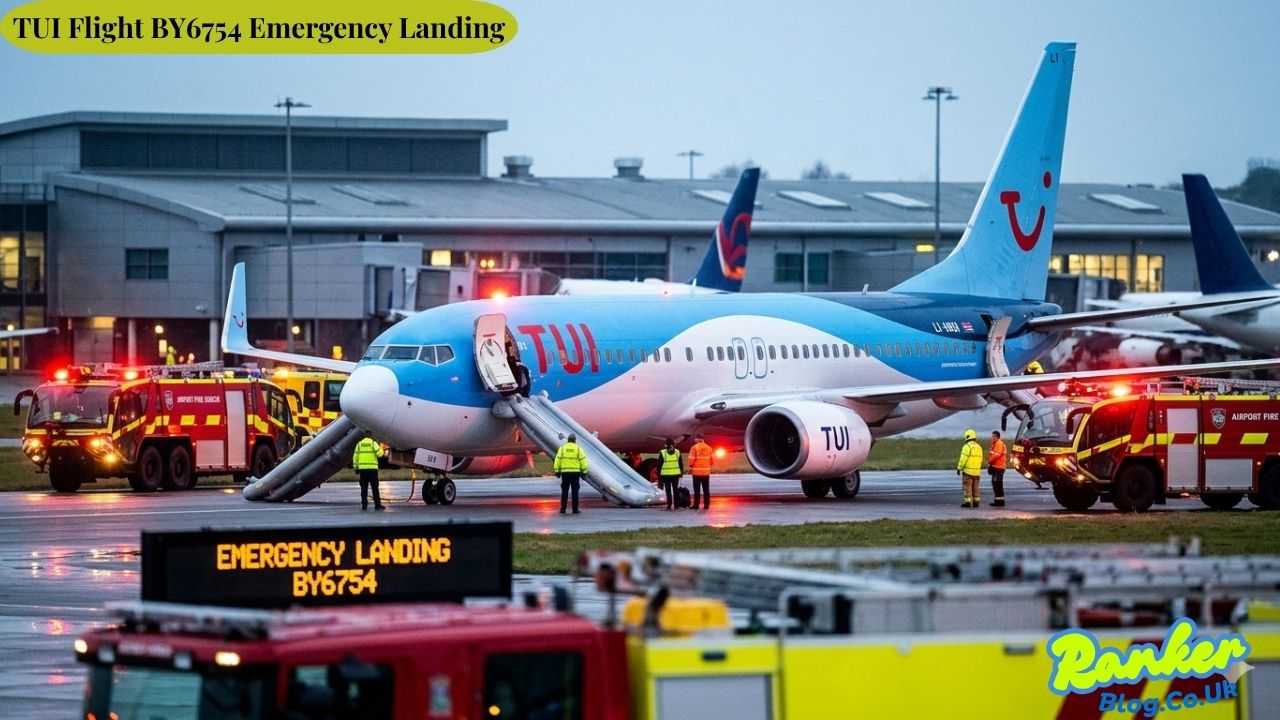
Introduction: When a Holiday Flight Becomes an Emergency
It was supposed to be the beginning of a relaxing holiday. Passengers aboard TUI flight BY6754 had buckled in, stowed their bags, and were ready to head to the sunny shores of Pafos, Cyprus. But within minutes of leaving Cardiff Airport on September 28, 2025, that routine departure turned into something far more stressful — and very few people onboard had any idea what was really happening.
TUI Airways flight BY6754 was forced to declare an emergency shortly after takeoff, setting off a chain of quick decisions, coordinated responses, and ultimately, a safe outcome that aviation professionals would later describe as a textbook emergency procedure.
This story matters — not just to the passengers who lived through it, but to anyone who flies, works in aviation, or simply wants to understand how modern air travel handles the unexpected. Whether you’re a frequent traveller, an aviation enthusiast, or someone researching flight safety, this breakdown covers everything you need to know about the TUI emergency landing that had an entire airport holding its breath.
Flight Overview and Background
The Route, the Aircraft, and the Airline
TUI Airways flight BY6754 — also recorded under the flight number TOM 6754 — was operating a scheduled passenger service from Cardiff Airport (CWL) to Pafos International Airport in Cyprus. It’s a popular holiday route, the kind that carries families, couples, and solo travelers off for a week or two of Mediterranean sunshine.
The aircraft assigned to the flight was a Boeing 737-800, a narrow-body workhorse that TUI and dozens of other carriers rely on for short-to-medium haul routes across Europe. TUI Airways, the UK arm of the global TUI Group, operates one of the largest leisure airline networks in the country and carries millions of passengers each year.
On this particular Sunday, the plane was scheduled to depart in the afternoon. The incident began unfolding at around 4:30 PM local time — a detail that would later matter, given the fuel decisions the crew had to make before landing.
What Happened: The Incident Unfolds
A Problem in the Skies Above Cardiff
Not long after the Boeing 737-800 lifted off from Cardiff Airport, the flight crew noticed something was wrong. Pilots stopped the aircraft’s climb and began circling west of Cardiff Airport before formally declaring an emergency with air traffic control.
In the tense minutes that followed, the plane circled Swansea Bay at approximately 3,000 feet. It was an unusual sight — a commercial jet looping over the Welsh coastline rather than continuing its climb toward cruising altitude. Onboard, passengers reportedly had little clarity about what was happening or why the plane appeared to be going in circles.
Eventually, the aircraft climbed back up to approximately 12,000 feet and began heading toward the West Midlands. It was not going to Cyprus that day.
The Bird Strike Clarification
Initial speculation in the immediate aftermath suggested there may have been an engine failure. However, TUI Airways later clarified what had actually happened: the plane had suffered a bird strike shortly after takeoff from Cardiff. The airline confirmed there had been no engine failure — a crucial distinction that helps explain how the situation was managed safely and without immediate catastrophic risk.
Bird strikes are more common than most passengers realize, and while they can cause serious damage — particularly to engines — a skilled crew can assess the impact and take controlled action, which is precisely what happened here.
The TUI Emergency Landing at Birmingham Airport
Diversion Decision and ATC Coordination
Once the crew declared an emergency, air traffic control began coordinating the aircraft’s path toward a diversion airport. Birmingham Airport, located in the West Midlands, was selected as the destination for the precautionary landing.
Before touching down, the pilots carried out a series of orbits in the skies above the region. This wasn’t indecision — it was procedure. The aircraft needed to burn fuel to reduce its landing weight to a safe level, since planes are generally heavier at takeoff than they’re designed to land. Those extra orbits were a deliberate, calculated step.
The TUI emergency landing at Birmingham Airport took place at 17:29 BST — just 29 minutes after the emergency had been officially declared. That’s a remarkably swift turnaround from declaration to wheels-down.
Runway 33 and the Emergency Response
The aircraft was cleared to land on runway 33 at Birmingham Airport. As it touched down, emergency services were already in position. Four fire appliances and several emergency response vehicles had been deployed to the runway in anticipation of the landing — standard protocol when an aircraft declares an emergency mid-flight.
After landing safely, the plane taxied toward the terminal, arriving at the gate at approximately 5:40 PM. Birmingham Airport suspended its operations for around 30 minutes to accommodate the emergency, a disruption that affected other flights but reflected exactly the kind of safety-first prioritization that aviation authorities demand.
Passenger Experience: Shock, Confusion, and Relief
What It Was Like Onboard
For the passengers on TUI flight BY6754, the experience was understandably unsettling. Reports emerging after the incident described people feeling shocked and confused, with many unsure why the plane was circling, why it appeared to be flying over Wales rather than heading southeast toward the Mediterranean, and ultimately, why they were landing in Birmingham instead of Pafos.
At one point during the diversion, passengers could reportedly see landmarks below them — including the vast Tata Steel complex at Port Talbot — which only added to the disorientation. For holidaymakers expecting to arrive in Cyprus, passing over a steelworks in South Wales was not part of the plan.
Safe Disembarkation and Onward Travel
Once the plane landed at Birmingham, passengers and crew were safely disembarked. There were no injuries reported — a testament to the professionalism of the flight crew and the coordinated ground response.
Passengers were subsequently expected to continue their journey to Cyprus on an alternative TUI flight, meaning that while their holiday was delayed, it wasn’t cancelled. For most, the emergency landing turned into a lengthy inconvenience rather than a ruined trip.
Aviation Safety Protocols in Action
The Crew’s Response: By the Book
What stands out most about the TUI BY6754 incident is how smoothly the crew executed emergency procedures under pressure. From the moment the bird strike was detected, the pilots followed the kind of methodical, trained response that aviation safety systems are built around.
They stopped the climb, assessed the situation, communicated with air traffic control, decided on a diversion airport, carried out fuel-burn orbits, and landed safely within 30 minutes of declaring the emergency. Every step was exactly what training demands.
Birmingham Airport’s Emergency Readiness
Birmingham Airport’s response to the TUI emergency landing was equally commendable. Four fire engines and multiple emergency vehicles were on standby well before the aircraft touched down. Air traffic controllers cleared the runway and managed surrounding traffic to ensure a smooth path to landing.
The airport suspended its operations for approximately 30 minutes — a decision that inconvenienced other travelers but was entirely appropriate given the circumstances. It’s the kind of coordinated, no-hesitation response that modern airport emergency planning is designed to produce.
Bird Strikes: A Growing Aviation Threat
What Exactly Is a Bird Strike?
A bird strike occurs when a bird — or in some cases a flock of birds — collides with an aircraft during takeoff, flight, or landing. Engines are particularly vulnerable, since they operate at high rotational speeds and can suffer serious damage when foreign objects are ingested. Windshields, wings, and fuselages can also be affected.
For the Boeing 737-800 aboard TUI flight BY6754, the bird strike shortly after liftoff from Cardiff triggered the emergency response that followed.
The Scale of the Problem
Bird strikes are far more common than most people realize, and the numbers are growing. In the United States alone, the FAA recorded over 22,000 wildlife strike incidents in 2024 — a 14% increase compared to the previous year. Globally, the picture is similarly concerning.
Financially, bird strikes cost the aviation industry an estimated $1.2 billion every year, accounting for aircraft damage, delays, diversions, and associated operational disruptions. That’s a staggering figure for an event that takes only a fraction of a second to occur.
Perhaps more alarming is the underreporting problem. Aviation safety experts believe that FAA strike records account for only around 20% of actual incidents — meaning the real number of bird strikes happening globally is likely far higher than official data suggests. Many go unreported because they result in no visible damage, encouraging crews and operators to skip the paperwork.
Why This Matters Beyond BY6754
The TUI flight BY6754 bird strike is part of a much bigger picture. As airports expand and urban development pushes into natural habitats, bird populations near runways are increasing. Wildlife management programs at airports — involving everything from falconry to habitat modification — are becoming increasingly critical components of aviation safety strategy.
Official Statements and Airline Response
Cardiff Airport
Cardiff Airport issued a statement following the incident, emphasizing that passenger safety is their number one priority. The airport confirmed that it had followed all required protocols and coordinated with relevant authorities throughout the event.
TUI Airways
TUI’s official response addressed the initial confusion around the cause of the emergency head-on. The airline confirmed that there had been no engine failure, clarifying that the incident had been caused by a bird strike shortly after departing Cardiff. The airline expressed its commitment to passenger safety and praised the crew for their professional handling of the situation.
Birmingham Airport
Birmingham Airport confirmed that it had activated its emergency response plan upon receiving notification of the incoming diversion. A spokesperson noted that the response had gone smoothly and that operations had returned to normal shortly after the aircraft was safely on the ground.
Outcome and Resolution
A Safe Landing, A Delayed Holiday
The most important headline from the TUI emergency landing is the simplest one: everyone was safe. All passengers and crew disembarked without injury, and the swift, professional response from both the flight crew and ground teams meant that what could have been a far more serious incident was resolved within the space of an afternoon.
Before returning to active service, the TUI aircraft involved in the incident was set to undergo full inspections to assess any damage caused by the bird strike and ensure it met all airworthiness requirements before flying again. That kind of mandatory post-incident review is a cornerstone of aviation safety culture.
Normal operations at Birmingham Airport resumed not long after the landing, and while some travelers experienced delays due to the temporary suspension of flights, the broader disruption was contained.
Key Takeaways and Lessons Learned
Pilot Training Saves Lives
The TUI BY6754 emergency landing is a reminder of just how much hinges on the quality of pilot training. In a matter of minutes, the flight crew assessed a mid-air emergency, coordinated with ATC, executed a fuel-burn diversion, and landed safely at an unfamiliar airport. That doesn’t happen by accident — it’s the result of years of rigorous simulator training and procedural drilling.
Airport Emergency Preparedness Works
Birmingham Airport’s rapid deployment of fire appliances and emergency vehicles the moment the distress call came in is exactly what modern emergency preparedness looks like. The 30-minute operational pause was a bold but necessary call, and it reflects how seriously UK airports take their emergency planning obligations.
Bird Strike Risk Management Needs Global Attention
With incidents rising year on year and the true scale of bird strikes likely being dramatically undercounted, the aviation industry faces a growing challenge. International standards such as ICAO Annex 14 set out requirements for wildlife hazard management at airports, but harmonising reporting practices across different countries remains an ongoing challenge. The TUI BY6754 incident is a small but vivid illustration of why that work matters.
Conclusion: A Scary Moment, A Safe Outcome
TUI flight BY6754 emergency landing at Birmingham Airport on September 28, 2025, was the kind of event that reminds passengers and aviation professionals alike how much skill, preparation, and coordination goes into keeping air travel safe. What began as a routine holiday departure from Cardiff ended with a precautionary landing in Birmingham — handled calmly, professionally, and without a single injury.
For the passengers who lived through it, it was no doubt a frightening experience. But in the broader context of aviation safety, it was also proof that the system works. The crew performed under pressure, the airports responded without hesitation, and the protocols that safety regulators have spent decades refining delivered exactly the outcome they were designed to produce.
If you found this article helpful, feel free to share it or explore more aviation safety stories — because understanding how flights handle emergencies makes every journey just a little less daunting.
Also Read: EasyJet Flight U2238 Emergency Landing Newcastle: What Really Happened