
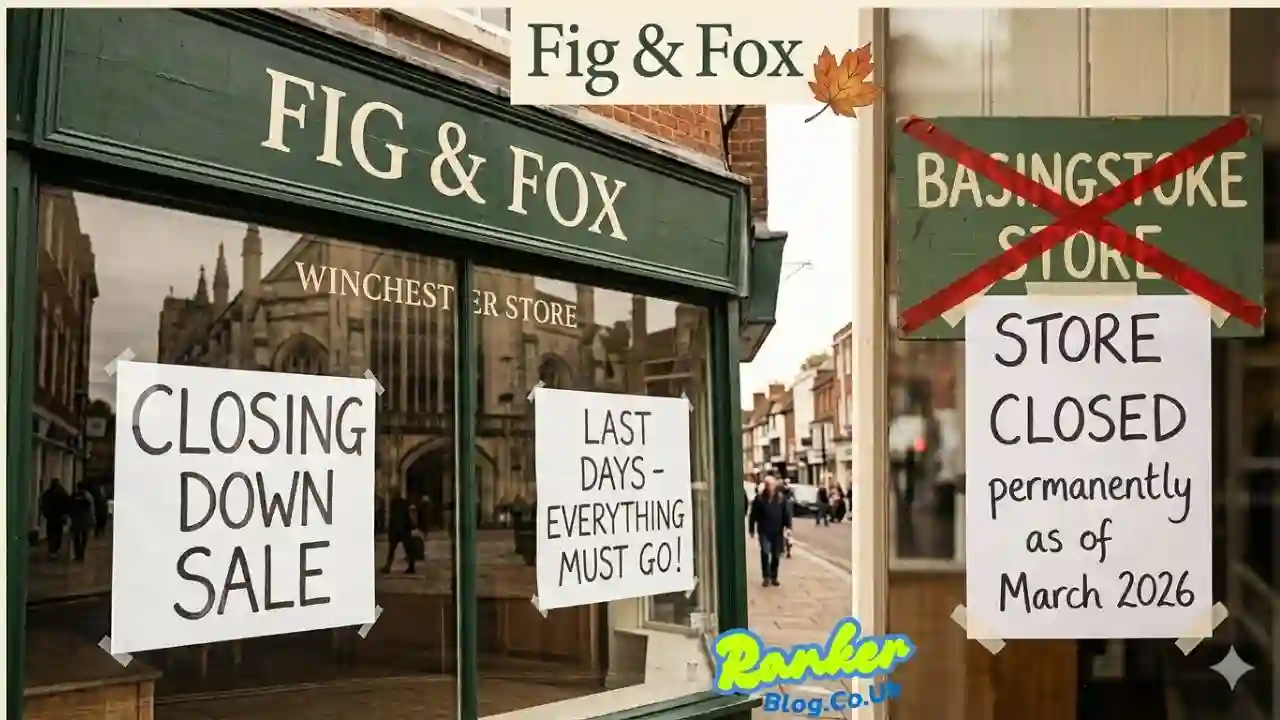
Going into the autumn of 2025, Fig & Fox was on something of a roll. The Hampshire-born independent had grown from two shops to four in the space of a single season, opening new branches in both Winchester and Salisbury. Six months later, two of those four shops were gone. The fig & fox store closures in Winchester and Basingstoke came quickly and quietly, landing in February and March 2026 respectively — leaving loyal customers surprised and the wider independent retail world with yet another cautionary tale. This article covers the brand’s story, what happened to the closed locations, why costs made trading unviable, and what the future looks like for the two remaining shops.
What Is Fig & Fox?
Fig and Fox Design Ltd was incorporated on 20 June 2022, founded by Helen Mitchell, who brings a fashion design background to the brand. James Mitchell, who came from a career in theatre, joined the board in April 2024. Together, the pair built something genuinely distinctive: a retail and café concept centred on independent makers, local suppliers, and the kind of considered curation that big-box retailers simply cannot replicate.
Shoppers coming through the door could expect gifts, candles, homeware, and houseplants displayed alongside a café menu built on locally sourced food, baked goods, and specialty coffee. It was a combination that clearly resonated with customers in Hampshire.
The first shop opened in October 2022 at 42–44 The Hundred in Romsey, and the response was strong from the outset. In October 2023, Test Valley Borough Council awarded the business a £750 incentive grant in recognition of its contribution to the local high street — a small but meaningful nod to what Fig & Fox was bringing to the community.
Fig & Fox Store Timeline — From Two Shops to Four (and Back to Two)
For much of 2023 and into 2024, Fig & Fox operated two shops. The brand began testing new markets cautiously before committing to leases — a sensible strategy that paid off initially. During Christmas 2023, the team ran a pop-up at Festival Place in Basingstoke and a seasonal stall at Winchester Christmas Market, gauging interest in both towns before making any permanent moves.
By the summer of 2025, the expansion was in full swing. The Winchester branch opened on 22 August 2025 at 52–54 St George’s Street, taking over a former NAAFI Café premises. A Salisbury location followed shortly after, bringing the total store count to four. James Mitchell spoke enthusiastically at the time about the refurbishments coming to an end and the brand’s momentum.
That momentum, however, proved short-lived. By the end of March 2026, both Winchester and Basingstoke had closed their doors for good — barely months after the brand had reached its peak footprint.
Which Fig & Fox Stores Have Closed?
Winchester
The Winchester shop at 52–54 St George’s Street opened on 22 August 2025 and traded through its first Christmas season. It closed in February 2026, approximately six months after launching. The location had formerly been home to the NAAFI Café and represented a significant step for the brand into one of Hampshire’s most visited city centres.
Basingstoke
The Basingstoke branch had a longer journey to permanence. It began life as a trial pop-up at Festival Place during Christmas 2023, was well enough received to become a permanent shop, and then closed on 31 March 2026 — its final trading day.
The two fig & fox store closures happened within approximately six weeks of each other. The Mitchells have not publicly explained why Salisbury — which also opened during the same summer expansion — survived while Winchester did not. Proximity to the established Romsey store, footfall differences, and lease terms are all possible factors, though none have been confirmed.
Here is a quick reference of all four locations and their current status:
| Store | Address | Status |
|---|---|---|
| Romsey | 42–44 The Hundred, SO51 8BX | Open |
| Salisbury | 46 High Street, SP1 2NT | Open |
| Winchester | 52–54 St George’s Street | Closed (Feb 2026) |
| Basingstoke | Festival Place | Closed (31 Mar 2026) |
Why Did Fig & Fox Close Two of Its Stores?
Helen and James Mitchell were clear that rising employment costs and the changes introduced in the October 2024 Budget made continued trading in those two locations unviable. The fig & fox store closures were not the result of poor products or lack of customer interest — they reflected a cost environment that has become genuinely brutal for small, people-heavy businesses.
Several overlapping pressures converged at once:
Employer National Insurance rose from 13.8% to 15% in April 2025, following the Chancellor’s October 2024 announcement. Alongside that, the secondary threshold — the salary level at which employers start paying NI — was cut from £9,100 to £5,000 per employee and frozen until at least 2031. That change alone significantly increased the cost of employing even part-time workers.
The National Living Wage rose from £12.21 to £12.71 per hour in April 2026, continuing a run of above-inflation increases. According to data from Whyfield accountancy, the total cost of employing a single National Living Wage worker reached £30,258 in 2026 — up from £18,734 in 2021/22. That is a 62% increase in under five years, and for a small multi-site retailer with several employees per location, the cumulative impact is enormous.
The Employment Rights Act also introduced new obligations from April 2026 — changes to statutory sick pay, zero-hours contract rules, and paternity leave — all of which added further complexity and cost to running a lean hospitality-retail operation.
The scale of these pressures is not unique to Fig & Fox. The British Retail Consortium estimated that the National Insurance change alone would add £2.3 billion per year to UK retail costs. A 2026 BRC survey found that 84% of retail finance leaders ranked employment costs among their top three concerns — up from just 21% in mid-2025. Independent businesses, with fewer staff and tighter margins than large chains, are feeling the weight of these changes most acutely.
Which Fig & Fox Stores Are Still Open?
Despite the fig & fox store closures in Winchester and Basingstoke, the brand itself is very much still trading. Two shops remain open:
Romsey — 42–44 The Hundred, SO51 8BX. This is the original location, opened in October 2022. It also has an escape room upstairs, which gives it an additional draw beyond the retail and café offer.
Salisbury — 46 High Street, SP1 2NT. The newer of the two surviving shops, opened in summer 2025. It joins Romsey as part of what is now a leaner, two-site operation.
Both shops are dog-friendly, serve food and coffee, and open seven days a week. Current opening hours are listed on the brand’s website. It is also worth noting that Fig and Fox Design Ltd filed its annual confirmation statement with Companies House on 2 April 2026 — just two days after Basingstoke’s last trading day — and the company is listed as active.
The Bigger Picture — Independent Retail Under Pressure in 2026
The story of Fig & Fox does not exist in isolation. It sits within a far wider pattern of independent retail contraction across the UK.
The Centre for Retail Research forecast approximately 17,350 UK store closures in 2025, with around 14,660 of them being independent retailers — nearly double the figure from the previous year. The British Independent Retailers Association (BIRA) warned that most independent shops would face higher business rates from April 2026. BIRA chief executive Andrew Goodacre stated plainly that the Budget multiplier reductions fell well short of what had originally been proposed, leaving small retailers exposed.
What the Fig & Fox story illustrates particularly clearly is the timing risk of opening new sites in a rapidly shifting cost environment. The two stores that closed were the two newest — opened after every major cost change was already written into law. The two that survived are the ones with more established trading histories, stronger local customer bases, and presumably more settled cost structures. Newness, in this climate, carries real risk.
What’s Next for Fig & Fox?
The Mitchells appear to be recalibrating rather than retreating entirely. Winchester Christmas Market is already listed on the brand’s website as a future roaming event, albeit marked as TBC for 2026.
This is a telling detail. It mirrors exactly how Fig & Fox approached Winchester the first time — testing the market with a seasonal stall in 2023 before committing to a permanent lease in 2025. Running a market pitch carries none of the fixed costs of a shop: no lease, no business rates, no year-round staffing bill. It is a way to maintain a presence and keep building brand awareness without taking on the overhead that proved unsustainable at St George’s Street.
Whether that eventually leads to another attempt at a permanent Winchester location remains to be seen. For now, the brand’s energy appears focused on strengthening what it has in Romsey and Salisbury — the two shops that weathered the storm.
Conclusion
The fig & fox store closures in Winchester and Basingstoke are disappointing for the communities those shops served and for anyone who had watched the brand grow from a single Romsey shop into a four-location operation in just three years. Helen and James Mitchell built something genuinely good — a business rooted in local suppliers, independent makers, and genuine community spirit. The closures were not a failure of concept. They were the product of a cost environment that arrived faster and hit harder than most small retailers could absorb.
Romsey and Salisbury are still open. The company is still active. And if history is any guide, Fig & Fox will find a way to keep showing up in the markets and towns that welcomed it from the start.
Also Read: United Flight UA967 Diverted: What Happened and What Passengers Should Know