
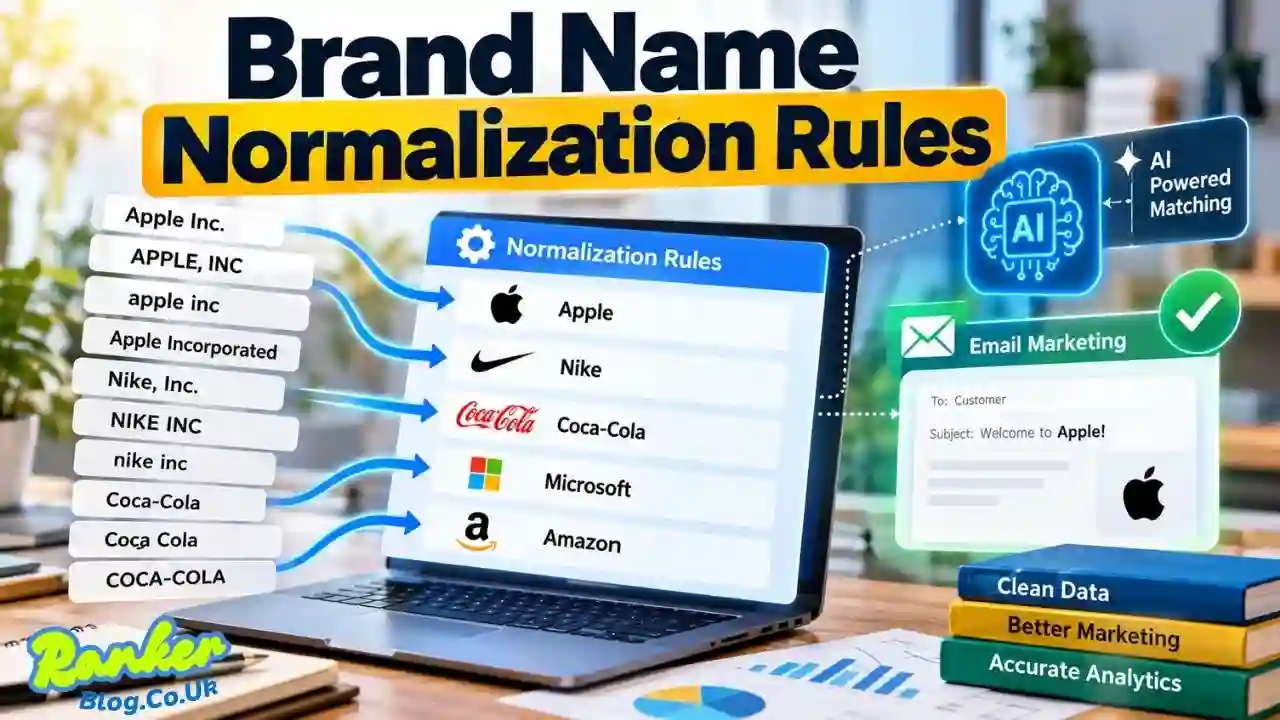
Brand name normalization rules are a set of consistent standards used to turn different versions of the same brand name into one reliable, usable form. For example, “Coca-Cola,” “Coca Cola,” and “coca-cola” may represent the same brand even though they appear differently across spreadsheets, websites, CRM records, product feeds, or customer data.
The goal is not to make every brand name look identical at all costs. The goal is to establish a repeatable standard that preserves identity while removing unnecessary variations, spelling inconsistencies, formatting differences, and duplicate records. This becomes especially important when organizations combine data from multiple sources or use AI systems and email marketing platforms that depend on clean brand information.
What Are Brand Name Normalization Rules?
Brand name normalization rules define how a brand should be written, stored, compared, searched, and displayed across a business’s systems.
A practical normalization system may determine whether these variations should be treated as one brand:
- Apple Inc.
- Apple, Inc.
- Apple Incorporated
- Apple
- APPLE
- apple
It can also establish rules for punctuation, capitalization, legal suffixes, spacing, abbreviations, special characters, regional naming, and alternate spellings.
The important distinction is between a canonical brand name and the original value.
For example:
| Source Value | Normalized Brand Name |
|---|---|
| Apple Inc. | Apple |
| APPLE INC | Apple |
| Apple, Inc. | Apple |
| apple | Apple |
| Microsoft Corporation | Microsoft |
| MICROSOFT CORP. | Microsoft |
A well-designed system does not necessarily overwrite the original source value. Instead, it can maintain both:
Original: MICROSOFT CORP.
Canonical: Microsoft
That approach gives data teams consistency without destroying useful source information.
Why Brand Name Normalization Rules Matter
Brand data often looks simple until it is collected at scale.
A company might receive brand names from ecommerce catalogs, vendor databases, customer-submitted forms, invoices, social profiles, CRM records, advertising platforms, or third-party APIs. Each source may follow different naming conventions.
Without normalization, one company can accidentally become several records.
For example, a CRM might contain:
- Nike
- NIKE
- Nike Inc
- Nike, Inc.
- Nike Incorporated
- nike.com brand
A reporting system may count those as six separate values even though they refer to the same organization.
This creates problems with analytics, segmentation, search, customer matching, reporting, personalization, and automation.
Normalization reduces that noise.
Common Benefits
Good normalization can help organizations:
- Reduce duplicate brand records
- Improve reporting accuracy
- Make search results more consistent
- Improve customer and account matching
- Simplify data integration
- Create cleaner CRM records
- Support more reliable AI processing
- Improve email personalization
- Make product and vendor databases easier to manage
The value increases as the number of data sources grows.
Core Brand Name Normalization Rules
There is no single universal rulebook that works perfectly for every organization. The best rules depend on the business, data sources, industry, and intended use.
However, the following framework provides a strong starting point.
1. Create a Canonical Brand Name
Every recognized brand should have one preferred display name.
For example:
Canonical name: The Coca-Cola Company
or, for customer-facing marketing:
Canonical display name: Coca-Cola
Choose one convention and apply it consistently.
Your organization should document whether the canonical value represents:
- The consumer-facing brand
- The legal company
- The parent organization
- The product line
- A specific sub-brand
These are not always the same thing.
For example, a database might need to distinguish between a corporate entity and a consumer brand rather than collapsing everything into a single value.
2. Standardize Capitalization
Capitalization is one of the easiest normalization problems to solve.
A basic rule might convert:
NIKE → Nike
nike → Nike
NiKe → Nike
But capitalization should not be blindly automated.
Some brands intentionally use unusual capitalization, such as:
- eBay
- adidas
- YouTube
- iPhone
The canonical value should preserve the brand’s officially preferred styling when that information is known.
Recommended Rule
Normalize capitalization while preserving documented brand-specific exceptions.
This is better than simply converting every word to title case.
3. Handle Legal Entity Suffixes Separately
Legal suffixes frequently create duplicates.
Examples include:
- Inc.
- Incorporated
- LLC
- Ltd.
- Limited
- Corp.
- Corporation
- PLC
- GmbH
- S.A.
For many marketing and analytics applications, the suffix may not be useful in the displayed brand name.
For example:
Amazon.com, Inc.
may become:
Amazon
However, removing the suffix can be inappropriate when the legal entity itself is important.
A financial, legal, procurement, or compliance database may need the complete registered entity.
Best Practice
Store the legal entity and normalized brand separately when the distinction matters.
Legal entity: Example Holdings LLC
Brand: Example
This prevents normalization from destroying important business information.
4. Normalize Punctuation
Punctuation differences can create unnecessary duplicates.
Examples:
Brand, Inc.Brand IncBrand-IncBrand Inc.
Depending on the use case, these may all map to the same canonical entity.
Common punctuation rules include standardizing:
- Periods
- Commas
- Apostrophes
- Hyphens
- Slashes
- Parentheses
- Ampersands
But punctuation should not automatically be removed.
A hyphen may be part of the actual brand identity.
For example:
Coca-Cola
should not casually become:
Coca Cola
if your canonical brand guidelines preserve the hyphen.
The goal is controlled normalization, not aggressive text stripping.
5. Normalize Whitespace
Whitespace errors are common in data imported from external systems.
Examples:
Acme Corporation
Acme Corporation
Acme Corporation
A basic normalization process can:
- Remove leading spaces
- Remove trailing spaces
- Convert repeated spaces to a single space
- Normalize unusual whitespace characters
This is simple but valuable because invisible formatting differences can break exact matching.
6. Decide How to Treat Ampersands and “And”
A common variation is:
Procter & Gamble
versus:
Procter and Gamble
Whether these should normalize to the same value depends on your canonical naming policy.
For customer-facing content, the official brand styling should normally take priority.
For matching logic, however, your system may treat both as equivalent during comparison.
This suggests using two concepts:
Comparison form: optimized for matching
Display form: optimized for human-readable output
That distinction is one of the most useful ideas in brand normalization.
7. Handle Abbreviations Carefully
Abbreviations can create both false duplicates and false matches.
For example:
- IBM
- International Business Machines
- International Business Machines Corporation
These may refer to the same organization, but they should not always be treated as interchangeable strings.
Create explicit aliases when necessary.
A structured record could contain:
| Field | Example |
|---|---|
| Canonical brand | IBM |
| Legal name | International Business Machines Corporation |
| Alias | International Business Machines |
| Alias | I.B.M. |
| Status | Active |
This gives systems enough information to recognize variants without pretending the strings are literally identical.
8. Maintain a Brand Alias Dictionary
An alias dictionary is one of the most effective tools for large-scale normalization.
It maps known variations to a canonical entity.
Example:
"International Business Machines" → "IBM"
"IBM Corp" → "IBM"
"IBM Corporation" → "IBM"
"I.B.M." → "IBM"
For larger organizations, the alias dictionary can include:
- Historical names
- Common misspellings
- Abbreviations
- Regional spellings
- Legacy names
- Marketplace names
- Vendor-specific names
The dictionary becomes especially valuable when integrating data from multiple platforms.
9. Preserve Original Values
One of the biggest mistakes in normalization projects is replacing the source data permanently.
Instead, preserve the raw value.
A strong data model may look like this:
original_brand_name
normalized_brand_name
brand_id
normalization_method
confidence_score
source
last_verified
For example:
original_brand_name: "NIKE, Inc."
normalized_brand_name: "Nike"
brand_id: BR-10482
normalization_method: "rule + alias"
confidence_score: 0.99
source: "vendor_feed"
This makes the system easier to audit and correct.
10. Use a Stable Brand ID
Names can change.
A company may rebrand, merge, acquire another organization, or modify its legal structure.
A stable internal identifier can therefore be more reliable than the name itself.
For example:
brand_id = 10482
can remain associated with the same business record even when its display name changes.
This is especially useful for:
- CRM systems
- Data warehouses
- Customer data platforms
- Marketing automation
- Business intelligence
- Product catalogs
- AI applications
The name becomes a human-readable label, while the ID becomes the durable identity key.
Brand Name Normalization Rules for AI
Brand name normalization rules AI implementations need an extra layer of control because language models can understand variations that traditional string matching may miss.
An AI system might recognize that:
Microsoft Corp.Microsoft CorporationMSFTMicrosoft
are related.
But recognizing semantic similarity is not the same as proving entity identity.
That distinction matters.
AI can help generate candidate matches, classify variants, identify likely aliases, and detect unusual patterns. However, high-impact normalization workflows should still use deterministic rules, reference data, validation, or human review where ambiguity exists.
How AI Can Help With Brand Normalization
AI can be useful for:
Variant Detection
An AI model can identify that multiple strings may represent the same brand even when the differences are not simple punctuation or capitalization changes.
Fuzzy Matching
AI-assisted systems can suggest matches when spelling or wording differs substantially.
Context Analysis
The surrounding context can help distinguish brands with similar names.
For example, the same word could refer to:
- A company
- A product
- A subsidiary
- A retailer
- A software platform
Context can help determine which entity is actually being referenced.
Alias Discovery
AI can surface likely aliases that a data team can review and add to a controlled dictionary.
Classification
AI can help classify records into:
- Brand
- Parent company
- Product
- Sub-brand
- Retailer
- Distributor
- Unknown
That makes normalization more accurate than relying on string cleaning alone.
AI Normalization Should Not Be Fully Uncontrolled
AI can make mistakes.
A model may incorrectly merge two companies because their names look similar. It may also interpret a product name as the parent brand.
A safer architecture is:
Raw data → deterministic cleaning → AI candidate matching → validation → canonical brand → audit trail
For uncertain cases, assign a review status rather than automatically merging records.
For example:
| Confidence | Recommended Action |
|---|---|
| 99–100% | Auto-accept |
| 95–98% | Optional automated validation |
| 80–94% | Human review |
| Below 80% | Keep unmatched |
These thresholds are examples, not universal standards. Each organization should calibrate them against its own data and error tolerance.
Brand Name Normalization Rules for Email Marketing
Email marketing is one area where inconsistent brand names can quickly become visible to customers.
Imagine one customer receives:
Welcome to Acme
while another receives:
Welcome to ACME INC.
and another receives:
Welcome to Acme Corporation
Those inconsistencies can make the underlying data system feel unreliable.
Brand name normalization rules email marketing workflows should therefore separate the internal canonical identity from the customer-facing display value.
Why Normalization Matters in Email Campaigns
Clean brand data can improve:
- Personalization
- Dynamic email content
- Customer segmentation
- Campaign reporting
- Account-based marketing
- Automated sequences
- Partner communications
- Template consistency
Suppose an email template contains:
{{brand_name}}
If the database is inconsistent, the same template may generate dramatically different output.
With a normalized field, every subscriber can receive the intended presentation.
Do Not Use Raw Brand Data Directly in Emails
A safer setup is:
CRM source
     ↓
Brand normalization
     ↓
Canonical brand ID
     ↓
Approved display name
     ↓
Email personalization
The email platform should ideally use an approved display value, not an unverified raw field.
This reduces the risk of awkward capitalization, legal suffixes, duplicate naming, and formatting errors appearing in customer communications.
Brand Name Normalization vs. Brand Name Matching
These concepts are related but not identical.
Normalization standardizes values.
Matching determines whether two values refer to the same entity.
For example:
Google LLC
may normalize to:
Google
But the system still needs an entity-matching process to determine whether another value such as Google Cloud represents the same brand, a sub-brand, or a different entity for the specific business purpose.
A useful data architecture keeps these processes separate.
Normalization
Focuses on:
- Formatting
- Capitalization
- Whitespace
- Punctuation
- Standard aliases
Entity Matching
Focuses on:
- Identity
- Ownership
- Parent-child relationships
- Subsidiaries
- Mergers
- Acquisitions
- Context
This separation prevents overly aggressive normalization.
A Practical Brand Normalization Workflow
A scalable workflow can be built in several stages.
Step 1: Collect the Raw Values
Gather brand names from all relevant systems.
Examples include:
- CRM
- Ecommerce platform
- Product database
- Vendor feeds
- Website forms
- Advertising systems
- Social media
- Customer service tools
Do not normalize first and investigate later. Start by understanding the actual source data.
Step 2: Standardize Basic Formatting
Apply deterministic operations such as:
- Trim whitespace
- Normalize character encoding
- Standardize repeated spaces
- Normalize approved punctuation
- Normalize capitalization where appropriate
These steps are usually low-risk.
Step 3: Apply the Alias Dictionary
Map known variations to the canonical brand.
"ACME INC" → "Acme"
"Acme Incorporated" → "Acme"
"Acme, Inc." → "Acme"
Step 4: Identify Ambiguous Records
Do not force every value into a brand.
Some records may be:
- Unknown
- Incomplete
- A product
- A department
- A retailer
- A parent company
- A subsidiary
- A person
- A misspelling
These should enter a review workflow.
Step 5: Assign a Canonical Brand ID
Once identity is established, associate the record with a stable internal ID.
Step 6: Store Confidence and Provenance
Record how the match was created.
For example:
rule-based
alias dictionary
AI suggestion
manual verification
This helps future audits.
Step 7: Review Exceptions Regularly
Brand data changes.
New aliases appear. Companies rebrand. Businesses merge. New vendors introduce new naming styles.
Normalization should therefore be treated as an ongoing data-quality process rather than a one-time cleanup project.
Example Brand Normalization Rule Set
A basic rule set might look like this:
| Rule | Example | Action |
|---|---|---|
| Trim whitespace | Nike | Nike |
| Collapse spaces | Nike Inc. | Nike Inc. |
| Normalize case | NIKE | Nike |
| Standardize punctuation | Nike, Inc. | Apply canonical policy |
| Remove approved legal suffix | Nike Inc. | Nike |
| Apply alias mapping | I.B.M. | IBM |
| Preserve official styling | eBay | eBay |
| Preserve original source | NIKE, Inc. | Store separately |
| Assign entity ID | Nike | BR-XXXX |
The exact implementation should be adapted to the business’s naming policy.
Common Edge Cases
Brand normalization becomes more difficult when names contain unusual structures.
Rebrands
A company may move from one brand identity to another.
The database should determine whether the new name represents:
- The same entity
- A new brand
- A new legal entity
- A successor organization
Do not automatically overwrite historical information.
Parent Companies and Sub-Brands
Consider a structure such as:
Parent company → Brand → Product
A normalization system should not collapse all three levels into one record unless the use case specifically requires it.
Regional Brand Names
A brand may use different names in different countries.
A global normalization model should support regional variants rather than assuming every market uses the same consumer-facing name.
Acquisitions
An acquired brand may continue operating independently.
Whether it should map to the acquiring organization depends on the purpose of the dataset.
Marketing data, legal data, and financial data may require different representations.
Similar Brand Names
Two organizations can have similar or identical names.
That is why string similarity alone should not be treated as proof of identity.
Useful supporting signals can include:
- Website domain
- Country
- Address
- Industry
- Parent organization
- External identifiers
- Product information
- Source system
Common Mistakes to Avoid
Over-Normalizing
Removing too much information can destroy meaningful differences.
For example, merging a parent company, sub-brand, and product into one record can create inaccurate reporting.
Removing Every Legal Suffix
A legal suffix may be unnecessary for marketing display but essential for legal or financial workflows.
Use context-specific fields instead of applying one universal rule everywhere.
Ignoring Historical Names
Historical names can be important for older transactions, contracts, campaign records, and analytics.
Preserve them where they have business value.
Trusting AI Without Validation
AI-generated matches should be treated as recommendations unless your process has demonstrated that automatic decisions are safe for that particular dataset.
Overwriting Raw Data
Once source data is overwritten, it becomes much harder to investigate why a normalization decision was made.
Keep the source value.
Creating Keyword-Based Normalization Rules
Normalization is a data-quality task, not an SEO tactic.
A strong normalization system should improve the underlying information itself rather than simply trying to make records contain particular phrases.
How to Measure the Quality of Brand Normalization
You can evaluate your normalization system using several practical metrics.
Duplicate Reduction
How many duplicate brand records disappeared after normalization?
Match Accuracy
How often are normalized records correctly associated with the intended entity?
False Merge Rate
How often are unrelated brands incorrectly merged?
This is one of the most important metrics because a clean-looking database can still be wrong.
Unmatched Rate
How many records remain unresolved?
A rising unmatched rate can indicate new naming patterns or missing reference data.
Manual Review Rate
How many records require human intervention?
A good system aims to reduce unnecessary review without sacrificing accuracy.
A Simple Brand Normalization Data Model
For teams building a long-term system, the following structure is useful:
Brand ID
Canonical Brand Name
Preferred Display Name
Legal Entity Name
Source Brand Name
Alias
Country/Region
Parent Brand ID
Brand Status
Normalization Method
Confidence Score
Source System
First Seen
Last Verified
This structure gives the business enough flexibility to support analytics, AI, CRM, marketing, and data integration without forcing everything into a single text field.
Brand Name Normalization Rules Checklist
Before deploying a normalization system, ask:
- Do we have one clearly defined canonical name?
- Are legal entities separated from consumer-facing brands?
- Are official capitalization rules documented?
- Are aliases maintained?
- Are source values preserved?
- Do we use stable brand IDs?
- Are ambiguous matches reviewed?
- Are regional variations supported?
- Are parent brands and sub-brands distinguished?
- Can normalization decisions be audited?
- Is there a process for updating the rules?
- Are AI suggestions validated before high-impact merges?
If several of these answers are “no,” the normalization process probably needs additional structure.
Frequently Asked Questions
What are brand name normalization rules?
Brand name normalization rules are standards used to convert different versions of a brand name into a consistent canonical representation while preserving important identity information.
Why is brand name normalization important?
It reduces duplicates and inconsistent records, making databases, reporting, search, CRM systems, AI workflows, and marketing automation more reliable.
Should brand normalization remove Inc. and LLC?
Not always. Removing legal suffixes can make marketing and analytics data cleaner, but legal, financial, and compliance systems may need the full legal name. A separate legal-entity field is often the better solution.
Can AI normalize brand names automatically?
AI can help identify likely aliases, spelling variations, and entity matches, but automatic merging should be validated according to the risk and accuracy requirements of the organization.
How does brand normalization help email marketing?
It gives email platforms a consistent display value for personalization and campaign content, reducing awkward variations such as inconsistent capitalization, duplicate names, or unnecessary legal suffixes.
What is the difference between normalization and entity matching?
Normalization standardizes how a value is represented. Entity matching determines whether two values refer to the same real-world entity. They should usually be treated as separate but connected processes.
Should I keep the original brand name after normalization?
Yes. Preserving the original source value makes the system easier to audit, troubleshoot, reverse, and improve.
How often should brand normalization rules be updated?
There is no universal schedule. Review them whenever new data sources, naming patterns, rebrands, acquisitions, regional variations, or significant numbers of unmatched records appear.
Is there one universal standard for brand name normalization?
No. The most reliable rules depend on the purpose of the dataset. Marketing, CRM, legal, finance, analytics, and product databases may legitimately require different representations of the same organization.
Final Thoughts
Effective brand name normalization rules are less about making every string look identical and more about creating a dependable identity system. The strongest approach combines deterministic formatting rules, a maintained alias dictionary, stable identifiers, source-value preservation, clear business definitions, and controlled handling of ambiguous records.
For AI, normalization creates cleaner inputs and more reliable entity relationships. For email marketing, it helps ensure that customer-facing brand references are consistent and professional. For analytics and operations, it reduces duplicate records and improves the quality of reporting.
The most important principle is simple: standardize what should be standardized, preserve what carries meaning, and never confuse textual similarity with actual identity.
Google’s current guidance also favors content that is genuinely useful, original, reliable, and created for people rather than primarily to manipulate rankings. That makes practical, transparent explanations like this more valuable than simply repeating variations of the target keyword.
CTA: Review your current brand fields, document your canonical naming policy, and start building a controlled normalization layer before inconsistent brand data spreads further across your CRM, analytics, AI, and marketing systems.
Also Read: URL Indexer: How URL Indexing Works, Why It Matters, and How to Get Pages Discovered Faster