
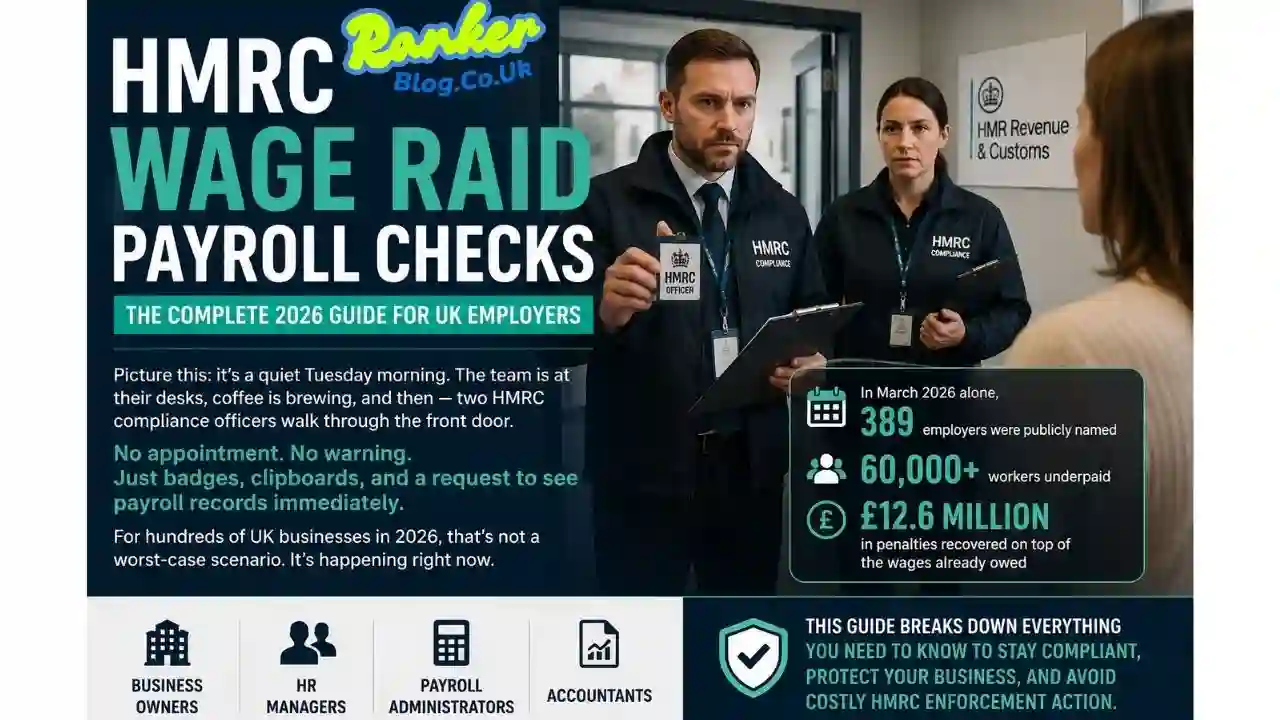
Picture this: it’s a quiet Tuesday morning. The team is at their desks, coffee is brewing, and then — two HMRC compliance officers walk through the front door. No appointment. No warning. Just badges, clipboards, and a request to see payroll records immediately. For hundreds of UK businesses in 2026, that’s not a worst-case scenario. It’s happening right now.
HMRC wage raid payroll checks have become one of the most talked-about compliance issues for UK employers this year, and the numbers explain why. In March 2026 alone, 389 employers were publicly named for underpaying over 60,000 workers, with HMRC recovering £12.6 million in penalties on top of the wages already owed. This guide breaks down everything UK business owners, HR managers, payroll administrators, and accountants need to know — from what triggers a check to how to walk away from one without a fine.
What Are HMRC Wage Raid Payroll Checks?
In straightforward terms, HMRC wage raid payroll checks are official compliance visits carried out by HM Revenue and Customs to verify that employers are paying their workers correctly and meeting their legal obligations under UK payroll law. HMRC officially refers to these as “compliance checks,” but employers have taken to calling them “wage raids” — and it’s easy to understand why. Officers can turn up out of the blue and immediately demand access to sensitive payroll records, contracts, and employee information.
These checks are quite different from standard tax queries or routine correspondence. Unlike a letter asking for clarification on a VAT return, HMRC wage raid payroll checks often involve inspectors physically arriving at business premises to verify actual working hours against recorded pay. The focus is on identifying hidden underpayments that might come from unpaid trial shifts, deductions from wages for uniforms, or simply rounding down an employee’s log-in time by a few minutes each day. Those small errors, multiplied across a team and across months, can add up to a significant compliance breach.
Why Are HMRC Wage Raids Increasing in 2026?
There are several reasons why HMRC wage raid payroll checks have intensified in 2026, and they all point in the same direction: HMRC now has more tools, more data, and more enforcement power than ever before.
The National Minimum Wage Has Gone Up
From 1 April 2026, the National Living Wage rose to £12.71 per hour for workers aged 21 and over. Workers aged 18 to 20 are now entitled to £10.85 per hour, while those aged 16 to 17 and apprentices receive £8.00 per hour. Any employer still running payroll at the old rates is already non-compliant — and already flagged in HMRC’s systems.
One detail that catches many employers off guard every year is the five-day gap between 1 April, when the new National Minimum Wage rates take effect, and 6 April, when the wider PAYE tax year begins. Some businesses assume they can update rates at the start of the new tax year. That assumption costs them.
Real-Time Information Has Given HMRC Greater Visibility
Every single time a business processes payroll, that data lands directly with HMRC through Real-Time Information (RTI) submissions. HMRC’s analytics systems then automatically scan for wage patterns that look too low, working hours that don’t add up, and pay rates that fall below the legal minimum. An inspection can be triggered entirely by algorithm — without a human at HMRC ever having read the returns manually. That shift from reactive to data-led enforcement has dramatically increased the number of businesses coming under scrutiny.
The Fair Work Agency Has Expanded Enforcement Powers
From April 2026, the newly established Fair Work Agency took over enforcement functions that were previously spread across HMRC, the Gangmasters and Labour Abuse Authority, and other bodies. This consolidation means a single agency now holds enhanced powers covering minimum wage, holiday pay, and statutory sick pay compliance. It has a larger budget, more field officers, and a specific mandate to close the compliance gap in the sectors where payroll errors are most common.
High-Risk Sectors Are Being Targeted
HMRC wage raid payroll checks are not spread evenly across all industries. Businesses in hospitality, retail, construction, and social care are receiving particularly close attention in 2026. These sectors share common characteristics — complex shift patterns, variable hours, high staff turnover, and payment structures that make minimum wage compliance genuinely difficult to track without rigorous systems in place.
What Triggers an HMRC Wage Raid? (Common Red Flags)
HMRC wage raid payroll checks don’t always happen at random. There are specific signals that put a business on HMRC’s radar, and it’s worth knowing what they are.
Employee complaints are one of the most direct triggers. If any employee contacts the National Minimum Wage helpline — even anonymously — HMRC will take notice and act quickly. A single disgruntled former employee can initiate a full investigation.
Late or incorrect RTI submissions immediately signal to HMRC that internal payroll processes may be unreliable. Frequent errors in payroll reporting are a red flag that invites further scrutiny.
Irregular wage patterns draw attention when a company’s declared wages appear unusually low relative to its industry, headcount, or declared revenue. HMRC’s analytics tools are specifically designed to identify these discrepancies.
Mismatches between income and employee costs can suggest undeclared cash-in-hand payments, which is a serious issue HMRC actively investigates.
Worker misclassification — treating people who are functionally employees as self-employed contractors — is another common trigger for HMRC wage raid payroll checks, particularly in construction and the gig economy.
Previous penalties place a business on a watchlist. Repeated non-compliance leads to more frequent and more thorough checks in the future.
Sector-based risk profiling means that even a well-run hospitality or care business may face a compliance visit simply because HMRC is running a targeted enforcement campaign in that industry.
What Happens During an HMRC Wage Raid? (Step-by-Step)
Understanding what actually happens during HMRC wage raid payroll checks takes a lot of the fear out of the process. These visits follow a defined procedure.
Before the Visit
In some cases, HMRC will send a formal written notice ahead of an inspection. In others — particularly where serious violations are suspected — officers arrive without any prior warning. It’s worth noting that HMRC compliance officers have full legal authority to enter business premises when conducting a payroll investigation. Refusing access is not a viable option and would only escalate the situation.
During the Inspection
The inspection itself typically follows a structured process. HMRC staff begin by introducing themselves and clearly explaining the purpose of their visit. They then proceed to review the company’s payroll software, payslips, employment contracts, and PAYE returns in detail. In many cases, inspectors will also speak directly with employees — asking them to confirm their working hours, their rate of pay, and whether they have received everything they’re entitled to.
All of the data gathered is cross-referenced against RTI submissions to identify any inconsistencies. Once the review is complete, HMRC provides a written report to the employer, setting out any discrepancies, violations, or areas of concern.
Rights During a Wage Raid
Employers are entitled to specific rights throughout this process. Any business going through HMRC wage raid payroll checks has the right to request identification from the officers and ask for a clear explanation of why the visit is taking place. An accountant or business advisor can be present throughout the inspection. It’s entirely reasonable — and advisable — to keep a written record of every question asked and every document reviewed. Employers are also entitled to request a reasonable amount of time to locate records, rather than being expected to produce everything instantly.
What Do HMRC Inspectors Look At?
HMRC inspectors conducting payroll checks have a detailed checklist of what they examine. Pay rates are the starting point — every employee’s hourly rate is checked against the current National Minimum Wage and National Living Wage thresholds. Payslip accuracy and overall record-keeping quality are reviewed, as are PAYE returns and National Insurance contribution records.
Inspectors pay close attention to the gap between contracted hours and actual hours worked, since minimum wage compliance is calculated on actual hours, not what’s written in a contract. Deductions are scrutinised carefully — deductions for branded clothing or uniforms, mandatory training sessions, and travel between job sites (as opposed to travel from home to the first location of the day) can all push an employee’s effective hourly rate below the legal minimum. Tips and service charges, regardless of how they are distributed, never count toward the National Minimum Wage.
Employee classification is another area of focus. Whether a worker is genuinely self-employed or has been misclassified can make a substantial difference to both the employer’s tax obligations and the worker’s wage entitlements. Pension contributions and holiday pay calculations are also reviewed during more thorough inspections.
Penalties for Failing an HMRC Wage Raid
The consequences of failing HMRC wage raid payroll checks are significant, and they extend well beyond simply repaying the wages owed.
Backdated wage repayments are calculated at current rates, not historical ones. This means that if a worker was underpaid back in 2024, the employer must repay the arrears at the 2026 National Living Wage rate — which can dramatically inflate the total cost.
Financial penalties are calculated at 200% of the total underpayment, capped at £20,000 per worker. For a business with a large workforce where small underpayments have accumulated over several years, this can result in a genuinely devastating financial liability.
Naming and shaming is one of the most damaging consequences. The Department for Business and Trade regularly publishes the names of every company issued a Notice of Underpayment. For small and medium-sized businesses, being named on that list often leads to local press coverage, reputational damage, and a direct loss of consumer trust.
HMRC can typically investigate payroll records going back four to six years. In cases where fraud or deliberate non-compliance is suspected, that window can extend to 20 years.
For smaller businesses in particular, the combined weight of backdated repayments and financial penalties can trigger a genuine liquidity crisis — threatening the survival of the business itself. This is why treating HMRC wage raid payroll checks as a routine administrative matter, rather than a serious compliance risk, can be a costly mistake.
The Most Common Payroll Mistakes That Cause Failures
Many of the businesses that fail HMRC wage raid payroll checks weren’t deliberately underpaying their staff. They simply had processes that allowed small errors to compound over time. The most common causes include:
Deductions for uniforms or equipment that inadvertently push hourly rates below the National Minimum Wage. Unpaid trial shifts or mandatory training sessions that aren’t counted as working time. Failing to log travel time between work sites as paid working hours. Delays in applying new NMW rates — particularly missing the 1 April effective date. Misclassifying workers as self-employed to reduce employer tax obligations. Rounding down clock-in and clock-out times, even by just a few minutes per shift. And treating tips or gratuities as counting toward the minimum wage, which they legally cannot.
Each of these on its own might seem minor. Across a team of twenty staff, over three years, they can amount to thousands of pounds in arrears.
How to Prepare for an HMRC Wage Raid (Employer Checklist)
The good news is that preparing for HMRC wage raid payroll checks isn’t complicated. It just needs to be systematic and consistent.
Audit Your Payroll Regularly
Reviewing payroll every quarter is one of the most effective things a business can do. Catching a mistake and correcting it before HMRC finds it consistently results in a lower penalty than when HMRC discovers the same issue first. Proactive correction demonstrates good faith.
Use Reliable Payroll Software
Modern payroll systems apply rate changes automatically, flag errors before submission, and generate compliant payslips. Manual spreadsheets, however carefully maintained, carry far greater risk of human error — and HMRC’s systems will spot the resulting discrepancies.
Train Your Team
HR managers, line managers, and everyone responsible for timesheets needs a working knowledge of minimum wage rules, permissible deductions, and what must be recorded. Payroll compliance isn’t just the payroll team’s problem — it’s everyone’s.
Keep Records Digitally and Accessible
Digital record-keeping means that if HMRC officers arrive unannounced, the business can produce the required documents immediately, without having to search through filing cabinets. Slow or incomplete responses during an inspection don’t create a good impression.
Post the Official NMW Poster
The official National Minimum Wage poster is a legal requirement and must be displayed visibly in the workplace. It’s a small detail, but inspectors look for it.
Work With a Payroll Specialist or Accountant
For businesses that don’t have in-house payroll expertise, working with a professional advisor offers two clear advantages: pre-emptive compliance support and professional representation if HMRC does come knocking.
Sectors Most at Risk in 2026
While any UK employer can face HMRC wage raid payroll checks, certain industries are under particular scrutiny this year.
Hospitality presents specific challenges around complex shift patterns, split shifts, sleepover duties, and the treatment of tips — all of which are areas where underpayments frequently occur without any deliberate intent.
Retail faces pressure around uniform deduction policies and the management of highly variable hours, which make it difficult to guarantee minimum wage compliance without robust tracking systems.
Construction carries elevated risk due to the widespread use of subcontractors, the complexity of site-to-site travel time, and the ongoing confusion around employment status and IR35 obligations.
Social care is one of the most scrutinised sectors, primarily because of sleep-in shift disputes and the legal requirement to pay for travel time between clients — an area where many care providers have historically fallen short.
The Fair Work Agency is specifically tasked with closing the compliance gap in these sectors, and with consolidated enforcement powers and a larger budget, its focus in 2026 is considerable.
Frequently Asked Questions
Can HMRC really arrive without warning?
Yes. HMRC compliance officers have the legal authority to conduct fully unannounced inspections, or to give only very short notice. There’s no requirement for them to schedule visits in advance.
How far back can HMRC investigate?
In most cases, HMRC will review payroll records going back four to six years. In situations involving suspected fraud or deliberate non-compliance, investigations can extend up to 20 years.
What is the 2026 National Living Wage?
£12.71 per hour for workers aged 21 and over, effective from 1 April 2026. Different rates apply to younger workers and apprentices.
What happens if a business disagrees with HMRC’s findings?
Employers can formally request an internal review of HMRC’s decision. If that doesn’t resolve the matter, they can appeal to an independent tax tribunal within the applicable statutory time limits. In many cases, early professional engagement resolves disputes before a formal appeal becomes necessary.
Does the Fair Work Agency change anything for employers?
From April 2026, the Fair Work Agency handles enforcement with unified powers. This potentially includes broader checks on holiday pay and the treatment of agency workers — so the scope of what might be reviewed during an inspection has expanded.
Conclusion
HMRC wage raid payroll checks in 2026 are not something UK employers can afford to treat lightly. With more sophisticated data-matching technology, a newly unified enforcement body, and rising National Minimum Wage rates creating tighter margins for error, the risk of an unannounced inspection has never been higher.
But compliance isn’t only about avoiding fines. It’s about being a business that employees trust, that clients respect, and that can face scrutiny with confidence. The steps to get there — regular payroll audits, reliable software, proper record-keeping, and good professional advice — aren’t onerous. They’re just good practice.
The time to act is before HMRC arrives at the door, not after. Conduct a payroll audit, update rates if needed, and reach out to a payroll specialist or accountant if there’s any doubt about current compliance. A small investment of time now could prevent a very costly morning later.
Also Read: Why Local Exterminators Provide More Personalized Pest Solutions