
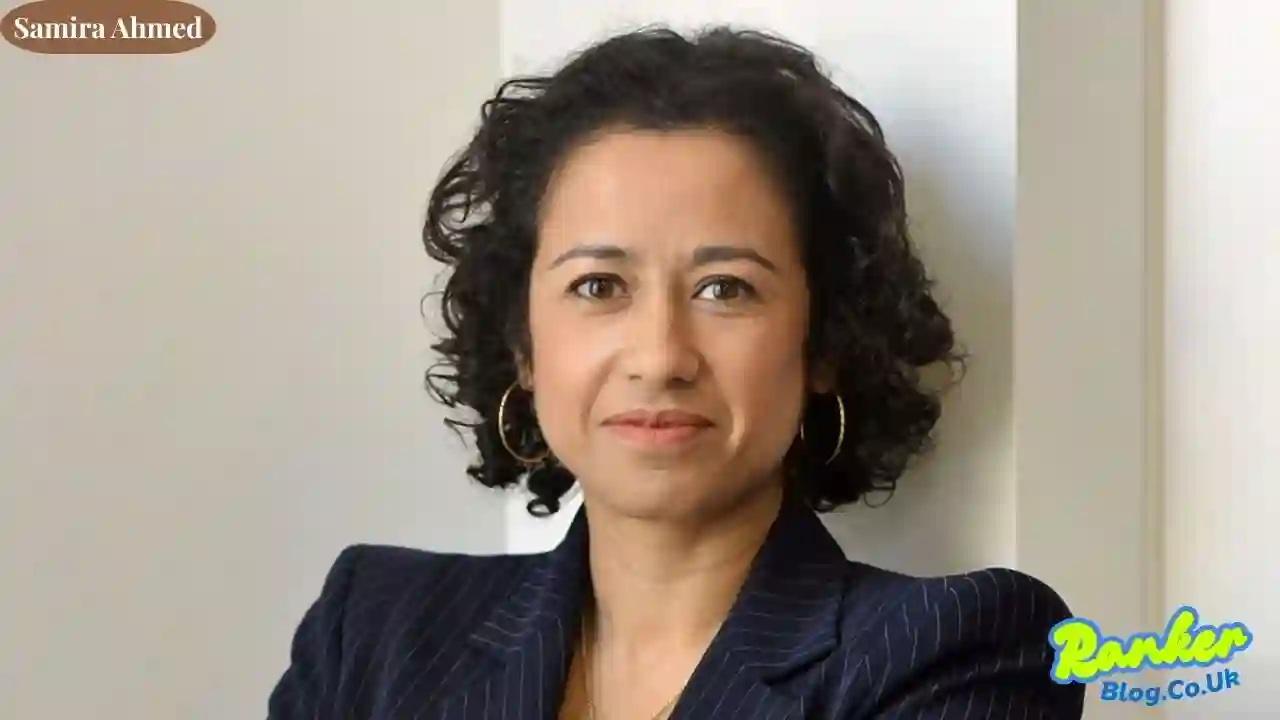
When people talk about integrity, courage, and authentic storytelling in British journalism, the name Samira Ahmed comes up almost immediately. She is not just a familiar face on the BBC — she is an institution in her own right. With a career stretching across more than three decades, Samira Ahmed has carved out a place at the very heart of British media, earning a reputation as one of the most trusted and versatile broadcasters the country has ever produced. From breaking news stories to arts programming, from investigative reporting to a landmark equal pay battle that changed the lives of hundreds of women — Samira Ahmed has done it all, and she has done it with extraordinary grace.
Biography Samira Ahmed
| Category | Details |
|---|---|
| Full Name | Samira Ahmed |
| Date of Birth | June 15, 1968 |
| Birthplace | London |
| Nationality | British |
| Ethnicity / Heritage | Indian–Pakistani heritage |
| Profession | Journalist, Broadcaster, Presenter, Documentary Maker, Writer |
| Known For | BBC journalism, Channel 4 News, Equal Pay Case against the BBC |
| Father | Athar Ahmed |
| Mother | Lalita Ahmed |
| Mother’s Profession | TV presenter, actress, chef, writer, BBC World Service contributor |
| School | Wimbledon High School |
| University | St Edmund Hall, City University London |
| Degree | English Literature; Postgraduate Diploma in Newspaper Journalism |
| Journalism Prize | Philip Geddes Journalism Prize |
| BBC Joined | 1992 |
| Early BBC Programs | Today, Newsnight |
| International Role | BBC Los Angeles Correspondent (1995–1996) |
| Other International Work | Deutsche Welle TV political correspondent and anchor |
| Channel 4 News | Reporter and presenter (2000–2011) |
| Major Award | Stonewall Broadcast of the Year Award (2009) |
| Famous Report | Investigation into “corrective” rape in South Africa |
| BBC Return | Front Row, Newswatch, The Proms |
| Documentary Subjects | David Bowie, H. G. Wells, Oliver Cromwell’s wife Elizabeth |
| Equal Pay Case | Won landmark equal pay tribunal against the BBC in 2020 |
| Compared With | Jeremy Vine |
| Pay Difference Revealed | £440 per episode vs £3,000 per episode |
| Legal Outcome | Tribunal ruled work was equivalent under Equality Act 2010 |
| Impact of Case | Around 700 BBC women reportedly benefited from pay rises |
| Union Support | National Union of Journalists (NUJ) |
| Publications Written For | The Guardian, New Statesman, New Humanist |
| Academic Role | Visiting Professor of Media at Kingston University |
| Honorary Recognition | Honorary Fellow of St Edmund Hall, Oxford |
| Honorary Doctorates | City University London, University of East Anglia, Kingston University, Winchester University |
| Husband | Brian Millar |
| Marriage Year | 1996 |
| Children | Two |
| Podcast | How I Found My Voice |
| TV Appearance | Celebrity Mastermind winner |
| Specialist Subject | Laura Ingalls Wilder |
| Legacy | Pioneer in gender pay equality and multicultural representation in British broadcasting |
Early Life and Background: Where It All Began
Samira Ahmed was born on June 15, 1968, in Wandsworth, south London. From the very beginning, she was surrounded by a household that valued culture, communication, and storytelling. Her father, Athar Ahmed, and her mother, Lalita Ahmed, raised her with a deep appreciation for the world of media and public life. Lalita Ahmed was no ordinary mother — she was a respected TV presenter, actress, chef, and writer on Indian cuisine who served at the BBC World Service’s Hindi section. It is easy to see where Samira’s passion for broadcasting first took root.
Growing up in a multicultural home of Indian-Pakistani heritage, Samira Ahmed developed an early and natural curiosity about people, ideas, and the power of telling a good story. That curiosity would define everything that came after.
She attended Wimbledon High School, an independent day school for girls in south London, where she showed early signs of her journalistic instincts. She took on the role of editing the school magazine — a small but telling detail about the kind of ambitious, storytelling-driven young woman she was becoming.
Samira Ahmed Education: Oxford, City University, and a Prize That Predicted the Future
When it comes to Samira Ahmed’s education, there is quite a lot to be impressed by. After her years at Wimbledon High School, she went on to study English at St Edmund Hall, Oxford — one of the most prestigious institutions in the world. Her time at Oxford was not spent quietly in the library. She edited both the Isis and the Union magazines, two of the university’s most prominent student publications, and won the Philip Geddes Journalism Prize for her outstanding work on student newspapers. It was a clear signal that a remarkable career in journalism was ahead of her.
After completing her undergraduate degree between 1986 and 1989, Samira Ahmed pursued a Postgraduate Diploma in Newspaper Journalism at City University, London, further sharpening her skills and preparing herself for the highly competitive world of broadcast and print media. Her educational foundation was as solid as it gets, and she made the most of every opportunity it offered.
A Career Built on Grit, Talent, and an Unshakeable Commitment to Truth
The Early BBC Years
Samira Ahmed joined the BBC as a graduate news trainee in 1992, and from there, her rise was remarkable. She reported on Radio 4’s flagship Today programme and on the BBC’s respected current affairs show Newsnight between 1993 and 1994. During her time at Newsnight, she uncovered a major charity scandal and became one of the very first journalists to investigate and report on the rise of radical Islam on British university campuses — both stories that required real courage and conviction.
Her career also took her across the Atlantic. As the BBC’s Los Angeles Correspondent between 1995 and 1996, Samira Ahmed covered some of the biggest stories of that era, including the OJ Simpson civil trial — one of the most watched legal proceedings in American history. She also worked as an anchor and political correspondent for Deutsche Welle TV in Berlin, gaining international experience that broadened her journalistic perspective considerably.
Channel 4 News: A Decade of Impact
In April 2000, Samira Ahmed joined Channel 4 News as a reporter and presenter, a role she would hold for eleven years. She became a full presenter after the birth of her second child in July 2002, balancing the demands of motherhood with one of the most high-profile presenting jobs in British television. It is a chapter in her career that many people remember with great warmth.
Her work during this period was marked by the same fearless journalism that had defined her BBC years. In 2009, she produced a special report on so-called “corrective” rape of lesbian women in South Africa — a deeply challenging subject handled with sensitivity and moral clarity. That report earned her the Broadcast of the Year award at the annual Stonewall Awards, one of the most meaningful honours of her career.
Returning to the BBC: Radio, Television, and Documentaries
After leaving Channel 4 in June 2011 and going freelance, Samira Ahmed returned to the BBC and took on a wide range of roles that showcased her remarkable range. She presents BBC Radio 4’s flagship arts programme Front Row, the weekly BBC One programme Newswatch, and The Proms on BBC Four. Between 2012 and 2013, she also presented Sunday Morning Live, a topical ethics discussion show on BBC One that brought thoughtful, accessible debate to a mainstream audience.
Beyond presenting, Samira Ahmed is also an experienced documentary-maker, having produced films for Radio 3, Radio 4, and Channel 4. Her documentaries have explored fascinating subjects — from Oliver Cromwell’s wife Elizabeth and David Bowie to HG Wells and the invention of the atomic bomb. These projects reflect her genuine love for the intersection of culture, history, science, and social change.
The Equal Pay Case: A Landmark Victory for Women Everywhere
Perhaps the most significant chapter in Samira Ahmed’s career — at least in terms of its wider impact — is her equal pay battle against the BBC. It is a story that deserves to be told in full.
From 2012, Samira Ahmed had been presenting Newswatch for the BBC. During that time, she was paid £440 per episode. Her male colleague, Jeremy Vine, was presenting Points of View — a programme strikingly similar in format and length — and receiving £3,000 per episode. The disparity was extraordinary: more than six times the pay for what the tribunal would later confirm was essentially the same work.
Samira Ahmed raised the issue internally with the BBC, quietly and professionally, for years before eventually filing for a formal employment tribunal. On January 10, 2020, the case went public. On February 24, 2020, the London Central Employment Tribunal ruled decisively in her favour, finding that her presenting work on Newswatch was equal to Jeremy Vine’s work on Points of View and that she was entitled to equal pay under the Equality Act 2010. The BBC’s arguments — that Vine’s “cheeky” personality and greater public profile justified the pay gap — were rejected.
The tribunal’s ruling was not just a personal victory. Samira Ahmed has since noted that around 700 BBC women received pay rises as a result of her case. She was supported throughout by the National Union of Journalists (NUJ), whose financial and professional backing she has credited as essential to the outcome. It is the kind of case that changes industries, and Samira Ahmed had the courage to see it through to the end.
Writing and Print Journalism: A Voice Beyond the Screen
Samira Ahmed’s talent has never been confined to television and radio. As a seasoned print journalist, her writing has appeared in some of the most respected publications in Britain — among them The Guardian, The New Statesman, and The New Humanist. Her essays, features, and interviews cover a wide range of themes: gender, culture, social change, public policy, and the arts. She brings to her writing the same intelligence and curiosity that defines her broadcasting work, offering readers analysis and insight that genuinely enriches public debate.
Academia and Public Life: Teaching the Next Generation
Samira Ahmed is also deeply committed to the future of journalism. She serves as a Visiting Professor of Media at Kingston University and lectures regularly on journalism at universities across the country. Her academic work reflects a genuine desire to share what she has learned with the next generation of reporters and broadcasters.
The institutions have recognised her contributions in kind. She holds honorary doctorates from City University of London in Social Sciences, the University of East Anglia in Civil Law, Kingston University (Doctor of Letters), and Winchester University. In 2019, she was made an Honorary Fellow of St Edmund Hall at the University of Oxford — a wonderful full-circle moment for the student who once edited the Isis magazine on that same campus.
She also regularly chairs discussions and panel events for major cultural institutions including the British Science Association and the British Museum, and has hosted annual Question Time events for teenagers at Westminster Abbey and other cathedrals. It speaks to her commitment not just to journalism, but to public life in the broadest sense.
Samira Ahmed Husband: Her Life with Brian Millar
Beyond the public life and the headlines, Samira Ahmed is also a wife and mother. Samira Ahmed husband is Brian Millar, whom she married in 1996. The couple has been together for nearly three decades now, and by all accounts, their partnership has been a steady and supportive one — particularly during the more turbulent moments of Samira’s career, including the years-long equal pay battle.
Details about Samira Ahmed husband Brian Millar are relatively private, in keeping with the couple’s approach to their personal lives. While Samira is very much a public figure, she has always been thoughtful about what she shares from her home life, and that privacy has served her family well.
As for Samira Ahmed wedding pictures, these have not been widely published or made public — again, a reflection of her preference for keeping certain parts of life away from the spotlight. What is known is that the couple married in 1996, shortly after Samira became the BBC’s Los Angeles Correspondent.
Together, Samira Ahmed and her husband Brian Millar are parents to two children. Balancing the demands of a high-profile journalism career with family life is never straightforward, but by all accounts Samira has navigated it with the same thoughtful determination that she brings to everything else she does.
Legacy and Impact: A Career That Truly Matters
It would be easy to reduce Samira Ahmed to a list of achievements — the awards, the landmark tribunal, the prestigious programmes she has presented, the honorary degrees. But what makes her story genuinely compelling is the thread of values that runs through all of it: a commitment to fairness, an instinct for the stories that matter, and the courage to keep going when things get difficult.
She is a pioneer in gender pay equity within British broadcasting, having taken on one of the country’s most powerful institutions and won. She is a role model for journalists from multicultural and minority backgrounds, having built a decades-long career at the top of her field at a time when that was far harder than it should have been. And she is a genuinely versatile journalist — equally at home interviewing a politician, presenting a Proms concert, or making a documentary about HG Wells.
Her podcast, How I Found My Voice, and her Celebrity Mastermind win — with the specialist subject of author Laura Ingalls Wilder, no less — offer a glimpse into a person who is endlessly curious, warmly human, and every bit as interesting off-camera as she is on it.
Samira Ahmed’s story is not just the story of one journalist’s career. It is a story about what happens when talent, integrity, and determination come together — and why it matters to have voices like hers in British public life.
Also Read: Is Robbie Cummins Married? Everything Fans Want to Know in 2026